- What Is 5G Technology, Really?
- How 5G Drastically Affects Your Internet Speed
- Understanding 5G vs. 4G: A Leap in Performance
- The Core Technologies That Boost 5G Internet Speed
- Beyond Speed: How 5G Latency Impacts Your Experience
- Frequently Asked Questions
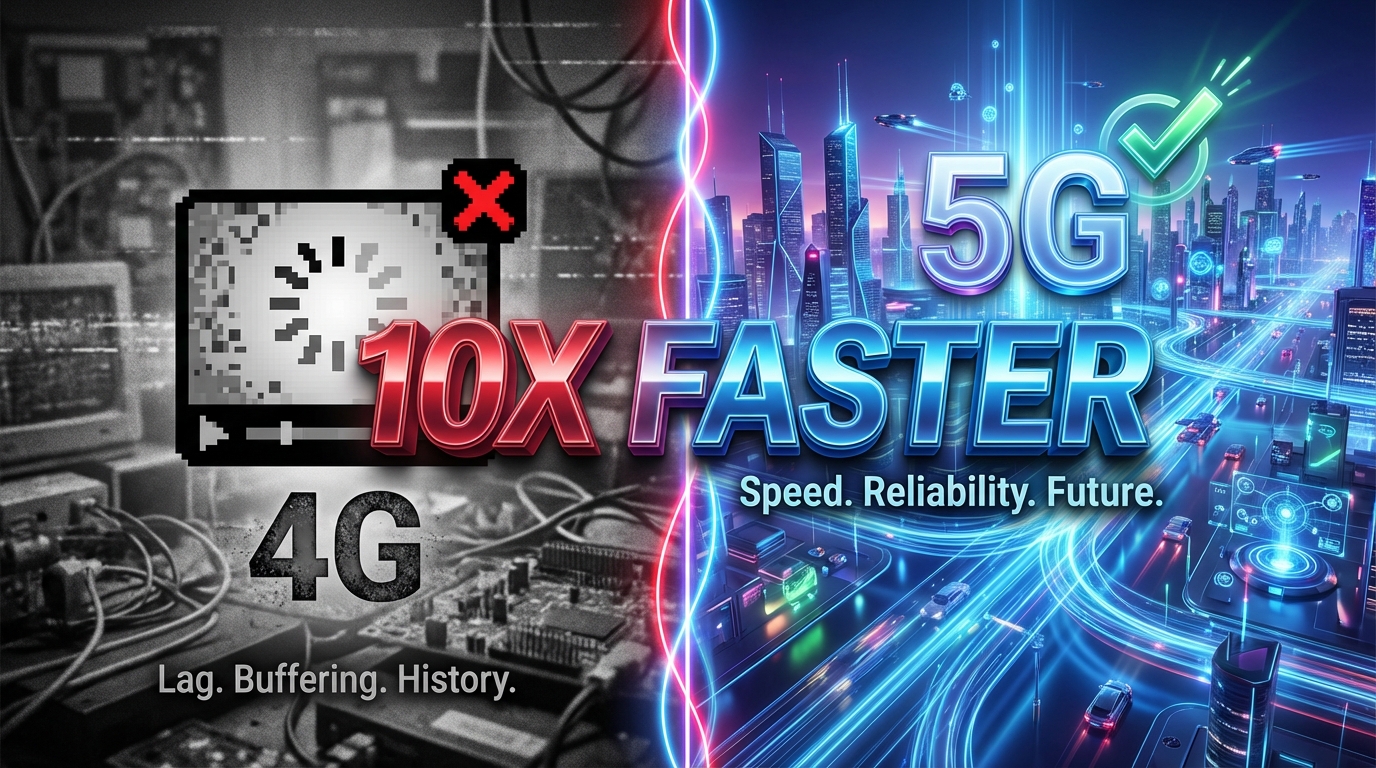
5G is the fifth-generation wireless technology, designed to deliver significantly faster internet speeds, much lower latency, and greater network capacity than 4G. It affects your internet by enabling downloads up to 10 Gbps, making streaming seamless, and supporting more connected devices simultaneously without slowdowns.
What Is 5G Technology, Really?
5G is the latest global standard for wireless communication, succeeding the 4G networks we’ve used for the last decade. It’s not just a minor update; it’s a fundamental overhaul of network architecture designed to handle the explosive growth of data and connected devices. At its core, 5G operates on a wider range of radio frequencies, including higher-band spectrums (like millimeter wave or mmWave) that were previously unused for mobile technology. This access to more airwaves is a primary reason it can deliver such a massive increase in performance. Think of it like expanding a two-lane highway into a twenty-lane superhighway—more vehicles (data) can travel at much higher speeds without causing traffic jams (congestion).
The problem with older networks like 4G was that they were built for a world dominated by smartphones. Today, our world is filled with smart home devices, wearables, connected cars, and industrial sensors—all competing for bandwidth. This creates agitation for users, who experience buffering videos, dropped connections in crowded areas, and lag during online gaming. 5G solves this by increasing network capacity, allowing for up to a million devices to be connected per square kilometer, a massive jump from 4G. As explained by tech leader Cisco, this is achieved through advanced technologies like a new radio interface (5G NR) and a more flexible network design.
A common misconception is that 5G is just about making phone downloads faster. While that’s a major benefit, its true purpose is to be the foundation for future innovations. It’s the connective tissue for the Internet of Things (IoT), autonomous vehicles that need to communicate in real-time, and augmented reality experiences that require ultra-reliable, low-latency connections. So, when you think of 5G, don’t just think of your phone. Think of a smarter, more connected environment where data flows instantly between all your devices, not just one.
How 5G Drastically Affects Your Internet Speed
The most immediate and noticeable impact of 5G is its effect on internet speed. While 4G LTE offered theoretical peak speeds of around 100 Mbps (megabits per second), 5G pushes that limit exponentially higher. Under ideal conditions, 5G can reach download speeds of up to 10 gigabits per second (Gbps), and some experts like Ericsson suggest it could even reach 20 Gbps. To put that in perspective, downloading a full-length 4K movie, which could take several minutes on a good 4G connection, could be completed in just a few seconds on a 5G network. This isn’t just a theoretical number; it’s a performance benchmark that changes how we interact with digital content.
The problem many users face today is data-intensive applications overwhelming their current connections. High-resolution video streaming, large file transfers for remote work, and competitive online gaming demand more bandwidth than 4G can consistently provide, leading to frustration from buffering, lag, and failed downloads. This agitation is felt by anyone trying to stream a 4K movie on a big screen or a professional needing to upload a massive project file. 5G directly solves this by offering a much wider ‘pipe’ for data. This is made possible by its use of a broader spectrum of radio frequencies. It can utilize low-band, mid-band, and high-band (mmWave) frequencies, each with different properties of speed and coverage, to deliver the best performance for the situation.
However, it’s a mistake to think you’ll always get 10 Gbps. Real-world speeds depend heavily on your proximity to a 5G cell tower, the type of 5G spectrum being used (mmWave is fastest but has short range), and network congestion. Even so, average 5G speeds are consistently several times faster than 4G, often ranging from 150 Mbps to over 1 Gbps. This dramatic increase in baseline speed means that even in less-than-ideal conditions, your experience—from web browsing to video calls—will be smoother, faster, and more reliable. According to IBM, this boost is not just about downloads but also about upload speeds, a critical factor for content creators and remote workers.
Understanding 5G vs. 4G: A Leap in Performance
Comparing 5G and 4G is like comparing a modern sports car to a reliable family sedan. Both will get you to your destination, but the experience, speed, and capability are worlds apart. The primary differences can be broken down into three key areas: speed, latency, and bandwidth. Users of 4G networks often face the problem of inconsistency; speeds can drop dramatically in crowded places like stadiums or concert venues, and real-time applications like video conferencing can suffer from noticeable delays. This creates agitation as our reliance on constant, stable connectivity grows for both work and entertainment.
5G provides the solution by offering a quantum leap in all three areas. Here’s a direct comparison:
| Feature | 4G (LTE) | 5G |
|---|---|---|
| Peak Download Speed | ~100 Mbps | 10 – 20 Gbps |
| Average Real-World Speed | 30 – 50 Mbps | 150 – 500+ Mbps |
| Latency (Round-trip time) | ~50 milliseconds (ms) | Under 10 ms (as low as 1 ms) |
| Network Capacity | Lower (struggles in crowds) | Vastly Higher (supports millions of devices/km²) |
A common misconception is that these improvements are only for power users. In reality, everyone benefits. Faster average speeds mean your apps download quicker and websites load instantly. Lower latency makes everything feel more responsive, from tapping a link to playing an online game where every millisecond counts. And greater capacity means your connection stays fast and stable even when you’re in a packed airport or sports arena. The move from 4G to 5G isn’t just an incremental upgrade; it’s a foundational shift that enables new technologies to become mainstream, from cloud gaming services to truly smart cities.
The Core Technologies That Boost 5G Internet Speed
The incredible performance of 5G isn’t magic; it’s the result of several sophisticated technologies working in tandem. Understanding these core components helps clarify why 5G is such a monumental upgrade. The central problem 4G faced was physical limitations—it couldn’t efficiently manage the massive data streams modern life demands, leading to the agitation of network congestion. 5G solves this with a smarter, more efficient approach to transmitting data.
Here are the key technologies that make 5G’s speed and reliability possible:
- Massive MIMO (Multiple Input, Multiple Output): Traditional 4G cell towers have a dozen or so antennas. 5G base stations, however, can support up to 100 antennas in a single array. This allows the network to handle vastly more data simultaneously for many different users, dramatically increasing overall network capacity and efficiency.
- Beamforming: This is a smart signal-routing technology. Instead of broadcasting a signal in all directions like a 4G tower (which wastes energy), beamforming allows a 5G base station to focus a targeted data stream directly at a specific user’s device. This creates a stronger, faster, and more reliable connection while reducing interference for other users. It’s like switching from a floodlight to a powerful, steerable spotlight.
- Wider Spectrum (mmWave): 5G is the first generation to utilize high-frequency bands known as millimeter wave (mmWave). These frequencies, between 30 and 300 GHz, have enormous bandwidth and can carry huge amounts of data at super-high speeds. The trade-off is that they have a shorter range and can be blocked by obstacles like walls, which is why 5G also uses low and mid-band frequencies for broader coverage.
- Network Slicing: This allows network operators to partition a single physical 5G network into multiple virtual networks. Each ‘slice’ can be customized for a specific application or user case. For example, one slice could be optimized for the ultra-low latency needed for autonomous cars, while another slice is dedicated to providing high-bandwidth connections for a business, ensuring performance isn’t compromised by other traffic on the network.
A common mistake is assuming that you need all these technologies active to experience 5G. In reality, your experience will be a blend. You might connect via a mid-band spectrum that offers a great mix of speed and coverage, with Massive MIMO managing traffic in the background. The full power of mmWave and network slicing will unlock more advanced applications over time, but the foundational improvements are what deliver a better internet experience today.
Beyond Speed: How 5G Latency Impacts Your Experience
While download speed gets all the headlines, low latency is arguably 5G’s most impactful feature. Latency is the delay between when you send a command to the network and when you receive a response. It’s the ‘reaction time’ of the internet. For 4G networks, this delay is typically around 50 milliseconds (ms). With 5G, it can drop to under 10 ms, and in ideal conditions, as low as 1 ms. This is faster than human visual processing, making the connection feel instantaneous.
The problem with high latency is that it creates a sense of lag. This is a minor annoyance when loading a webpage but becomes a major point of agitation for any real-time application. For an online gamer, a 50 ms delay is the difference between winning and losing. For a doctor performing remote surgery, it’s a non-starter. Even in a simple video call, high latency causes people to talk over each other because of the delay. The solution offered by 5G’s ultra-low latency is a network that responds in real-time, just like our own nervous system.
This near-instantaneous response time unlocks a whole new class of applications:
- Cloud Gaming: Services like Xbox Cloud Gaming or NVIDIA GeForce Now can stream complex games directly to your screen without you needing a powerful console. The low latency of 5G makes the input from your controller feel as responsive as if the hardware were in the room with you.
- Augmented and Virtual Reality (AR/VR): For AR/VR to feel immersive, the digital world must react instantly to your head and body movements. Any perceptible lag can cause motion sickness. 5G’s low latency is essential for making these experiences seamless and comfortable.
- Connected Vehicles: Autonomous cars need to communicate with each other and with smart traffic infrastructure in real-time to make critical decisions about braking or changing lanes. 5G’s reliability and low latency are critical for this to work safely.
A common misconception is that latency only matters for these high-tech applications. This is incorrect. Lower latency makes everything you do online feel snappier and more fluid. Every click, every tap, every search query gets a near-instant response. It removes the subtle digital friction we’ve grown accustomed to, creating a much smoother and more pleasant user experience across the board.
Frequently Asked Questions
How does 5G compare to 4G in terms of speed and latency?
5G is a major upgrade over 4G in both areas. In terms of speed, 5G can theoretically reach speeds of 10 Gbps or higher, while 4G maxes out around 100 Mbps. In real-world use, this means 5G is consistently many times faster. For latency, 4G has a delay of about 50 milliseconds, whereas 5G reduces that to under 10 milliseconds, making it feel instantaneous for most applications.
What are the main benefits of 5G for everyday users?
For everyday users, the main benefits are significantly faster download and upload speeds, which means quicker app downloads and smoother streaming of high-quality video (like 4K) without buffering. The lower latency makes web browsing, social media, and online gaming much more responsive. Finally, greater network capacity means you’ll get a more reliable, fast connection even in crowded areas like concerts or airports.
How does 5G impact the Internet of Things (IoT)?
5G is a critical enabler for the massive growth of IoT. It can connect a much higher density of devices (up to 1 million per square kilometer) than 4G. Its low latency allows for real-time communication between devices, which is essential for applications like smart city infrastructure, connected vehicles, and industrial automation. Network slicing also allows for dedicated, reliable network resources for critical IoT applications.