- Quick Summary: The Impact of Mars Water
- 1. The Fuel Problem: How Water Unlocks the Solar System
- 2. Breathing Room: Splitting Water for Life Support
- 3. Radiation Shielding: The Subsurface Solution
- 4. Ancient Evidence vs. Usable Resources
- 5. The ‘Salty’ Truth: Engineering Challenges of Martian Brine
- Frequently Asked Questions
How does the discovery of water on Mars impact human colonization?
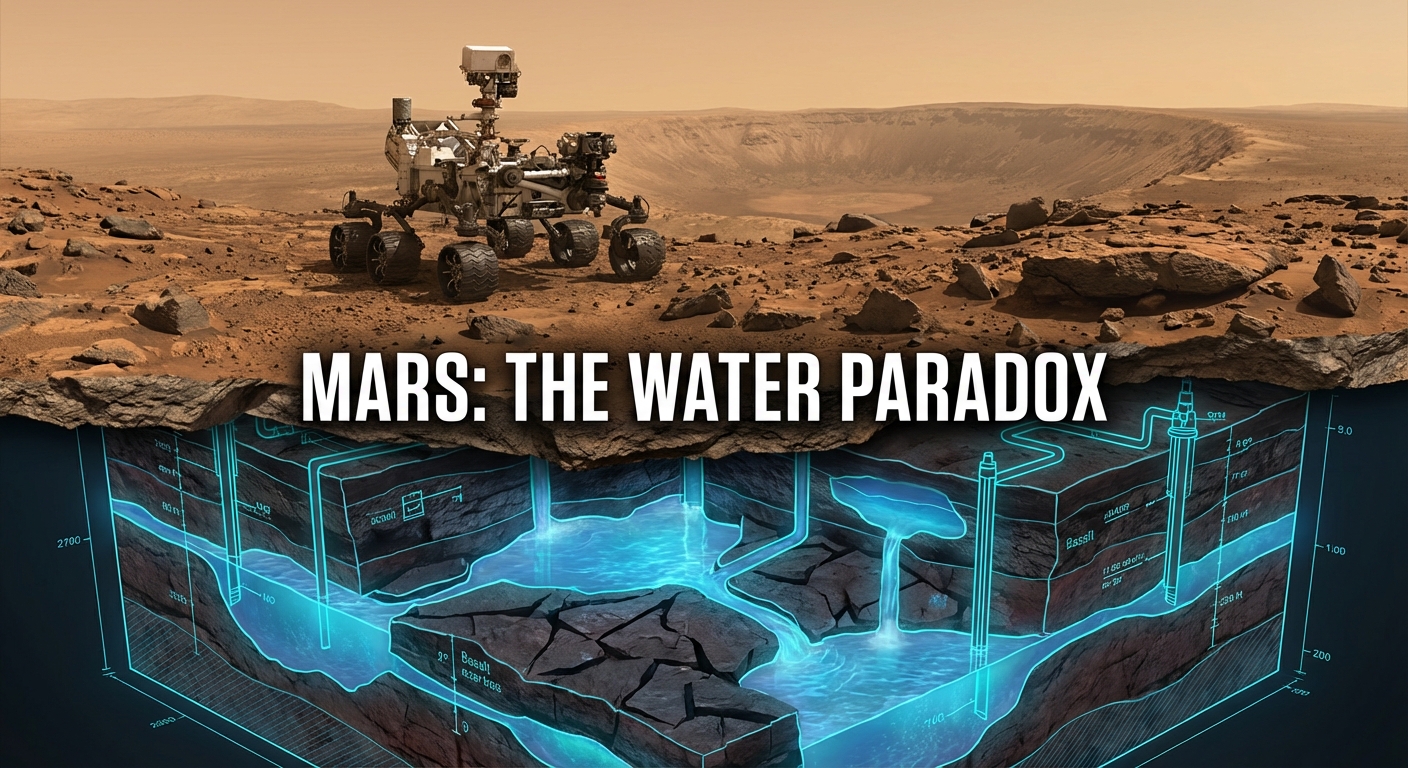
The confirmation of subsurface water and ancient aquifers on Mars fundamentally shifts colonization viability by enabling In-Situ Resource Utilization (ISRU). Instead of hauling fuel from Earth, colonies can use electrolysis to split water into hydrogen fuel and breathable oxygen. Additionally, water deposits provide critical radiation shielding and a sustainable source for agriculture, reducing reliance on Earth-based supply chains.
1. The Fuel Problem: How Water Unlocks the Solar System
The single biggest hurdle in space exploration is the tyranny of the rocket equation: to bring more fuel, you need more fuel to lift it. This is why the discovery of accessible water on Mars is not just a biological curiosity—it is an industrial necessity. Water (H2O) is essentially liquid hydrogen and oxygen, the most potent chemical rocket propellant known to man.
The Mechanism: Through a process called electrolysis, solar energy can be used to split Martian water molecules into hydrogen and oxygen. The Sabatier process then takes this hydrogen and combines it with carbon dioxide (CO2) from the Martian atmosphere to produce methane (CH4) and water. This methane serves as fuel for rockets like SpaceX’s Starship. Without this in-situ resource utilization, a return trip from Mars would require a ship to carry all its return fuel from Earth, making the vessel impossibly heavy.
A Common Misconception: Many assume that “water on Mars” means we can just dip a bucket into a lake. In reality, much of this water is locked in subsurface ice or hydrated minerals. Extracting it requires heavy industrial drilling and heating equipment. For a deeper look at the heavy-lift rockets capable of transporting this infrastructure, read our comparison of Starship vs. New Glenn.
2. Breathing Room: Splitting Water for Life Support
While fuel gets you home, oxygen keeps you alive. The recent confirmation of subsurface water deposits provides a reliable feedstock for breathing air. Currently, the International Space Station (ISS) recycles about 90% of its water, but a Mars colony cannot rely on recycling alone; it needs a net positive input to account for losses and population growth.
The Process: Electrolysis units, similar to those tested on the MOXIE experiment aboard the Perseverance rover, can be scaled up. By running an electric current through the harvested water, colonists can produce oxygen for breathable atmosphere and hydrogen for industrial use. This creates a closed-loop life support system that mimics Earth’s biosphere.
However, relying on machinery for air introduces a single point of failure. If the water extraction pumps fail, the oxygen supply halts. This is why redundancy is key. Colonists will likely need to store months’ worth of oxygen in buffer tanks, a logistical challenge that requires advanced materials. We discuss similar advancements in material strength in our guide to commercial graphene applications.

Recommended Reading: For a foundational understanding of how we can use Martian resources to build a self-sustaining civilization, Robert Zubrin’s The Case for Mars remains the definitive text. It outlines the “Mars Direct” plan, which heavily relies on the water extraction principles discussed here.
3. Radiation Shielding: The Subsurface Solution
Mars lacks a global magnetic field, meaning its surface is bombarded by cosmic rays and solar radiation. Long-term exposure poses severe cancer risks to human settlers. The discovery of ancient underground water and large ice deposits offers a dual solution: resources and protection.
How It Works: Water is an excellent radiation shield because it is rich in hydrogen, which effectively blocks cosmic rays. By constructing habitats inside subterranean aquifers or lava tubes (as suggested by research from NYU Abu Dhabi), colonists can use the planet’s own crust and water ice as a natural barrier. Alternatively, surface habitats could be covered in “ice domes”—thick layers of frozen water that let in light but block harmful radiation.
The Challenge: Building underground is technically demanding. It requires autonomous digging robots capable of navigating the complex, basaltic geology of Mars. Recent mission updates suggest that selecting the right site is crucial; you want a location that balances radiation protection with access to sunlight for solar power. Check out our 2025 Mars Mission Updates for the latest on landing site selection.
4. Ancient Evidence vs. Usable Resources
It is vital to distinguish between “evidence of ancient water” and “currently usable water.” Studies, such as those analyzing Gale Crater, show that liquid water was present billions of years ago, turning sand dunes into rock. This is fascinating for astrobiology and the search for ancient life, but it doesn’t help a thirsty astronaut today.
The Reality: The water available for colonization exists primarily as ice at the poles or as brines in the subsurface. The “ancient water” evidence tells us where to look for hydrated minerals, like gypsum and clays, which can be heated to release water. This is a more energy-intensive process than melting ice but provides a critical backup source in equatorial regions where surface ice is unstable.

Visualizing the Target: To truly appreciate the terrain we are discussing—from the polar ice caps to the dusty equatorial basins—a high-quality telescope is essential for enthusiasts. The Celestron NexStar 8SE is legendary for its ability to resolve details on the Martian surface during opposition, bringing the reality of these future landing sites into focus.
5. The ‘Salty’ Truth: Engineering Challenges of Martian Brine
A recent report referenced by the National Academies highlights a critical issue: liquid water on Mars is likely extremely salty. Pure liquid water cannot exist on the Martian surface due to low atmospheric pressure—it would boil away instantly. However, water mixed with perchlorates (salts) can remain liquid at lower temperatures.
The Engineering Problem: These perchlorates are toxic to humans. Using this brine requires advanced desalination and purification technology. If colonists drink water laced with perchlorates, it attacks the thyroid gland. Furthermore, the salt is corrosive to equipment. “Water on Mars” is not a pristine mountain spring; it is a toxic chemical sludge that must be heavily processed. This adds a layer of complexity to colonization plans that is often overlooked in optimistic sci-fi depictions.
Frequently Asked Questions
Is the water on Mars safe to drink?
No, not directly. Martian water, particularly in liquid form, is likely a brine containing high concentrations of perchlorates (salts). These are toxic to humans and can cause thyroid damage. Any water extracted on Mars would need to undergo rigorous desalination and purification processes before it is safe for human consumption.
Can we use Martian water to grow plants?
Yes, but the water must be purified first. The toxic salts (perchlorates) found in Martian soil and water are harmful to most plants. However, once treated, this water can be used in hydroponic or aeroponic systems to grow food, which is essential for a self-sustaining colony.
How much water is actually on Mars?
There is a significant amount of water on Mars, but most of it is frozen. The polar ice caps contain enough water to cover the entire planet in a shallow ocean if melted. Additionally, recent radar data suggests the presence of vast subsurface ice deposits and potentially liquid brines even in non-polar regions.
What is In-Situ Resource Utilization (ISRU)?
ISRU is the practice of collecting and processing local resources found on other celestial bodies to support space missions. On Mars, this primarily refers to mining water ice to create oxygen and rocket fuel, rather than transporting these heavy consumables all the way from Earth.
Does the discovery of water mean there is life on Mars?
Not necessarily. While water is a prerequisite for life as we know it, its presence does not guarantee biology. However, the discovery of ancient subsurface water systems suggests that Mars had habitable conditions for millions of years, increasing the statistical likelihood that microbial life could have evolved.