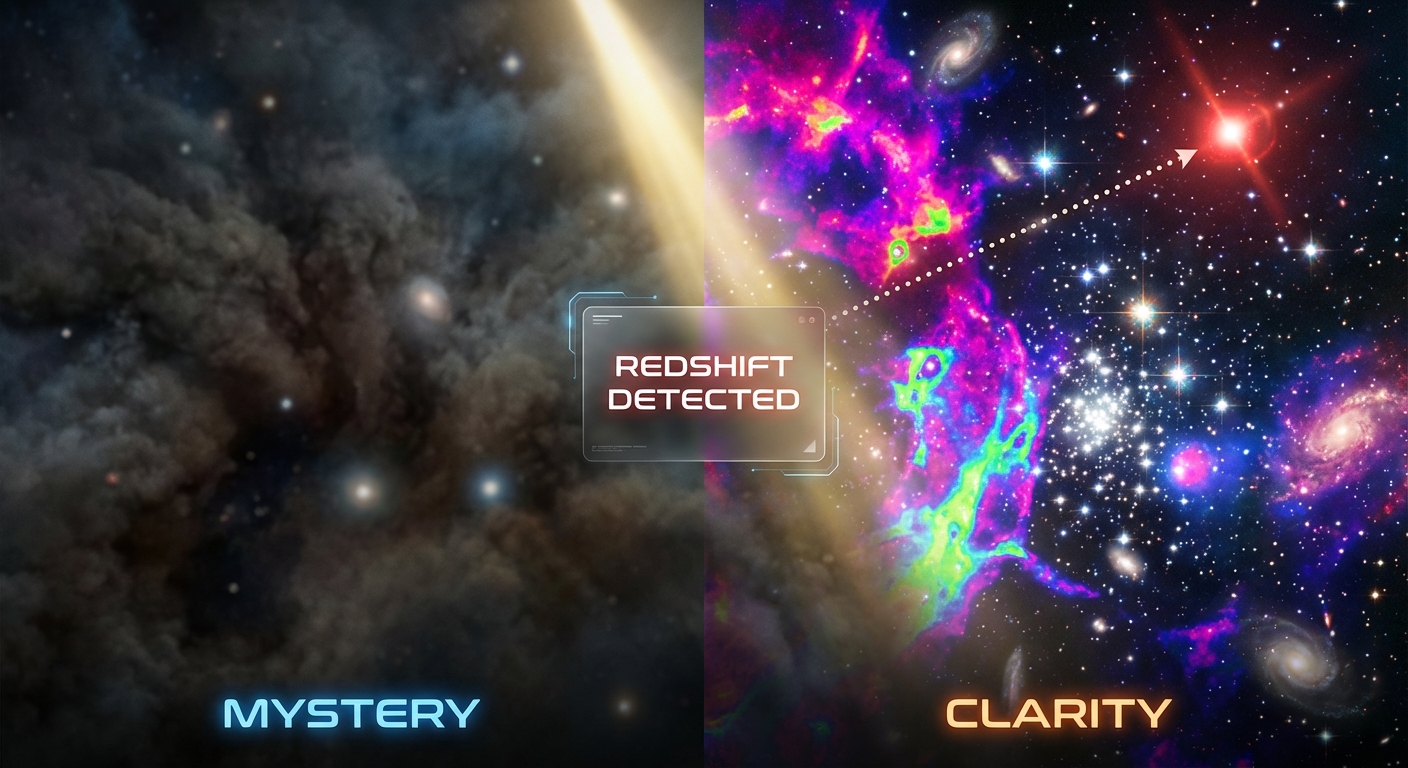
- Quick Summary: Webb’s 2025 Breakthroughs
- 1. Hidden Monsters: Supermassive Black Holes in the Early Universe
- 2. Atmosphere Analysis: The ‘Wet Lava Ball’ and Lemon Worlds
- 3. Galactic Shapeshifters: The ‘Virgil’ Galaxy Mystery
- 4. Stellar Nurseries: Seeing Through the Dust of Westerlund 2
- 5. Resolution Revolution: How MIRI Changes the Game
- Frequently Asked Questions
What are the James Webb Space Telescope’s major discoveries in 2025?
In 2025, the James Webb Space Telescope (JWST) revolutionized deep space imaging by discovering “Little Red Dots”—ancient, compact galaxies acting as seeds for supermassive black holes just 570 million years after the Big Bang. It also characterized the atmosphere of the rocky exoplanet TOI-561 b as a “wet lava ball” and revealed the “Virgil” galaxy, a cosmic shapeshifter that appears dormant in optical light but highly active in the infrared spectrum.
1. Hidden Monsters: Supermassive Black Holes in the Early Universe
One of the most perplexing questions in astrophysics has been how supermassive black holes formed so quickly after the Big Bang. Standard theory suggested they needed billions of years to grow. However, JWST’s 2025 observations of the “Little Red Dots” have upended this timeline.
The Discovery: Using its Near-Infrared Spectrograph (NIRSpec), Webb identified compact, red objects at redshifts 4-8. These are not just passive galaxies; they are active galactic nuclei housing supermassive black holes (SMBHs) that are 10 to 100 times more massive than expected relative to their host galaxies. For example, the galaxy CANUCS-LRD-z8.6 contains a black hole feasting on gas just 570 million years after the universe began.
Why It Matters: This confirms that black holes didn’t just grow from dying stars; they likely formed from “heavy seeds”—massive clouds of gas collapsing directly. This parallels the biological search for origins discussed in our analysis of Mars rover biosignatures, where understanding the initial conditions is key to solving the puzzle of existence.
Common Misconception: People often confuse these “red dots” with dying red dwarf stars. In this context, the “red” comes from cosmological redshift—the stretching of light as it travels across the expanding universe—indicating these objects are from the dawn of time, not just dim local stars.

2. Atmosphere Analysis: The ‘Wet Lava Ball’ and Lemon Worlds
While Hubble could detect water vapor on gas giants, JWST is pushing the frontier to rocky exoplanets. The standout discovery of 2025 is TOI-561 b, a planet that challenges our definition of habitability.
The Mechanism: Published in The Astrophysical Journal Letters, the data reveals a planet with a molten surface where gases cycle between a magma ocean and a steam-heavy atmosphere. This “wet lava ball” state suggests that even planets orbiting perilously close to their stars can retain volatile atmospheres. Webb also spotted a lemon-shaped exoplanet with a bizarre, unstable atmosphere, likely deformed by the immense gravitational tidal forces of its host star.
The Implications: This proves that silicate vapor atmospheres exist. It helps astronomers refine their models for what a “habitable” atmosphere might look like, a concept we explore further in our guide to Mars colonization and water implications. If rocky planets can hold atmospheres under such extreme heat, the “Goldilocks zone” for life might be wider than previously thought.
3. Galactic Shapeshifters: The ‘Virgil’ Galaxy Mystery
In optical light, the galaxy dubbed “Virgil” looks like a standard, quiet collection of stars. But when the University of Arizona team trained JWST’s MIRI (Mid-Infrared Instrument) on it, they saw a monster.
The Shapeshifter Effect: “Virgil” is a textbook example of a “Jekyll and Hyde” galaxy. In the visible spectrum seen by older telescopes, the thick dust clouds block the light from the core, making it appear dormant. However, infrared light penetrates this dust, revealing a raging, accreting supermassive black hole at the center. This discovery implies that our census of active black holes in the early universe is likely a massive undercount.
Why Infrared Wins: Visible light has a shorter wavelength and bounces off dust particles (scattering). Infrared light has a longer wavelength and passes through dust like it isn’t even there. This capability allows JWST to essentially “X-ray” the universe’s dustiest corners.
4. Stellar Nurseries: Seeing Through the Dust of Westerlund 2
The image of the Westerlund 2 star cluster is a direct face-off between Hubble and Webb. While Hubble’s 2015 image was a masterpiece, it was obscured by the nebula’s gas. Webb’s 2025 update peeled back those layers to reveal a bustling factory of brown dwarfs and protoplanetary disks.
The Technical Detail: Located 20,000 light-years away, this cluster is a laboratory for understanding star formation. Webb’s resolution is so high it can distinguish between binary star systems and single stars in this crowded field. According to NASA’s mission updates, detecting these low-mass brown dwarfs provides the “missing link” data points between giant planets and small stars, helping to calibrate our models of galactic evolution.

5. Resolution Revolution: How MIRI Changes the Game
The comparison between the James Webb Space Telescope and the Hubble Space Telescope is often framed as a competition, but it is effectively a generational leap in technology. The key difference lies in the wavelengths they observe.
- Hubble: Primarily Ultraviolet (UV) and Visible light. Excellent for seeing high-energy stars but blocked by dust.
- Webb: Near-Infrared (NIR) and Mid-Infrared (MIR). Excellent for seeing heat, ancient redshifted galaxies, and through dust clouds.
The Deep Space Advantage: Because the universe is expanding, light from the first galaxies has been stretched (redshifted) out of the visible spectrum and into the infrared. Hubble physically cannot see the “Little Red Dots” Webb is finding because that light is invisible to its sensors. Webb was built specifically to hunt these ghosts of the cosmic dawn.
Frequently Asked Questions
What is the most significant JWST discovery of 2025?
The identification of “Little Red Dots”—galaxies rich in supermassive black holes at redshifts 4-8—is arguably the most significant. It forces a rewrite of standard cosmological models regarding how quickly black holes can grow in the early universe.
How far back in time can the James Webb Telescope see?
JWST can see back to about 100-250 million years after the Big Bang. It is designed to capture the light from the very first stars and galaxies (Population III stars) as they ignited, effectively letting us watch the universe “turn the lights on.”
Why are exoplanet atmospheres important to study?
Analyzing an exoplanet’s atmosphere allows scientists to look for biosignatures (like methane, oxygen, and carbon dioxide ratios) that suggest biological activity. It also helps us understand planetary formation, distinguishing between rocky worlds like Earth and gas giants like Jupiter.
What is the ‘Virgil’ galaxy?
“Virgil” is a galaxy discovered by the University of Arizona team that appears normal in visible light but reveals a massive, active black hole in infrared. It serves as a case study for how dust can hide the universe’s most violent events from traditional optical telescopes.
Can I see what Webb sees with a home telescope?
No, not exactly. Webb observes in infrared light, which human eyes (and most home telescopes) cannot see. However, high-quality amateur telescopes can resolve many of the same targets—like the Orion Nebula or Andromeda Galaxy—in visible light, offering a beautiful, albeit different, perspective.