- Direct Answer: The Core Difference
- 1. The Cost Equation: API Fees vs. Engineering Salaries
- 2. Data Privacy & Security: The Liability Gap
- 3. Customization: Fine-Tuning vs. RAG Wrappers
- 4. Performance Parity: Do You Really Need Frontier Intelligence?
- 5. The ‘Vendor Lock-in’ Trap
- Recommended Strategic Resources
- Frequently Asked Questions
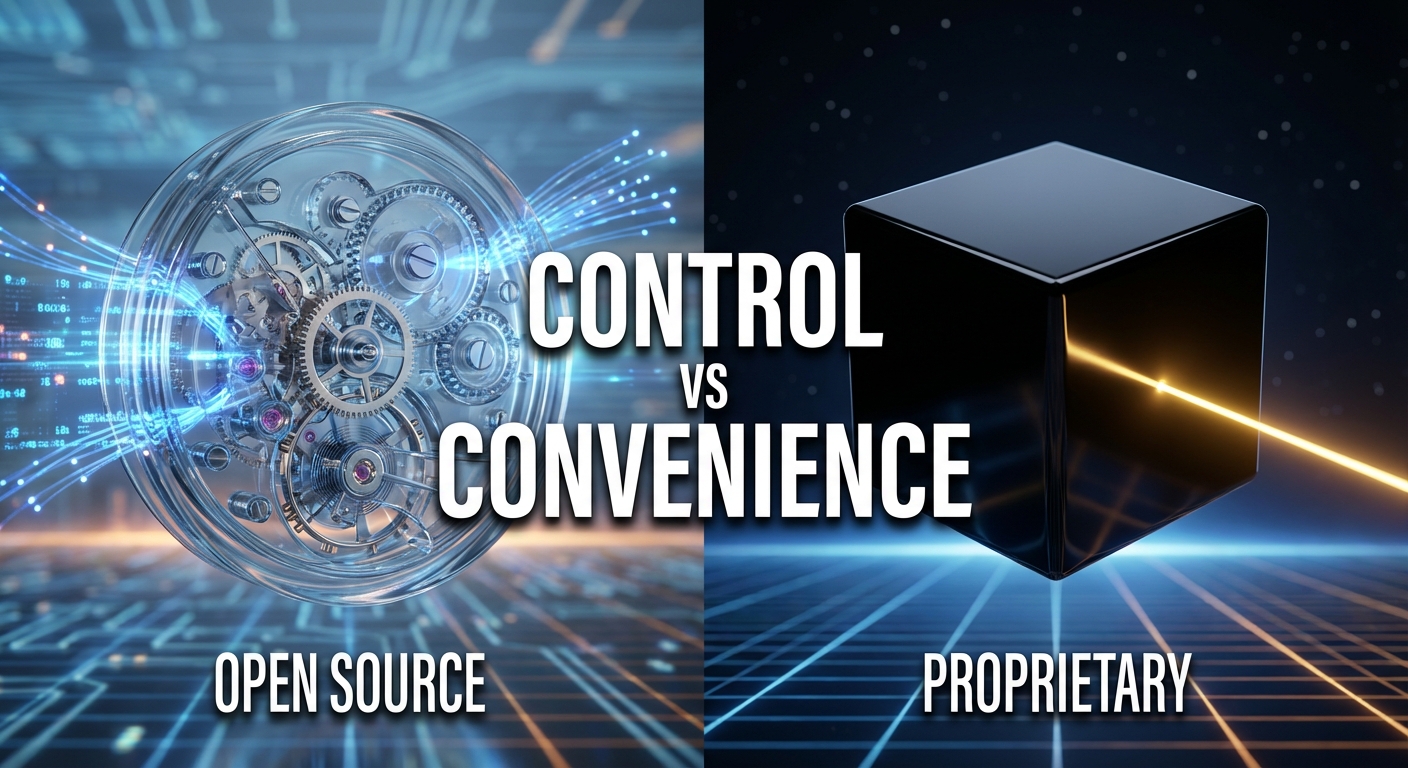
Compare open source vs proprietary LLM models for startups: The choice comes down to Speed vs. Control. Proprietary models (like GPT-4 or Claude) offer immediate, state-of-the-art performance with zero infrastructure management, making them ideal for MVPs and rapid scaling. Open Source models (like Llama 3 or Mistral) require dedicated engineering resources to host but offer total data sovereignty, lower per-token costs at scale, and immunity to vendor price hikes. Startups should typically start with proprietary to validate product-market fit, then migrate to open source to optimize margins.
1. The Cost Equation: API Fees vs. Engineering Salaries
The most common misconception startups make is assuming that “Open Source” means “Free.” While the model weights for Llama-3 or Mistral are indeed free to download, running them is not. You must evaluate the Total Cost of Ownership (TCO).
Proprietary Costs (The Variable Trap):
Proprietary models charge per token. This is excellent for low-volume apps because your cost scales linearly with revenue. However, as your user base explodes, your AWS or OpenAI bill can become a margin-killing monthly expense. You are renting intelligence, and the landlord can raise the rent at any time.
Open Source Costs (The Fixed Burden):
Open Source shifts the cost from variable (tokens) to fixed (GPUs and Engineers). You need to rent high-performance GPUs (like H100s) and, more importantly, hire Machine Learning Engineers to manage latency, quantization, and uptime. As noted by Civo, the tipping point usually occurs when your API bill exceeds the monthly salary of an ML engineer. Until then, self-hosting is often more expensive than using an API.
2. Data Privacy & Security: The Liability Gap
For startups in regulated industries (FinTech, MedTech), this is often the deciding factor. When you send a prompt to a proprietary model, that data leaves your secure VPC (Virtual Private Cloud). While enterprise agreements promise not to train on your data, you are still trusting a third party with your IP.
The Mechanism of Sovereignty:
Open Source models allow for Air-Gapped Deployment. You can run the model entirely within your own firewall. This means no data ever travels over the public internet. According to BuiltIn, this level of reproducibility and transparency is non-negotiable for companies that need to audit exactly why an AI made a specific decision. If your startup handles sensitive PII (Personally Identifiable Information), the liability reduction of keeping data in-house often outweighs the infrastructure costs.
For a deeper dive into evaluating these risks, read our guide on how to evaluate LLM models for specific business needs, which covers security benchmarks in detail.
3. Customization: Fine-Tuning vs. RAG Wrappers
All startups want a “differentiated” AI, but there are two ways to achieve this: Retrieval Augmented Generation (RAG) and Fine-Tuning.
Proprietary Limits:
With proprietary models, you are mostly limited to RAG (feeding context in the prompt) or lightweight fine-tuning APIs. You cannot modify the model’s architecture or deeper weights. You are essentially polishing someone else’s car.
Open Source Freedom:
Open Source allows for Deep Fine-Tuning. You can retrain the model on your specific domain language (e.g., legal contracts or biological code) until it speaks your dialect natively. This allows smaller, open-source models (like 7B parameters) to outperform massive proprietary models (1T+ parameters) on niche tasks. This distinction is critical for automation strategies, as discussed in our LLM vs Traditional ML models guide.
4. Performance Parity: Do You Really Need Frontier Intelligence?
A major trend in 2025 is the closing of the performance gap. While proprietary models (like GPT-5 class) still hold the crown for complex reasoning and coding, open-source models are achieving Performance Parity on standard tasks like summarization, classification, and chat.
The Over-Engineering Mistake:
Startups often burn cash using the smartest model available for simple tasks. You do not need a PhD-level intelligence to summarize an email. By using a “router” system, you can send complex queries to a proprietary model and simple queries to a cheap, self-hosted open-source model. Hatchworks emphasizes that this hybrid approach is becoming the standard for cost-efficient scaling.
5. The ‘Vendor Lock-in’ Trap
Building your entire startup on top of a single proprietary API is a strategic risk. If the vendor deprecates the model, changes the pricing, or alters the safety filters, your product breaks. We call this Platform Risk.
The Mitigation Strategy:
Open Source is the ultimate insurance policy. Even if the creator of Llama stops updating it, you still have the weights. You can run it forever. To mitigate lock-in, smart startups use an abstraction layer (like LangChain) that allows them to swap models in the backend without rewriting their application code. This flexibility is essential for using the best generative AI tools for enterprise automation.
Recommended Strategic Resources
Choosing the right infrastructure is a high-stakes bet. These resources provide the frameworks needed to make that decision based on business logic, not just hype.

Why we recommend it: This book moves beyond the code and focuses on the business strategy of AI adoption, helping you calculate the ROI of open source vs. proprietary investments.

Frequently Asked Questions
Is open source AI truly free for commercial use?
Usually, but not always. Models like Llama 3 often have a ‘Community License’ that allows free commercial use up to a certain revenue or user threshold (e.g., 700 million users). Always read the specific license (Apache 2.0 vs. Custom) before deploying.
Which is safer for data privacy?
Open Source is safer for data privacy because it allows for self-hosting. You can run the model on your own servers, ensuring that no sensitive customer data ever is sent to a third-party API provider.
Can I switch from proprietary to open source later?
Yes, and this is a common strategy. Startups often use proprietary APIs for the MVP phase to move fast, and then ‘distill’ or migrate to a fine-tuned open-source model once they have enough data and scale to justify the engineering effort.
What is the biggest hidden cost of open source LLMs?
The biggest hidden cost is Engineering Talent. Managing a Kubernetes cluster with GPU nodes requires specialized DevOps and ML knowledge. These engineers are expensive and hard to hire.
Do proprietary models hallucinate less?
Generally, yes. Proprietary models (like GPT-4) are trained on larger datasets with more rigorous Reinforcement Learning from Human Feedback (RLHF), which tends to reduce—but not eliminate—hallucinations compared to raw open-source base models.