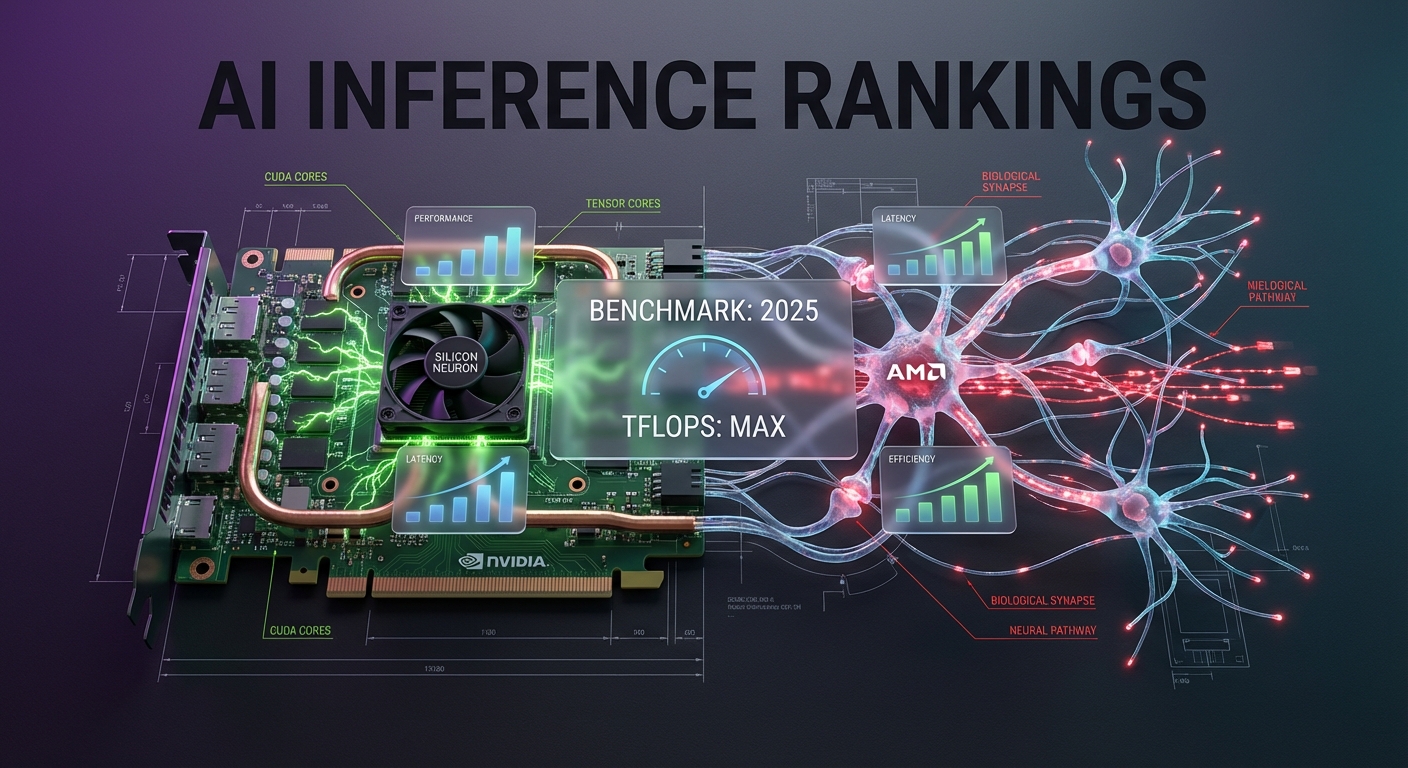
The top GPU for AI workloads in 2025 is the NVIDIA Blackwell B200. In standardized MLPerf benchmarks, the B200 outperforms the previous H100 by up to 30x in inference throughput due to its new FP4 Tensor Core precision and NVLink Switch architecture. For local/consumer AI development, the NVIDIA GeForce RTX 5090 is the undisputed king, offering the highest memory bandwidth and VRAM capacity available without purchasing enterprise-grade server racks.
1. The Heavyweights: NVIDIA Blackwell B200 vs. AMD MI325X
In the enterprise sector, the battle is no longer just about raw clock speed; it is about inference efficiency and memory density. The 2025 benchmarks indicate a massive shift away from monolithic training clusters toward specialized inference engines.
NVIDIA Blackwell B200/GB200:
The Blackwell architecture is the current benchmark leader. Its dominance stems from the introduction of FP4 quantization support. While previous generations relied on FP8 or FP16, Blackwell can process data at 4-bit precision with minimal accuracy loss. This effectively doubles the throughput for Large Language Models (LLMs) like GPT-4 or DeepSeek-R1. Additionally, the B200 supports 192GB of HBM3e memory, crucial for fitting massive models entirely on-chip to reduce latency.
AMD Instinct MI325X:
AMD has countered with the MI325X, which positions itself as the value and capacity leader. According to comparative analysis by Fluence Network, the MI325X’s primary advantage is its open ecosystem (ROCm) and massive memory footprint (up to 288GB HBM3e). For workloads that are memory-bound rather than compute-bound—such as serving extremely large context windows for RAG (Retrieval-Augmented Generation)—the AMD MI325X often provides better performance-per-dollar than the NVIDIA H100, though it trails the B200 in raw peak compute.
Key Takeaway: Choose Blackwell for peak low-latency inference on the most popular models. Choose MI325X if your specific workload requires holding massive datasets in VRAM to avoid expensive server-to-server communication.
2. Best Consumer GPUs for Local LLMs (RTX 5090 & 4090)
For researchers, developers, and enthusiasts running models like Llama 3 locally, enterprise racks are overkill. The “Local AI” market has been revolutionized by the release of the RTX 50-series. The most critical metric here is VRAM capacity—if the model doesn’t fit in your GPU memory, it falls back to system RAM, slowing from tokens-per-millisecond to tokens-per-second.
The New King: ASUS ROG Astral GeForce RTX 5090
The RTX 5090 is the first consumer card to feature GDDR7 memory, significantly boosting bandwidth. This allows for faster token generation in “Chat with RTX” style applications. With 32GB of VRAM (in specific prosumer configurations), it can comfortably run 70B parameter models at 4-bit quantization entirely on the GPU.
Why It Wins:
Unlike the 4090, the 5090’s architecture includes specialized Transformer Engine improvements trickle-down from Blackwell, making it disproportionately faster at inference tasks compared to gaming.

3. Value Performance: The Best Budget AI Cards
Not everyone has $3,000+ to spend on a GPU. If you are a student or a developer just starting with GPU architecture improvements, you need a card that balances VRAM with cost. A common mistake is buying a card with high clock speeds but low memory (like an 8GB card), which renders it useless for anything beyond basic image generation.
The Sweet Spot: RTX 4070 Super / RTX 5070
The RTX 4070 Super remains a benchmark hero for entry-level AI. With 12GB of VRAM, it can run Stable Diffusion XL and 7B/13B parameter LLMs comfortably. It offers the best “Tokens per Dollar” ratio in the market.
Recommended Solution for Beginners:
This card is perfect for those learning PyTorch, TensorFlow, or fine-tuning small LoRAs (Low-Rank Adaptations) for image generators.

4. Understanding the Metrics: FP4 vs. FP8 vs. VRAM
When reading benchmark charts from sources like Tom’s Hardware, it is vital to understand what the numbers represent. The 2025 hierarchy has shifted focus from TFLOPS (Tera-Floating Point Operations Per Second) to specialized AI metrics.
- FP8 & FP4 Tensor TFLOPS: This measures how fast the GPU can do the math required for deep learning. FP4 is the new 2025 standard; if a card doesn’t support it hardware-natively, it will be significantly slower on future models.
- Memory Bandwidth (GB/s): This is the speed limit of your AI. It dictates how fast the GPU can read the model’s weights. The RTX 5090’s move to GDDR7 provides a massive leap here, reducing the “time to first token” latency.
- Interconnect Speed (NVLink): For multi-GPU setups, this matters. However, for single-card consumer setups, it is irrelevant.
If you want a deeper technical breakdown of how these architectures function, check out our guide on latest GPU architecture improvements for AI inference.
Frequently Asked Questions
Is the NVIDIA RTX 5090 better than the H100 for AI?
For a single user running local inference, the RTX 5090 is better value and easier to deploy. However, for enterprise-scale training of massive models (100B+ parameters), the H100 (or B200) is superior due to its ability to cluster thousands of GPUs together efficiently.
How much VRAM do I need for AI in 2025?
For image generation (Stable Diffusion), 12GB is the minimum recommended. For running LLMs (Text Generation), aim for 24GB or more. This allows you to run models like Llama-3-70B with 4-bit quantization without severe slowdowns.
What is the difference between Hopper and Blackwell architectures?
Hopper (H100) was the standard for 2023-2024. Blackwell (B200) is the 2025 successor, introducing FP4 precision support, higher memory bandwidth with HBM3e, and a dual-die architecture that effectively stitches two chips into one for massive performance gains.
Can AMD GPUs be used for AI workloads?
Yes. While NVIDIA has better software support (CUDA), AMD’s ROCm software has improved significantly. The AMD MI300 and MI325 series are excellent for inference, offering more VRAM per dollar than NVIDIA, though they may require more technical setup.
What is the best budget GPU for AI students?
The NVIDIA RTX 4060 Ti (16GB version) or the RTX 4070 Super are the best entry-level cards. They provide enough VRAM to load decent-sized models and full compatibility with standard AI libraries.