- Direct Answer: What is the Fossil Record of Extinction?
- 1. The Big Five: Mass Extinctions Through Time
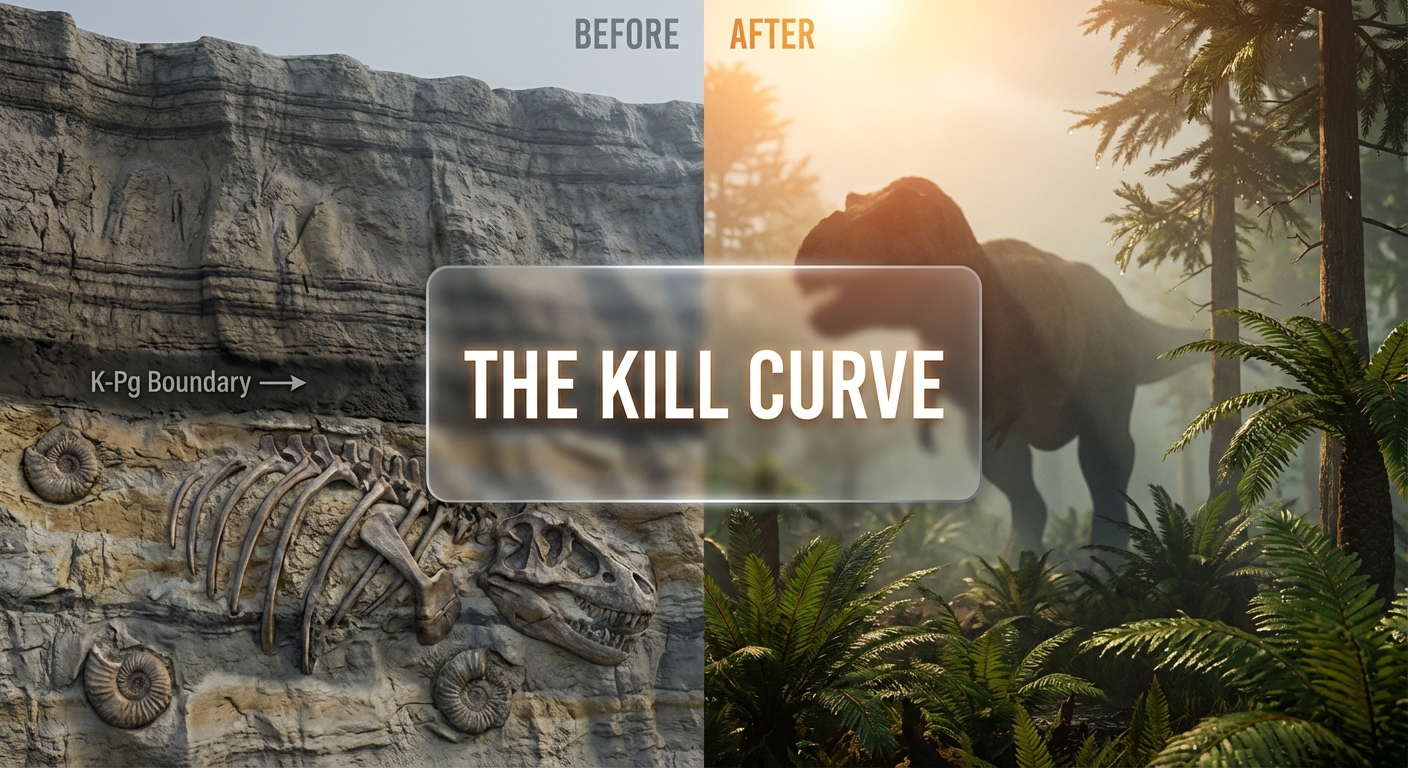
- 2. The K-Pg Boundary: Evidence of the Asteroid
- 3. Reading the Rocks: Stratigraphy and Index Fossils
- 4. The Signor-Lipps Effect: Why Fossils “Disappear” Early
- 5. The Recovery: How Life Rebounds (and Mammals Rise)
- 6. Recommended Paleontology Resources
- Frequently Asked Questions
Mass extinction events in the fossil record are defined by a rapid, widespread decrease in biodiversity, where over 75% of species vanish within a geologically short timeframe (less than 2.8 million years). The most famous of these, the End-Cretaceous (K-Pg) event 66 million years ago, is marked in the geologic strata by a distinct layer of iridium-rich clay. This boundary physically separates the age of non-avian dinosaurs (Mesozoic) from the age of mammals (Cenozoic), providing irrefutable evidence of a catastrophic global shift triggered by an asteroid impact.
1. The Big Five: Mass Extinctions Through Time
When paleontologists speak of “extinction,” they are usually referring to background extinction—the natural, slow turnover of species. However, the fossil record reveals five distinct moments where the rules of life were rewritten instantly. These are known as the “Big Five.”
The Mechanism of Collapse:
According to the National Park Service, these events share a common thread: a rapid change in the global climate that outpaces the ability of species to adapt. Whether it is the glaciation of the End-Ordovician or the volcanic “Great Dying” of the End-Permian, the result is the same: the collapse of food webs.
| Event | Time (Ma) | Primary Cause | Est. Species Loss |
|---|---|---|---|
| End-Ordovician | 444 | Glaciation / Sea Level Drop | 86% |
| Late Devonian | 372 | Anoxia (Low Oxygen) | 75% |
| End-Permian | 252 | Volcanism (Siberian Traps) | 96% |
| Triassic-Jurassic | 201 | Volcanism (CAMP) | 80% |
| End-Cretaceous (K-Pg) | 66 | Asteroid Impact | 76% |
Understanding these shifts requires analyzing vast datasets of occurrences, a process not unlike how modern analysts use SaaS project management tools to track complex timelines. In paleontology, the “project” is reconstructing the history of life on Earth.
2. The K-Pg Boundary: Evidence of the Asteroid
The extinction of the non-avian dinosaurs is the most studied event in paleontology, largely due to the discovery of the K-Pg (Cretaceous-Paleogene) boundary. This is not a theoretical concept; it is a physical line in the rock that you can touch.
The Iridium Anomaly:
In the late 1970s, Walter Alvarez discovered a thin layer of clay in Italy that contained abnormally high levels of iridium. Iridium is rare on Earth’s crust but common in asteroids. This “smoking gun” suggested that a massive extraterrestrial object struck the planet. This hypothesis was later confirmed by the discovery of the Chicxulub crater in the Yucatán Peninsula.
Shocked Quartz and Tektites:
Beyond iridium, the Smithsonian National Museum of Natural History notes that the boundary layer contains “shocked quartz”—mineral grains that have been deformed by immense pressure—and tektites, which are droplets of molten rock ejected into the atmosphere that cooled as they fell back to Earth. These geological signatures provide a precise timestamp for the event.
3. Reading the Rocks: Stratigraphy and Index Fossils
How do we know exactly when these events happened? We rely on stratigraphy (the study of rock layers) and index fossils.
The Role of Index Fossils:
An index fossil is a species that was widespread, abundant, and short-lived. For the Cretaceous, certain species of Ammonites (shelled cephalopods) serve this purpose perfectly. When you find these specific ammonites, you know you are looking at rock from the very end of the dinosaur age. If you move one inch up the rock face—crossing the K-Pg boundary—they are gone. Forever.
This abrupt disappearance is what separates a mass extinction from a gradual decline. Evaluating these theories requires critical thinking, much like the analysis found in the best opinion pieces on current events, where evidence must be weighed against conflicting narratives.
4. The Signor-Lipps Effect: Why Fossils “Disappear” Early
A common misconception is that because we don’t find dinosaur fossils right at the boundary line in every location, they must have died out gradually before the asteroid hit. This is a statistical error known as the Signor-Lipps Effect.
The Mechanism:
Fossilization is incredibly rare. Most animals die and decay without leaving a trace. Therefore, the “last known fossil” of a species is almost never the last individual that actually lived. It just represents the last one that got buried in sediment. This statistical bias makes sudden extinctions look gradual in the rock record.
Recent studies in the Hell Creek Formation (USA) have helped correct this bias, showing that dinosaur diversity remained relatively stable right up until the impact event, debunking the idea that they were already “doomed to die.”
5. The Recovery: How Life Rebounds (and Mammals Rise)
Nature abhors a vacuum. Following the K-Pg mass extinction, the ecosystems were devastated, but they were also cleared of competition. This allowed the surviving lineages—primarily small, nocturnal mammals and avian dinosaurs (birds)—to undergo an explosion of adaptive radiation.
The Rise of Mammals:
Within just a few million years (a geological blink of an eye), mammals evolved from shrew-sized insectivores into massive herbivores and carnivores. This rapid diversification was driven by the availability of new ecological niches—forests were regrowing, and there were no longer Tyrannosaurs to hunt them.
The biological resilience seen here is reminiscent of the complex cellular mechanisms discussed in our guide to mRNA vaccine mechanisms, where life finds a way to adapt and survive through genetic variation and selection.
6. Recommended Paleontology Resources
To truly understand the scale of these events, visual aids are essential. We recommend this comprehensive visual guide, which offers detailed reconstructions of the flora and fauna from these lost worlds.

Frequently Asked Questions
What is the “Kill Curve” in paleontology?
The “Kill Curve” is a theoretical graph that plots the average wait time between extinction events against the intensity of the event (percent of species killed). It suggests that massive events (like the K-Pg) are rare but statistically inevitable over geological time.
Did any dinosaurs survive the K-Pg extinction?
Yes. Avian dinosaurs (birds) survived. Every bird you see today, from a chicken to an eagle, is a direct descendant of the theropod dinosaurs that survived the asteroid impact.
How do we date the K-Pg boundary so precisely?
Scientists use radiometric dating (specifically Argon-Argon dating) on the volcanic ash layers found within or near the boundary clay. This gives us the precise date of approximately 66.04 million years ago.
What is the difference between background and mass extinction?
Background extinction is the normal rate at which species disappear due to local environmental changes or competition (roughly 1 species per million species years). Mass extinction is a global, catastrophic event where the extinction rate spikes far above the background rate.
Could a sixth mass extinction be happening now?
Many biologists believe we are currently in the Holocene Extinction (the Sixth Extinction), driven by human activity, habitat destruction, and climate change. Current extinction rates are estimated to be 100 to 1,000 times higher than the natural background rate.