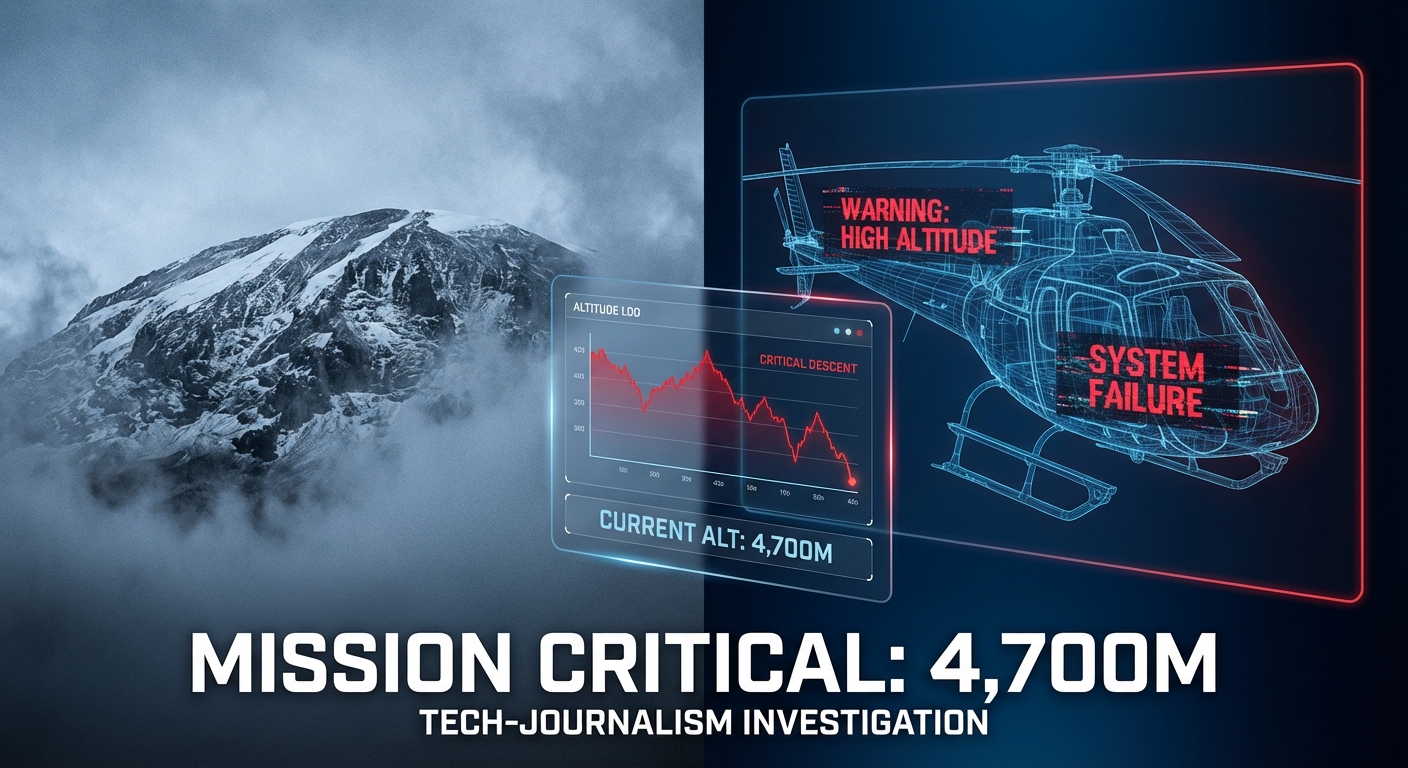
The December 24, 2025, Mount Kilimanjaro helicopter crash occurred in the Barafu Valley at approximately 4,700 meters (15,400 ft). The accident involved a Kilimanjaro Aviation Airbus AS350 B3 conducting a medical evacuation (MEDEVAC) mission. The crash resulted in 5 fatalities, including two Czech climbers, a Tanzanian doctor, a guide, and the pilot. While the official cause is under investigation by the Tanzania Civil Aviation Authority, preliminary inquiries focus on the interplay of extreme high-altitude thin air, sudden weather changes common between Barafu Camp and Kibo Summit, and mechanical performance limits.
The Incident: December 24, 2025
On Christmas Eve 2025, a rescue mission turned into a tragedy that has shaken the climbing community. An Airbus AS350 B3, a helicopter model renowned for its high-altitude capabilities, was dispatched to evacuate a patient suffering from severe altitude sickness near the Kibo Summit. The aircraft crashed in the Barafu Valley, a rugged and exposed area serving as the final staging point for summit attempts.
According to reports from CBS News, all five souls on board perished. This included the pilot, a medical professional, a guide, and two tourists from the Czech Republic. This event highlights the inherent risks of rescue missions in environments where the margin for error is non-existent. The crash site, located at an altitude of nearly 4,700 meters, presents significant challenges for recovery and investigation teams due to the thin air and unpredictable weather patterns.
Investigation & Causes
The Tanzania Civil Aviation Authority (TCAA) has launched a comprehensive investigation to determine the precise cause of the crash. While mechanical failure is always a possibility, experts are looking closely at environmental factors. Flying a helicopter near the Kibo Summit is vastly different from sea-level operations.
Key Factors Under Scrutiny:
- Density Altitude: At 15,000+ feet, the air density is significantly lower. This reduces the lift generated by the helicopter’s rotor blades and the power output of the engine. The pilot must manage power reserves meticulously; a sudden downdraft or a maneuver requiring extra power can instantly exceed the aircraft’s performance envelope.
- Micro-Climates: The weather on Kilimanjaro can shift in minutes. The area between Barafu Camp and the summit is notorious for high winds and sudden cloud cover, which can lead to spatial disorientation (loss of visual reference).
- Operational Weight: MEDEVAC missions often involve carrying extra medical gear and personnel. In high-altitude scenarios, every kilogram counts against the aircraft’s lift capacity.
The Physics of High-Altitude Aviation
To understand why these crashes happen, we must look at the science. Helicopters rely on air molecules striking the rotor blades to generate lift. As you ascend Mount Kilimanjaro, the number of air molecules decreases drastically.
The “Dead Man’s Curve”
In aviation, there is a height-velocity diagram often called the “dead man’s curve.” At high altitudes, this danger zone expands. If an engine fails or power is lost at high altitude, the pilot has less aerodynamic authority to perform an autorotation (a controlled gliding landing). The thin air simply cannot support the descent as effectively as denser air would.
Most climbers assume that a helicopter rescue is a guaranteed safety net. This tragedy serves as a grim reminder that medical evacuation via air is a high-risk operation, not a taxi service. It is often safer to descend on foot or by stretcher (a “ground evacuation”) if the patient’s condition permits, rather than risking a flight in marginal conditions.
Safety Protocols for Trekkers
If you are planning a climb, understanding the limitations of emergency protocols is vital. Relying solely on a helicopter rescue can be a fatal mistake if weather prevents flying.
Essential Safety Rules:
- Acclimatization is King: The primary reason for rescues is Acute Mountain Sickness (AMS), HAPE, or HACE. Following a route that allows for “climb high, sleep low” is the best prevention.
- Insurance Verification: Ensure your travel insurance covers high-altitude medical evacuation up to 6,000 meters. Many standard policies exclude this.
- Ground Evacuation Readiness: Be mentally prepared for a ground rescue. This involves being carried by porters or wheeled on a specialized stretcher. It is slower but often safer in bad weather.
Recommended Safety Gear
While you cannot control the helicopter operations, you can control your own health monitoring. Detecting altitude issues early prevents the need for a rescue in the first place. A high-quality pulse oximeter is non-negotiable gear for Kilimanjaro.
1. The Reliable Choice for High Altitude

The Zacurate Pro Series 500DL is widely used by climbers for its accuracy. Unlike cheaper models, it is designed to read through the lower perfusion (colder blood flow) often experienced at high altitudes. It provides instant feedback on your SpO2 (oxygen saturation) levels, allowing you to catch hypoxia before it becomes critical.
2. The Premium Monitoring Solution

For those wanting plethysmograph (wave) data to ensure the reading is stable, the Innovo Deluxe iP900AP is a top-tier choice. It features a warning alarm that sounds if your oxygen levels drop below a set threshold—a feature that can literally wake you up to a life-saving reality check during the night.
Frequently Asked Questions
What caused the Kilimanjaro helicopter crash on Dec 24, 2025?
The crash is currently under investigation by the Tanzania Civil Aviation Authority. However, initial reports suggest a combination of high-altitude factors (thin air reducing lift), the complex terrain of the Barafu Valley, and potential sudden weather shifts contributed to the accident during the MEDEVAC mission.
How common are helicopter crashes on Mount Kilimanjaro?
Helicopter crashes on Kilimanjaro are relatively rare but not unprecedented. The mountain poses unique risks due to its extreme altitude (nearly 6,000m) and rapid weather changes. Most operations are successful, but the margin for safety is much thinner than at sea level.
Is it safe to use a helicopter for evacuation on Kilimanjaro?
Helicopter evacuations are a critical lifeline but come with risks. They are generally safe when operated by experienced pilots like those at Kilimanjaro Aviation, but they are highly weather-dependent. Ground evacuation remains the primary and most reliable method for non-critical cases or when weather grounds aircraft.
What is the ‘Death Zone’ on Kilimanjaro?
The ‘Death Zone’ generally refers to altitudes above 8,000 meters, which Kilimanjaro (5,895m) does not reach. However, altitudes above 5,500m are considered extreme altitude, where the body degrades faster than it can recover. The crash occurred at 4,700m, a ‘Very High Altitude’ zone where hypoxia is a serious threat.
Can I climb Kilimanjaro after this incident?
Yes, climbing operations continue. This incident was a specific medical rescue flight, not a tourism flight. Standard climbing protocols remain safe provided you follow proper acclimatization schedules and listen to your guides regarding weather and health.