How does CRISPR compare to prime editing for genetic disorders?
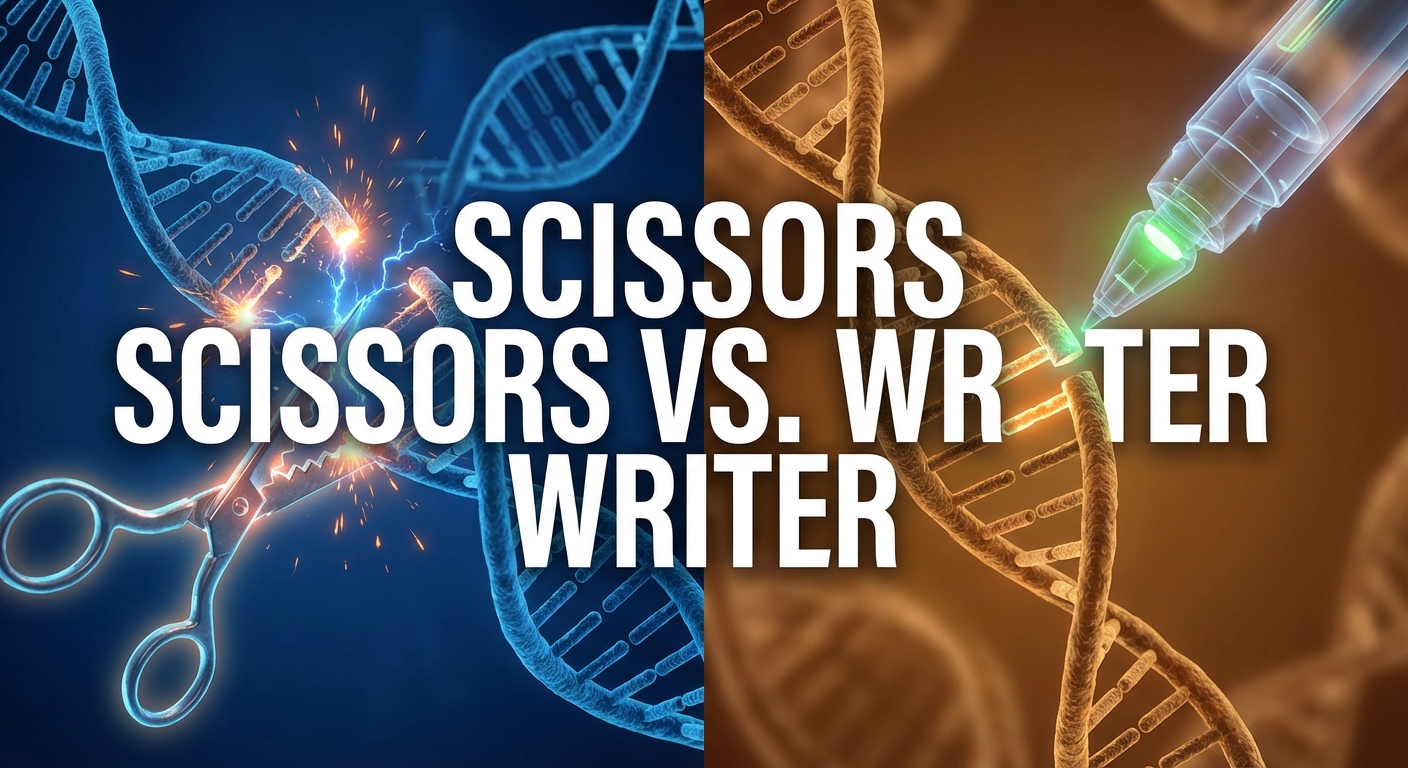
CRISPR-Cas9 functions as “molecular scissors” that cut both strands of DNA to disrupt a gene (ideal for knocking out harmful genes). Prime Editing acts as a “word processor,” using a modified Cas9 nickase and reverse transcriptase to search and replace specific DNA sequences without breaking the helix. While CRISPR is currently more efficient for simple deletions, prime editing offers superior precision for correcting complex point mutations with fewer off-target effects.
1. Molecular Scissors vs. Word Processor
To understand which technology will cure your specific genetic disorder, you must understand the tool’s fundamental action. Standard CRISPR-Cas9 relies on a crude but effective mechanism: the Double-Strand Break (DSB). It slices through the DNA helix entirely, forcing the cell to panic and attempt a repair.
This repair process (Non-Homologous End Joining) is messy. It often results in random insertions or deletions (indels). This is perfect if your goal is to break a gene—for example, destroying the gene that suppresses fetal hemoglobin in Sickle Cell patients. However, if you need to fix a specific letter (e.g., changing an ‘A’ to a ‘T’), CRISPR is like trying to fix a typo with a sledgehammer.
Prime Editing changes the game. As detailed in our comprehensive comparison of base and prime editing, this technology does not snap the DNA in half. Instead, it uses a “nickase” to cut just one strand. It then uses an enzyme called reverse transcriptase to copy a new, correct sequence of DNA directly into the site. It is slower, but infinitely more precise.
2. The Safety Gap: Double-Strand Breaks
The primary concern with standard CRISPR therapies is safety. When DNA is cut completely (DSB), it can lead to unintended consequences that regulators fear.
- Translocations: Loose ends of DNA can reattach to the wrong chromosomes.
- p53 Activation: The cell may recognize the break as severe damage and trigger suicide (apoptosis), or worse, select for cells that have damaged p53 mechanisms (a cancer risk).
- Unwanted Indels: According to studies on therapeutic options, standard CRISPR can introduce random mutations near the target site.
Prime Editing mitigates these risks by avoiding the DSB entirely. Because it only nicks one strand and uses a template to write the repair, the risk of “off-target” chaos is significantly lower. This makes it the preferred candidate for treating diseases in sensitive tissues where cell death is not an option.
3. Clinical Reality: Which Disorders Fit Which Tool?
Despite the elegance of prime editing, standard CRISPR is winning the race to the clinic today. Why? Because breaking things is easier than fixing them.
The CRISPR Sweet Spot (Knockouts):
Diseases like Sickle Cell Disease and Beta-Thalassemia are currently treated by disabling a gene (BCL11A). You don’t need elegance; you just need the gene to stop working. This is why therapies like Casgevy are already approved. For more on these approvals, read our report on CRISPR success rates.
The Prime Editing Sweet Spot (Corrections):
Prime editing is essential for diseases caused by specific point mutations where the gene must be preserved, not destroyed. Examples include:
- Tay-Sachs Disease: Requires a precise 4-base insertion correction.
- Cystic Fibrosis: Often caused by a specific deletion (deltaF508) that prime editing can rewrite.
- Progeria: A single letter mutation that causes rapid aging, requiring a precise C-to-T swap.
4. Why Isn’t Prime Editing Used Everywhere Yet?
If prime editing is safer and more precise, why aren’t we using it for everything? The answer lies in delivery and efficiency.
The Prime Editor protein is massive. It is a fusion of a Cas9 molecule and a reverse transcriptase enzyme. Physically fitting this giant molecule into a delivery vector (like an AAV virus) to get it inside a human cell is an engineering nightmare. Furthermore, efficiency rates in vivo are still lower than the brutal efficiency of standard Cas9 cuts.
Recommended Reading:
To understand the history of these discoveries, Walter Isaacson’s biography of the pioneers is unmatched.

Recommended Reading:
For a deep dive into the ethics of rewriting the human genome, we recommend A Crack in Creation.

Frequently Asked Questions
Can prime editing fix all genetic diseases?
Theoretically, prime editing can correct about 89% of known pathogenic genetic variants. However, it struggles with very large insertions or deletions that exceed the capacity of its guide RNA template.
Is prime editing more expensive than CRISPR?
Currently, yes. Because it is a newer technology with more complex manufacturing requirements (due to the size of the protein), the cost of gene therapies utilizing prime editing is expected to be higher initially until manufacturing processes standardize.
Does prime editing cause off-target effects?
Prime editing has a much lower rate of off-target effects compared to CRISPR-Cas9. This is because the editing event requires three separate molecular steps to align perfectly, making accidental edits highly unlikely.
What is the ‘pegRNA’ in prime editing?
The pegRNA (prime editing guide RNA) is the special instruction manual used in prime editing. Unlike standard CRISPR RNA which just points to the target, pegRNA contains both the address and the new genetic text to be written.
Are there clinical trials for prime editing yet?
As of late 2024/early 2025, prime editing is moving rapidly toward clinical trials, particularly for liver and eye diseases, but it trails behind standard CRISPR which has already achieved FDA approvals.