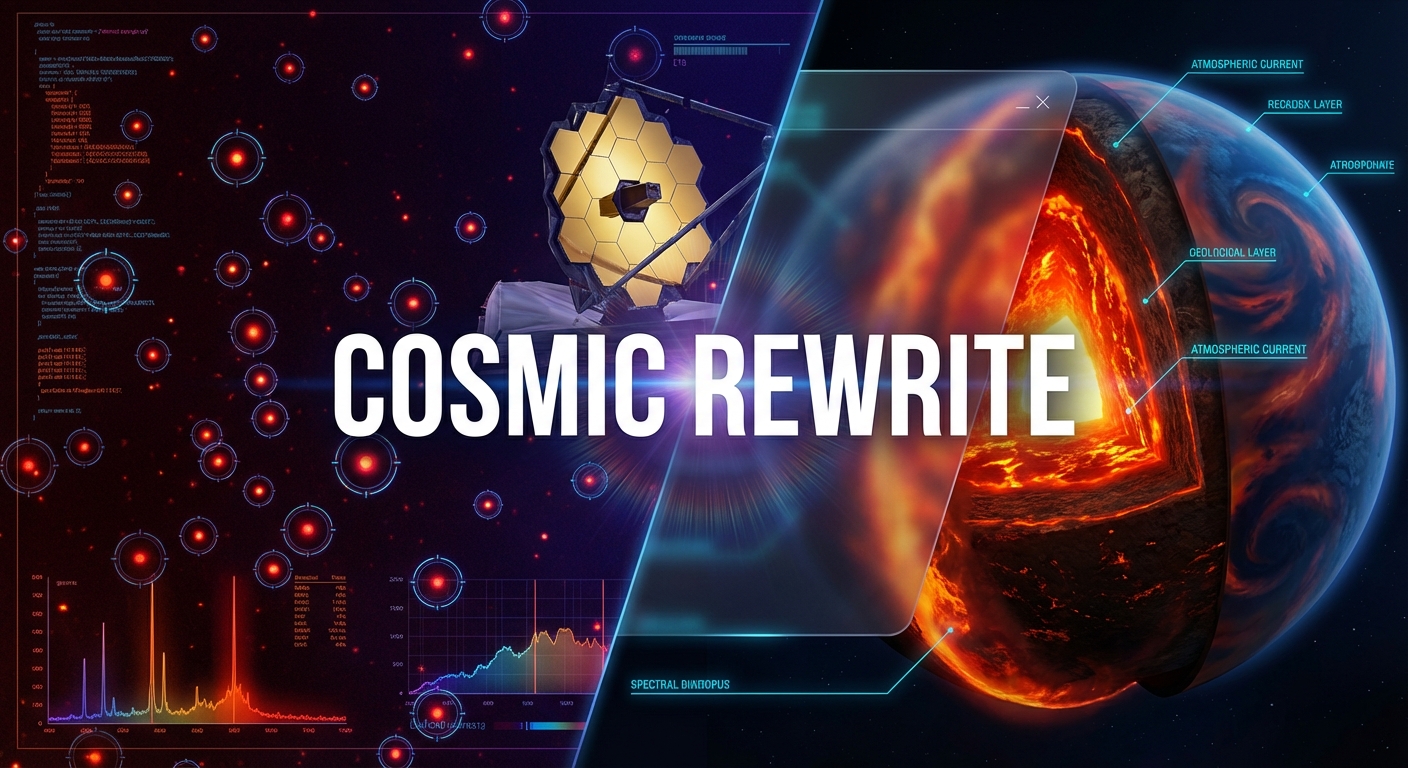
- Direct Answer: The Top JWST Discoveries of 2025
- 1. The “Little Red Dots”: Early Universe Black Holes
- 2. Exoplanet Atmospheres: The Wet Lava Worlds
- 3. The Hubble Tension: A Universe Evolving Too Fast
- 4. Galactic Shapeshifters: The “Virgil” Mystery
- 5. The Cosmic Dawn: Seeing the First Starlight
- 6. Recommended Gear for Space Enthusiasts
- Frequently Asked Questions
What are the best JWST discoveries of 2024 and 2025?
The most significant discoveries include the identification of “Little Red Dots”—compact, ancient galaxies housing supermassive black holes just 570 million years after the Big Bang, which challenges standard growth models. Other major findings include the characterization of exoplanet atmospheres on rocky worlds like 55 Cancri e (detecting likely lava oceans) and confirming the rapid maturation of spiral galaxies in the early universe, suggesting the cosmos evolved faster than previously thought.
1. The “Little Red Dots”: Early Universe Black Holes
If you ask any astronomer what the most disruptive finding of 2025 has been, they will likely point to the “Little Red Dots.” These innocent-sounding objects have created a massive headache for cosmologists—in the best way possible.
The Discovery:
Deep in the James Webb Space Telescope’s deep space imaging fields, researchers found tiny, distinct red specks appearing at redshifts of z=4 to z=8. Initially thought to be standard galaxies, spectral analysis revealed they are actually supermassive black holes (SMBHs) that are far too massive for their age. Some of these monsters existed mere hundreds of millions of years after the Big Bang.
The Mechanism (Why it matters):
Standard physics suggests black holes grow by slowly eating gas or merging with other black holes over billions of years. However, finding such massive holes so early is like walking into a nursery and finding a toddler who is six feet tall. It implies a mechanism known as “Direct Collapse,” where massive clouds of primordial gas collapsed directly into black holes, skipping the star formation phase entirely. This fundamentally rewrites the timeline of the early universe.
2. Exoplanet Atmospheres: The Wet Lava Worlds
While looking at the edge of time is fascinating, the JWST is also acting as the ultimate planetary weatherman. In 2024 and 2025, the telescope turned its Near-Infrared Spectrograph (NIRSpec) toward rocky exoplanets, achieving a feat Hubble never could: analyzing the air of Earth-sized worlds.
The Case of 55 Cancri e:
This planet, often called a “Hell World,” orbits so close to its star that its surface is likely molten. Webb’s data detected a thick envelope of gases, suggesting a secondary atmosphere dominated by carbon or even silicates. Essentially, it is a “wet lava ball”—a planet with a magma ocean that constantly outgases to replenish its atmosphere.
How Webb Does It:
To learn more about the technical process, you can read our guide on how Webb discovers exoplanets. In short, Webb waits for the planet to pass in front of its star. As starlight filters through the planet’s atmosphere, different gases absorb specific colors of light. Webb reads these missing colors (absorption spectra) to determine if the planet has water, methane, or carbon dioxide.
3. The Hubble Tension: A Universe Evolving Too Fast
One of the quietest yet most profound crises in modern physics is the “Hubble Tension”—a discrepancy in the measurement of how fast the universe is expanding. Webb was expected to resolve this; instead, it might have deepened the mystery.
The Conflict:
Measurements taken from the early universe (Cosmic Microwave Background) predict a specific expansion rate. Measurements from the local universe (supernovae) show a faster rate. In 2025, Webb’s precise observations of Cepheid variable stars (standard candles used to measure distance) confirmed that the local measurements are accurate. The telescope’s resolution allowed it to separate these stars from crowding dust, removing potential errors.
The Implication:
This means our model of the universe is missing something fundamental. It could be a new particle, a misunderstood property of Dark Energy, or a flaw in our understanding of gravity itself. Webb has effectively proven that the universe is evolving faster than our math says it should.
4. Galactic Shapeshifters: The “Virgil” Mystery
A fascinating 2025 update from the ESA/Webb archive involves objects that look completely different depending on how you view them. The prime example is a galaxy nicknamed “Virgil.”
The Jekyll and Hyde Effect:
In visible light (what our eyes see), Virgil appears to be a quiet, dead galaxy. But when viewed through Webb’s Mid-Infrared Instrument (MIRI), it lights up like a Christmas tree. The infrared view penetrates thick curtains of dust to reveal a raging, active black hole at its center.
Why This Happens:
Dust blocks short wavelengths (visible light) but allows long wavelengths (infrared) to pass through. This discovery warns astronomers that our previous census of the universe—mostly done in visible light—likely missed millions of active galaxies simply because they were hiding behind dust curtains.
5. The Cosmic Dawn: Seeing the First Starlight
Webb’s primary mission was to see the “First Light”—the moment the lights turned on in the universe. In late 2024 and throughout 2025, it delivered.
Population III Stars:
Theorists have long hypothesized the existence of “Population III” stars—the first generation of stars made purely of hydrogen and helium, with no heavy metals. Webb has found indirect evidence of these stars by analyzing the chemical composition of extremely distant gas clouds. These stars were likely massive, hot, and short-lived, exploding as supernovae that seeded the universe with the first elements for life (carbon, oxygen, iron).
This connects deeply to our understanding of our own origins. Just as we trace our biological lineage through fossils (like the Ledi-Geraru discovery), Webb traces our chemical lineage back to these first stellar furnaces.
6. Recommended Gear for Space Enthusiasts
If reading about these discoveries has reignited your passion for the cosmos, you don’t need a billion-dollar space telescope to get started. Here are two ways to bring the universe into your home.
For the Builder: Metal Earth JWST Model
This intricate 3D model allows you to build a replica of the James Webb Telescope. It’s a fantastic desk piece that features the iconic gold hexagonal mirrors.

For the Observer: Gskyer 70mm Telescope
While you can’t see infrared like Webb, a solid amateur telescope will let you see the rings of Saturn, the moons of Jupiter, and the Orion Nebula with your own eyes.

Frequently Asked Questions
What is the most important discovery JWST made in 2025?
The consensus among astronomers is the confirmation of “Little Red Dots” as early-universe supermassive black holes. This discovery challenges the “accretion” model of black hole growth and suggests that massive black holes formed much faster—or via different methods—than previously believed.
Did the Webb Telescope find life in 2025?
No, it has not found definitive proof of life. However, it has detected “biosignature candidates” like methane and carbon dioxide in the atmospheres of planets like K2-18 b. These are promising signs, but further data is required to rule out non-biological geological processes.
How far back in time can James Webb see?
JWST can see back to approximately 100 to 200 million years after the Big Bang. This is the era of “First Light,” where the very first stars and galaxies began to form from the primordial hydrogen fog.
Why are the pictures from Webb so different from Hubble?
Hubble observes primarily in visible and ultraviolet light (what our eyes see). Webb observes in infrared light (heat). Infrared can penetrate dust clouds that block visible light, allowing Webb to see inside stellar nurseries and spot galaxies that are much further away (and thus more redshifted).
What is the “Hubble Tension”?
The Hubble Tension is a major problem in physics where the universe appears to be expanding at different rates depending on how you measure it. Webb’s 2025 data confirmed that the local measurements are accurate, meaning the discrepancy is real and our current model of the universe needs to be adjusted.