- Direct Answer: RISC-V vs ARM vs x86 Architecture Differences
- 1. The ISA Wars: CISC vs. RISC vs. Open Source
- 2. The “Royalty-Free” Revolution: Why Startups Choose RISC-V
- 3. Performance Reality Check: Can RISC-V Game?
- 4. The AI Advantage: Modular Customization in Machine Learning
- 5. Ecosystem Maturity: The Software Bottleneck
- 6. Recommended Solution: Start Developing Today
- Frequently Asked Questions
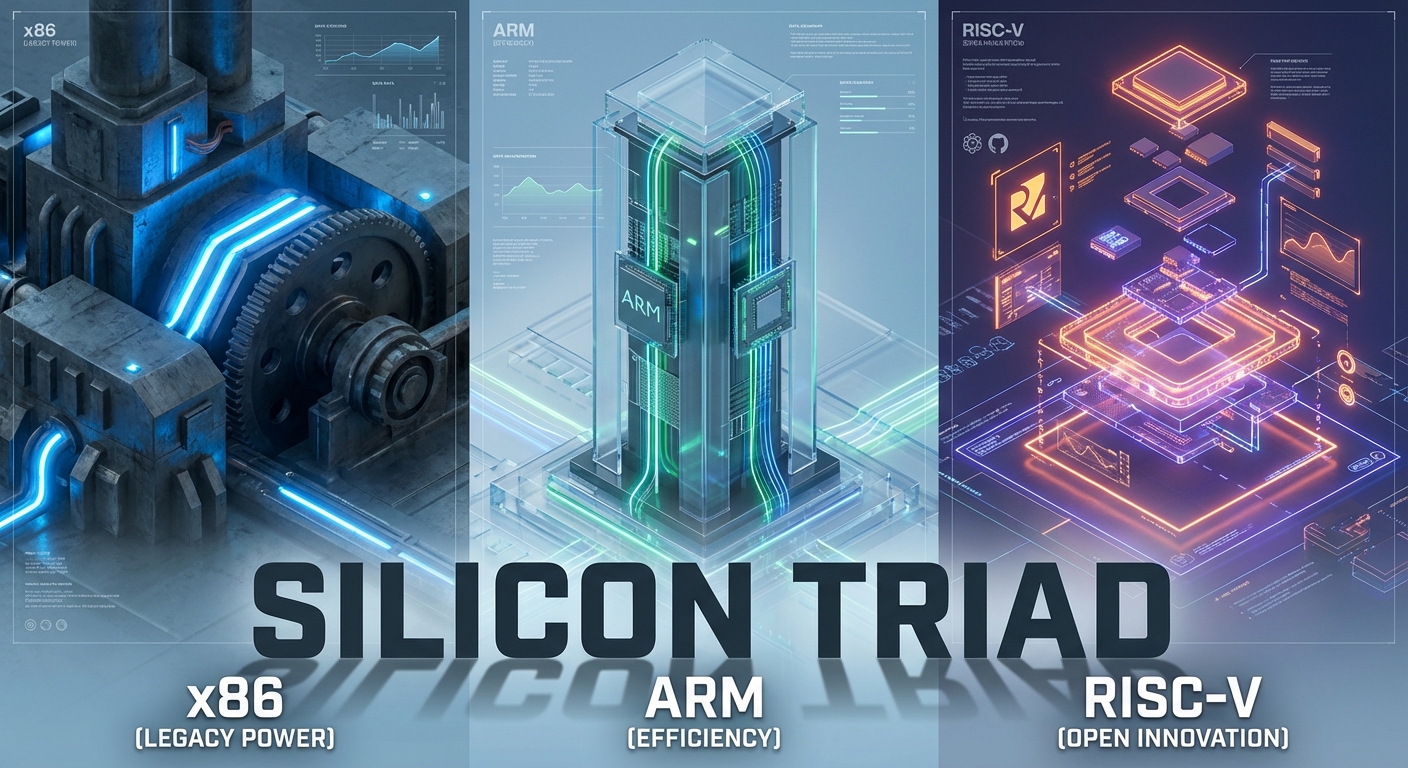
The primary difference in RISC-V processor adoption vs x86 vs ARM architecture lies in licensing and instruction sets. x86 (Intel/AMD) is a high-performance, proprietary CISC architecture dominant in desktops/servers. ARM is a power-efficient, licensed RISC architecture ruling mobile (95% share). RISC-V is an open-source, royalty-free RISC standard allowing extreme modularity, currently seeing 30% annual growth in embedded systems and AI workloads.
1. The ISA Wars: CISC vs. RISC vs. Open Source
To understand the current shift in the semiconductor landscape, you must first understand the underlying “language” these processors speak: the Instruction Set Architecture (ISA). The battle is no longer just about speed; it is about the philosophy of ownership and efficiency.
x86: The Complex Giant (CISC)
The x86 architecture, championed by Intel and AMD, utilizes Complex Instruction Set Computing (CISC). This allows a single instruction to execute multi-step operations. While this provides massive raw performance for legacy software and heavy computational tasks (gaming, servers), it comes with a “bloat” penalty—requiring more silicon area and power to decode these complex instructions.
ARM: The Efficient Ruler (RISC)
ARM (Advanced RISC Machine) stripped down the instruction set to Reduced Instruction Set Computing (RISC). By simplifying instructions, ARM chips consume significantly less power, which is why they dominate the mobile flagship market. However, ARM is a proprietary product. If you want to build an ARM chip, you must pay licensing fees and royalties to Arm Holdings.
RISC-V: The Open Challenger
RISC-V is also a RISC architecture, but it is unique because it is open-source. It is not a processor *design* but a *standard*. Anyone can build a RISC-V chip without paying a cent in royalties. This lack of licensing friction has accelerated its adoption in semiconductor manufacturing, specifically for custom embedded solutions where every penny counts.
2. The “Royalty-Free” Revolution: Why Startups Choose RISC-V
A common misconception is that companies choose RISC-V solely because it is “cheaper.” While cost is a factor, the true driver is sovereignty. In the traditional model, if a company like Apple or Qualcomm wants to modify an ARM core to better suit their needs, they face strict contract limitations.
The Mechanism of Cost Savings:
With RISC-V, the $0 licensing fee allows companies to reallocate budget toward “Architecture Licenses”—essentially hiring engineers to customize the chip logic itself. According to EE Times, this customizability allows for cost-effective scaling that proprietary models cannot match. A startup building a smart toaster doesn’t need the overhead of a full ARM Cortex core; they can strip a RISC-V core down to the bare essentials, saving silicon area and reducing the Bill of Materials (BOM).
This freedom is critical in a geopolitical context. As nations seek technological independence, RISC-V provides a neutral ground free from the export restrictions that sometimes plague x86 and ARM IP.
3. Performance Reality Check: Can RISC-V Game?
While the hype is real, the performance reality is nuanced. If you are expecting to swap your Intel Core i9 or Apple M4 for a RISC-V desktop CPU tomorrow, you will be disappointed.
The 2-3x Performance Lag:
Current benchmarks indicate that high-end RISC-V implementations still suffer from a 2-3x performance lag compared to top-tier ARM equivalents in general-purpose computing. This is largely due to the maturity of the *microarchitecture*—the physical implementation of the ISA. Intel and ARM have had decades to optimize branch prediction, out-of-order execution, and cache hierarchies. RISC-V designers are catching up, but the gap remains for high-performance desktop tasks.
However, raw speed isn’t the goal for 90% of the market. For microcontrollers, IoT devices, and storage controllers, RISC-V is already “fast enough.” The architecture’s modularity means it doesn’t need to win benchmarks to win market share; it just needs to be efficient enough for the specific task at hand.
4. The AI Advantage: Modular Customization in Machine Learning
The strongest sector for RISC-V adoption is arguably Artificial Intelligence and Machine Learning (AI/ML). This is driven by the architecture’s support for Custom Extensions.
Why x86 Struggles Here:
In x86, the instruction set is fixed. You cannot add a new instruction to accelerate a specific neural network operation without Intel’s permission (which you won’t get). In RISC-V, a company can invent a custom instruction specifically designed to accelerate matrix multiplication—a core task in AI processing—and bake it directly into the hardware.
According to Patent PC, this capability has driven a 60% year-over-year adoption rate in AI/ML sectors. By offloading repetitive AI tasks to custom hardware logic rather than running them in software, RISC-V chips can achieve higher performance-per-watt ratios than general-purpose ARM or x86 cores.
5. Ecosystem Maturity: The Software Bottleneck
The hardware is ready, but is the software? This is the “chicken and egg” problem of any new architecture. x86 has Windows. ARM has Android and iOS. RISC-V is currently building its software foundation.
The RVA23 Profile:
To combat fragmentation, the RISC-V International body introduced profiles like RVA23 to standardize the instruction set for operating systems. This ensures that a Linux distribution compiled for one RISC-V chip works on another. While Celus reports a 30% annual growth projection, widespread consumer adoption relies on robust OS support.
Currently, Linux support is strong, and Android is rapidly maturing on the platform (projected 25% presence by 2026). However, for users relying on legacy Windows applications or proprietary creative suites, x86 remains the only viable option for the immediate future.
6. Recommended Solution: Start Developing Today
For developers, engineers, and enthusiasts looking to future-proof their skills, the best way to understand the architecture is to get hands-on. Unlike the theoretical study of x86, RISC-V offers affordable hardware platforms that run full Linux distributions.
The Developer’s Choice: StarFive VisionFive 2
This is widely considered the “Raspberry Pi” of the RISC-V world. It features a quad-core processor that is powerful enough to run a desktop Linux environment, making it the perfect entry point for testing software compatibility and learning the ISA.

Frequently Asked Questions
Is RISC-V faster than ARM?
Generally, no. In high-performance consumer applications (like smartphones), top-tier ARM cores currently outperform RISC-V designs by a factor of 2-3x. However, in specific custom workloads like AI or simple embedded tasks, a custom RISC-V chip can be more efficient and faster than a generic ARM core.
Can RISC-V run Windows?
Not natively in a way that is consumer-ready yet. While there are proof-of-concept demonstrations, Windows is primarily optimized for x86 and ARM. The primary operating systems for RISC-V currently are various distributions of Linux and RTOS (Real-Time Operating Systems).
Will RISC-V replace x86?
It is unlikely to replace x86 in high-performance desktop gaming and legacy enterprise servers in the next decade due to the massive existing software library. However, it is rapidly replacing proprietary architectures in microcontrollers, IoT, and potentially server-grade accelerators.
What are the main challenges for RISC-V adoption?
The biggest challenge is software ecosystem maturity. While the hardware is capable, thousands of software packages need to be optimized and recompiled for the architecture. Additionally, fragmentation (too many companies creating slightly different custom versions) poses a risk to standard compatibility.
Who owns RISC-V?
No single company owns it. It is managed by RISC-V International, a non-profit organization. This is different from ARM (owned by SoftBank) and x86 (Intel/AMD), making it a geopolitically neutral technology.