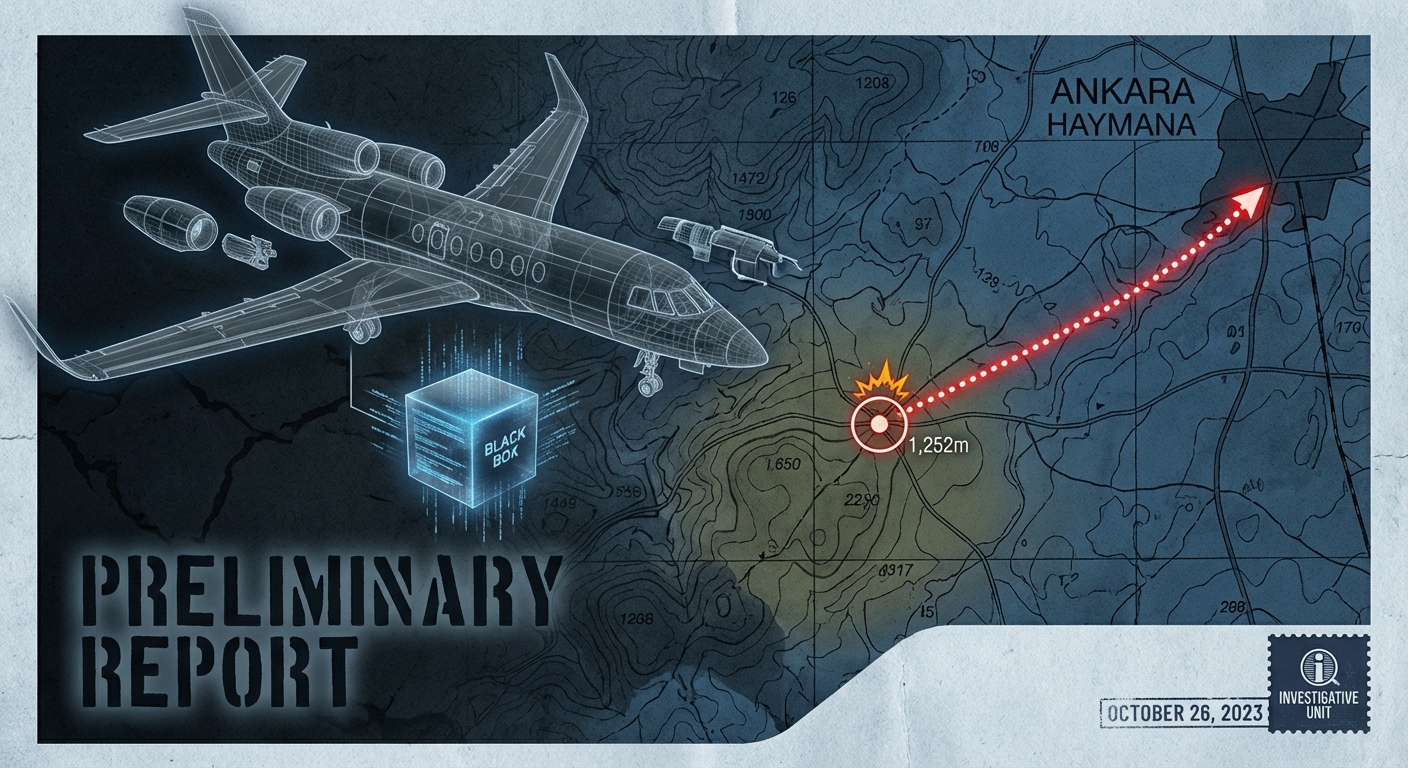
The Libyan military jet crash on December 23, 2025, near Ankara, Turkey, was caused by a suspected electrical failure, according to the preliminary technical report. The Dassault Falcon 50 carrying General Mohammed al-Haddad impacted the Haymana hillside at 1,252 meters with engines running at high speed. Investigators confirmed there was no evidence of an in-flight fire or explosion, effectively ruling out immediate speculation of a missile strike or internal bomb.
The Incident: December 23, 2025
On the evening of December 23, 2025, a tragic aviation disaster unfolded near Ankara, claiming the lives of Libya’s Chief of Staff, General Mohammed al-Haddad, his entourage, and the flight crew. The aircraft, a Dassault Falcon 50 (registration 9H-DFS), had just departed from Ankara Esenboga Airport en route to Tripoli following high-level diplomatic talks.
According to reports from The New Arab, contact was lost approximately 40 minutes after the 8:17 p.m. takeoff. The pilot had communicated a distress signal regarding an “electrical failure” at 8:33 p.m., just minutes before the impact. The wreckage was located on a hillside in the Haymana district, a rugged terrain that complicated immediate recovery efforts.
This event has sent shockwaves through the region, given the delicate political stability in Libya. However, Turkish authorities moved quickly to transparently release preliminary findings to quell unrest. For those following regional security closely, this incident occurred amidst a backdrop of heightened alerts, similar to the situations analyzed in our Turkey Security & Travel Safety Guide.
Preliminary Report: Engines Running at Impact
The most significant revelation from the preliminary investigation is the state of the engines upon impact. Contrary to theories of engine flameout or fuel starvation, the report confirms that the engines were operational and running at high speed when the plane hit the ground.
Why This Matters:
In aviation accident investigation, “engines running at impact” is a critical data point. It tells investigators that:
- Fuel Supply was Intact: The engines were receiving fuel.
- Mechanical Integrity: The turbines were rotating, meaning the crash was not caused by a total mechanical seizure of the powerplants.
- High Energy Impact: The plane struck the hillside at significant velocity, which unfortunately correlates with the high fatality rate.
The absence of an in-flight explosion is equally telling. The wreckage field suggests a Controlled Flight Into Terrain (CFIT) scenario precipitated by technical failure, rather than a mid-air disintegration. As noted by Hurriyet Daily News, the plane was “intact” until the moment it struck the 1,252-meter elevation point.
The ‘Electrical Failure’ Theory Explained
The pilot’s final transmission cited “electrical failure.” In a complex tri-jet like the Falcon 50, a total electrical failure at night is catastrophic. It leads to the loss of critical flight instruments, navigation displays, and interior lighting.
The Mechanism of Disorientation:
Without electrical power, the pilot may lose the Artificial Horizon (Attitude Indicator). In the pitch-black conditions over the Haymana hills, this results in “spatial disorientation.” The pilot can no longer distinguish up from down. Even if the engines are screaming at full power (as the report indicates), a pilot unable to reference the horizon may unknowingly fly a perfectly capable aircraft directly into the ground.
This aligns with the findings that the aircraft had undergone maintenance between December 1 and December 9. Investigators will now be scrutinizing the maintenance logs to see if a recent repair to the electrical bus or generator systems was performed incorrectly.
Ruling Out Sabotage & Terrorism
Whenever a high-ranking military figure dies in a crash, conspiracy theories abound. However, the physical evidence currently rules out sabotage.
The Evidence Against a Bomb:
If a bomb had detonated, the wreckage field would be vast, with debris scattered over kilometers due to mid-air breakup. The fuselage would show signs of outward petal-ing (metal bent outwards from an explosive force). Instead, the debris field is consistent with a high-speed impact on the ground. Turkish officials have stated there are no links to terrorism or espionage.
To stay updated on how this story evolves globally, check our daily global news briefings, which are tracking the diplomatic fallout of this event.
Context: Recent Aviation Safety Incidents
The Ankara crash is unfortunately not an isolated incident of high-altitude aviation tragedy this month. It shares grim similarities with the recent helicopter disaster on Mount Kilimanjaro.
In both cases, we see the lethal combination of challenging terrain and sudden technical or environmental stressors. While the Kilimanjaro incident was a rescue mission and the Libya crash was a diplomatic transport, both underscore the unforgiving nature of flight when systems fail near terrain. You can read our full analysis of the Kilimanjaro Helicopter Crash here.
Recommended Resources for Aviation Safety
For those interested in the science of how investigators piece together crashes like the Falcon 50 incident, studying the history of the “Black Box” is essential. These devices, currently being analyzed in London for the Libya crash, are the only witnesses that tell the full truth.
1. The Definitive Guide to Crash Forensics

Beyond the Black Box provides a technical yet accessible look into how investigators use physics and data to reconstruct the final moments of a flight. It is essential reading for understanding reports like the one released by the Turkish authorities.
2. The Narrative of Disaster Investigation

The Crash Detectives focuses on the human element and the complex puzzles behind famous crashes. It helps contextalize why the “human factor” (like pilot response to electrical failure) is often the final link in the chain of errors.
Frequently Asked Questions
Who was on the Libyan plane that crashed in Turkey?
The primary passenger was General Mohammed al-Haddad, the Chief of Staff of the Libyan Army. He was accompanied by several aides and a flight crew, all of whom perished in the crash.
What caused the Falcon 50 crash in Ankara?
Preliminary reports indicate a massive electrical failure occurred shortly after takeoff. The loss of electrical systems likely led to instrument failure and spatial disorientation at night, resulting in a collision with the hillside.
Was the Libyan General’s plane shot down?
No. Investigators found no evidence of external impact, shrapnel, or in-flight explosion. The engines were running at high speed upon impact, which is consistent with a crash caused by technical failure or pilot error, not a missile strike.
What is a Falcon 50 jet?
The Dassault Falcon 50 is a French-made super-midsize business jet featuring a unique tri-jet (three engine) layout. It is known for its range and performance, making it a popular choice for government and military transport roles.
Where did the crash happen?
The crash occurred in the Haymana district of the Ankara province in Turkey, approximately 1,252 meters above sea level on a hillside.