- Quick Summary: The 5G Streaming Revolution
- 1. Bandwidth Expansion: The Era of Seamless 4K and 8K
- 2. Ultra-Low Latency: Why ‘Live’ Finally Means Live
- 3. Network Slicing & Capacity: Streaming in Crowds
- 4. Remote Production: Cloud Workflows for Creators
- 5. Beyond Video: VR, AR, and Volumetric Streaming
- Recommended Solution: Professional 5G Hotspot
- Frequently Asked Questions
5G impacts streaming by increasing network bandwidth by up to 100x and reducing latency to under 10 milliseconds. This enables seamless 4K/8K mobile streaming, eliminates buffering in crowded areas via Massive MIMO, and facilitates real-time interactivity for live sports and cloud gaming. It transforms media from a passive viewing experience into an immersive, instant interaction.
1. Bandwidth Expansion: The Era of Seamless 4K and 8K
The most immediate consumer benefit of 5G is the sheer size of the data pipe. While 4G networks often struggle to maintain a stable 1080p stream during peak hours, 5G’s expanded spectrum (specifically mmWave high-band frequencies) opens the door for massive data throughput.
The Technical Mechanism:
4G LTE networks typically cap out at roughly 100 Mbps in real-world scenarios. 5G can theoretically reach speeds of 10-20 Gbps. This massive increase in throughput means that data-heavy formats like 4K and 8K HDR video can be streamed wirelessly without compression artifacts or the dreaded loading spinner. You can learn more about the foundational technology in our guide to how 5G supercharges internet speed.
Why It Matters:
For content platforms like Netflix or YouTube, this eliminates the need for aggressive compression algorithms that degrade picture quality. For the viewer, it means the “quality” toggle can remain permanently set to “Ultra HD,” regardless of whether you are on Wi-Fi or cellular data.
2. Ultra-Low Latency: Why ‘Live’ Finally Means Live
High speed is great for downloading movies, but low latency is what revolutionizes live streaming. Latency is the delay between the camera capturing an image and that image appearing on your screen. On 4G, this delay is typically 30-50 milliseconds (plus buffering time), resulting in a 30-second lag behind real-time action.
The Shift to Real-Time:
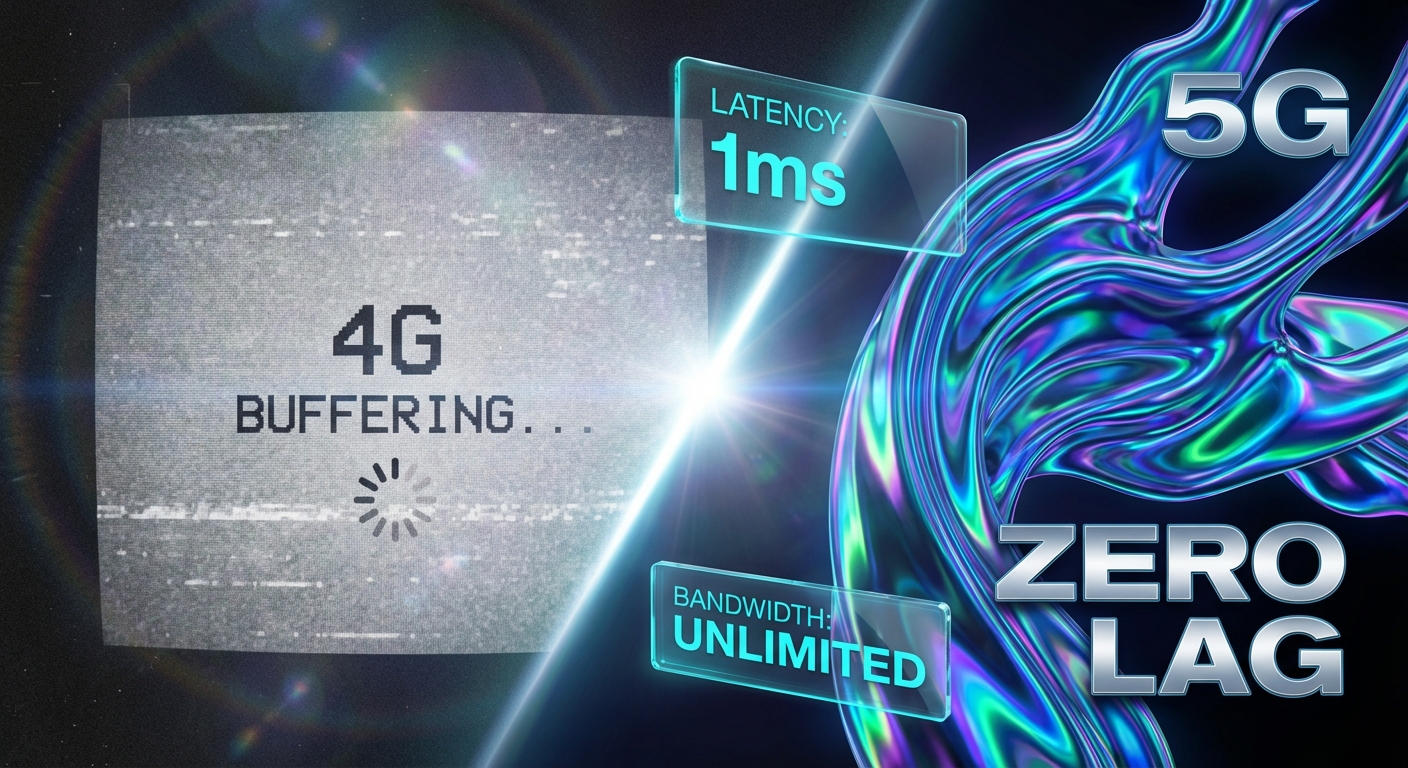
5G reduces this network latency to as low as 1 millisecond. This near-instant response time is critical for interactive content. According to Verizon, this shift allows for real-time betting, synchronized multi-angle viewing, and instant audience voting during live broadcasts. If you are watching a football game, you will see the goal on your phone at the exact same moment the crowd roars in the stadium.
A Common Misconception:
Many people believe latency only matters for gamers. However, for live news coverage—like real-time global press briefings—low latency ensures that financial traders and journalists receive information the second it is spoken, not 45 seconds later.
3. Network Slicing & Capacity: Streaming in Crowds
We have all experienced the frustration of trying to stream a video at a concert or stadium, only to have the connection fail because thousands of people are using the tower simultaneously. This is a capacity issue, not a coverage issue.
The Solution: Massive MIMO and Network Slicing:
5G utilizes Massive MIMO (Multiple Input Multiple Output) technology, which uses dozens of antennas on a single tower to handle more simultaneous connections. Furthermore, 5G introduces Network Slicing. This allows operators to create a virtual “slice” of the network specifically dedicated to video streaming services, guaranteeing bandwidth even when the rest of the network is congested.
The Result:
This ensures a consistent Quality of Experience (QoE). You can stream a replay of the touchdown while sitting in a stadium of 80,000 people, and the video will play instantly.
4. Remote Production: Cloud Workflows for Creators
For content creators and broadcasters, 5G changes how video is produced. Traditionally, live broadcasting required massive satellite trucks (OB vans) and miles of cabling. 5G enables Remote Production over the cellular network.
How It Works:
Cameras equipped with 5G encoders send raw footage directly to the cloud for editing and mixing. The production team doesn’t need to be on-site; they can switch camera angles and add graphics from a studio halfway across the world. According to the GSMA, this can reduce the cost of live event production by up to 90%, democratizing high-quality live streams for smaller creators and niche sports leagues.
5. Beyond Video: VR, AR, and Volumetric Streaming
Finally, 5G opens the door for media formats that were previously impossible to stream wirelessly. This includes 360-degree 8K video, Virtual Reality (VR), and Augmented Reality (AR) overlays.
The Bandwidth Requirement:
Streaming a high-fidelity VR experience requires roughly 4-5 times the bandwidth of a standard 4K video. 5G provides the throughput necessary to render these volumetric worlds in the cloud (Edge Computing) and stream the visuals to your headset, removing the need for heavy, expensive processing hardware on the user’s face.
Recommended Solution: Professional 5G Hotspot
To truly experience the benefits of 5G streaming—especially if you are a creator needing to upload 4K footage from the field or a traveler wanting seamless entertainment—relying on your phone’s battery isn’t enough. A dedicated mobile hotspot ensures you get the maximum throughput of the mmWave spectrum.
We recommend the NETGEAR Nighthawk M6 Pro. It is one of the few unlocked devices that supports mmWave, WiFi 6E, and speeds up to 8Gbps, making it a portable studio for streamers.

Frequently Asked Questions
How does 5G improve live sports streaming?
5G improves live sports through ultra-low latency and multi-angle viewing. It reduces the delay between the live action and your screen, allowing for real-time betting and interaction. It also supports high-bandwidth streams that let users switch between different 4K camera angles instantly on their devices.
Will 5G make buffering completely disappear?
In areas with proper 5G coverage, yes. 5G’s bandwidth is significantly higher than the bitrate required for 4K streaming. Buffering is usually caused by a lack of data speed; 5G provides a “pipe” large enough that the video buffer fills faster than it plays, eliminating pauses.
Does 5G use more data for streaming?
Technically, the video file size is the same, but because 5G allows for higher quality (bitrate) streams, apps like Netflix may automatically switch to the highest resolution available (4K/8K), which does consume more data. Users on capped data plans should monitor their usage or adjust app settings.
What is network slicing in 5G streaming?
Network slicing is a virtual architecture that allows operators to dedicate a specific portion of the 5G network to a single task—like video streaming or emergency services. This guarantees that your movie stream doesn’t slow down just because other users on the network are downloading large files.
Can I stream 8K video on 5G?
Yes. 8K video typically requires a connection speed of 50-100 Mbps. 5G networks, especially those using mmWave technology, can easily sustain speeds over 1,000 Mbps (1 Gbps), making wireless 8K streaming not just possible, but smooth.