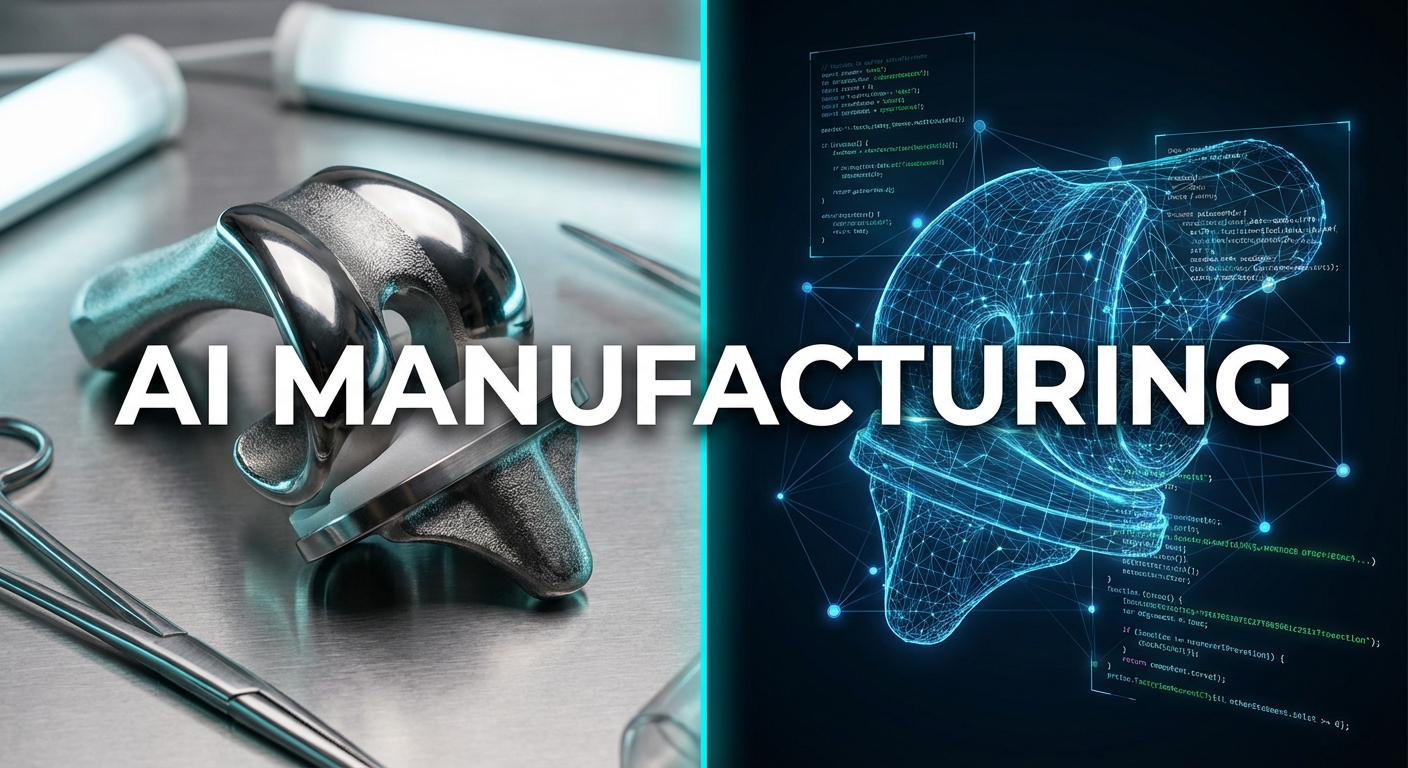
AI in medical device manufacturing refers to the integration of machine learning algorithms to optimize the entire product lifecycle—from generative design prototyping to automated quality control and supply chain management. By utilizing tools like predictive maintenance and computer vision, manufacturers can reduce defect rates, ensure FDA compliance, and accelerate the production of high-precision devices like implants and diagnostic scanners.
1. Generative Design: Beyond Human Engineering
The traditional design process for medical devices is linear: an engineer creates a CAD model, tests it, identifies a failure point, and redesigns it. Artificial Intelligence has fundamentally disrupted this workflow through generative design. Instead of drawing a specific shape, engineers now input constraints—such as weight, material strength, and FDA durability requirements—and the AI generates thousands of potential permutations in seconds.
How It Works: Generative algorithms (often based on evolutionary logic) simulate “survival of the fittest” for engineering. For example, when designing a titanium spinal implant, the AI might suggest an organic, lattice-like structure that uses 30% less material than a solid block but offers superior osseointegration (bone growth) and structural integrity. These complex geometries are often impossible for a human to conceive but are easily manufacturable via 3D printing (additive manufacturing).
The Strategic Advantage: This is not just about aesthetics; it is about patient outcomes. Lighter, stronger implants reduce recovery times and surgical fatigue. Furthermore, using advanced machine learning models allows for patient-specific customization, where an AI can ingest a patient’s CT scan and generate a bespoke device fitted to their unique anatomy within hours.
Common Misconception: Many assume generative design is fully autonomous. In reality, it requires a “human-in-the-loop.” The AI proposes options, but a qualified engineer must validate the manufacturability and regulatory viability of the design before it moves to prototyping.
2. Automated Quality Control & Vision Systems
In the medical device industry, a defect is not just a refund request; it is a potential lawsuit or a life-safety hazard. Consequently, quality control (QC) is the single most critical phase of manufacturing. Traditional manual inspection is slow, subjective, and prone to fatigue. AI-powered computer vision systems are replacing these manual checks with microscopic precision.
The Mechanism: High-resolution cameras capture images of the product on the assembly line. These images are fed into a Convolutional Neural Network (CNN) trained on thousands of examples of “good” and “bad” units. Unlike simple pixel-matching software, these AI models understand texture, depth, and context. They can detect microscopic hairline fractures, coating inconsistencies, or contamination that the human eye would miss.
Real-World Application: According to industry reports, companies like GE Healthcare and Siemens have integrated these systems to inspect complex electronics in MRI machines. By catching defects at the component level (before final assembly), manufacturers save millions in rework costs. This aligns with the broader trend of robotics applications transforming manufacturing, where vision systems guide robotic arms to sort and discard defective parts automatically.
Recommended Resource: For those looking to understand the broader ecosystem of AI in this sector, this comprehensive guide offers a deep dive into the technology reshaping healthcare.

3. Predictive Maintenance with Digital Twins
Unplanned downtime is the enemy of efficiency. In medical device manufacturing, where sterilization and precision environment controls are mandatory, a machine failure can ruin entire batches of product. Predictive maintenance uses AI to foresee equipment failure before it happens, often utilizing a concept known as the Digital Twin.
What is a Digital Twin? A Digital Twin is a virtual replica of a physical machine or production line. IoT sensors on the factory floor stream real-time data—temperature, vibration, acoustics, and power consumption—to the digital model. The AI analyzes this stream to establish a “baseline” of normal operation.
The Predictive Power: When a bearing inside a CNC machine begins to wear, it emits a vibration frequency that is imperceptible to humans but obvious to an AI model. The system flags this anomaly and alerts the maintenance team: “Replace Bearing X in 48 hours to prevent failure.” This shifts the maintenance strategy from “Reactive” (fixing it after it breaks) to “Proactive,” ensuring continuous operation.
According to NVIDIA, the integration of these sophisticated sensor networks is a key driver in the “software-defined” evolution of medical devices, ensuring that the manufacturing equipment itself is as advanced as the products it creates.
4. Supply Chain & Demand Forecasting
The medical device supply chain is notoriously complex, involving strict cold-chain requirements for reagents and traceability for every component. AI algorithms excel at multivariate analysis, allowing manufacturers to optimize their supply chains in ways that spreadsheets cannot.
Optimization Techniques:
- Demand Forecasting: AI models analyze historical sales data, seasonal flu trends, and even hospital admission rates to predict surges in demand for specific devices (like ventilators or testing kits).
- Dynamic Routing: Logistics algorithms adjust shipping routes in real-time based on weather, traffic, and fuel costs to ensure time-sensitive medical components arrive within their sterility window.
- Inventory Management: By predicting raw material needs, manufacturers can carry less “safety stock” (reducing overhead) while eliminating the risk of stockouts during critical production runs.
This level of agility is essential for maintaining regulatory compliance. If a raw material supplier changes a formulation, the AI can instantly flag which product batches are affected, simplifying the recall or verification process.
5. Navigating FDA Compliance for AI Devices
Perhaps the biggest hurdle in this industry is the FDA. The regulatory landscape for Software as a Medical Device (SaMD) and AI-enabled manufacturing is strict. However, AI is now being used to solve the very compliance headaches it creates.
Automated Documentation: FDA compliance requires thousands of pages of documentation proving that a device was manufactured according to Good Manufacturing Practices (GMP). NLP (Natural Language Processing) models can automatically generate these reports by pulling data logs from the manufacturing floor, identifying gaps, and ensuring every step is traceable.
The 510(k) Pathway: For AI-enabled devices themselves, the FDA has released guidelines on how to handle “adaptive” algorithms (models that learn and change over time). Manufacturers must now prove that their AI will not “drift” into unsafe behavior. The FDA’s framework emphasizes “Good Machine Learning Practice” (GMLP), which parallels traditional GMP but focuses on data quality and bias prevention.
Trust Signal: Ignoring these guidelines is a fatal error. Successful manufacturers treat compliance not as a final hurdle, but as a continuous parameter in their generative design algorithms, ensuring that no device is ever designed that cannot be legally sold.
Frequently Asked Questions
How does AI reduce costs in medical device manufacturing?
AI reduces costs primarily through defect reduction and predictive maintenance. By catching errors early (via vision systems) and preventing machine downtime (via digital twins), manufacturers minimize waste and maximize throughput. Additionally, generative design can reduce material usage by optimizing part topology.
What is the difference between SaMD and AI in manufacturing?
SaMD (Software as a Medical Device) refers to software that is the medical product (e.g., an AI algorithm that detects cancer in X-rays). AI in manufacturing refers to the use of AI tools (like robots and sensors) to build the physical device. Both are regulated, but under different frameworks.
Is AI replacing human engineers in this field?
No. AI acts as a “force multiplier.” It handles repetitive tasks like data entry, basic inspection, and initial design iterations, allowing human engineers to focus on complex problem-solving, regulatory strategy, and final safety validation.
Does the FDA approve AI algorithms?
The FDA approves the device or the software based on its safety and efficacy. They have cleared hundreds of AI-enabled devices. The focus is on the Total Product Lifecycle (TPLC), ensuring the AI remains safe even as it updates or encounters new data.
What is a Digital Twin in medical manufacturing?
A Digital Twin is a virtual simulation of a physical manufacturing system. It allows engineers to test changes—like speeding up a conveyor belt or switching a material—in a virtual environment to see the effects before risking physical equipment or product quality.