- Summary: Recent Discoveries in Human Evolution
- 1. The Ledi-Geraru Jaw: Bridging the 3-Million-Year Gap
- 2. Paranthropus boisei: The Hand That Held the Tool
- 3. Drimolen Cave: The Melting Pot of Early Species
- 4. The End of the "March of Progress"
- 5. Methodology: How We Date the Undatable
- Frequently Asked Questions
Recent paleontology discoveries indicate that human evolution was a branching process, not a linear one. Major findings at the Ledi-Geraru site in Ethiopia and Drimolen Cave in South Africa reveal that multiple hominin species, including Australopithecus, Paranthropus, and early Homo, coexisted and competed for resources. Crucially, new fossil evidence suggests that “side branches” like Paranthropus boisei possessed the dexterity to use tools, challenging the theory that tool use was exclusive to the direct human lineage.
1. The Ledi-Geraru Jaw: Bridging the 3-Million-Year Gap
For decades, paleoanthropologists faced a frustrating “black hole” in the fossil record between 3.0 and 2.5 million years ago. This is the critical window where the ape-like Australopithecus afarensis (Lucy’s species) supposedly gave way to the first members of the genus Homo. Recent excavations at the Ledi-Geraru research site in the Afar region of Ethiopia have finally illuminated this dark age.
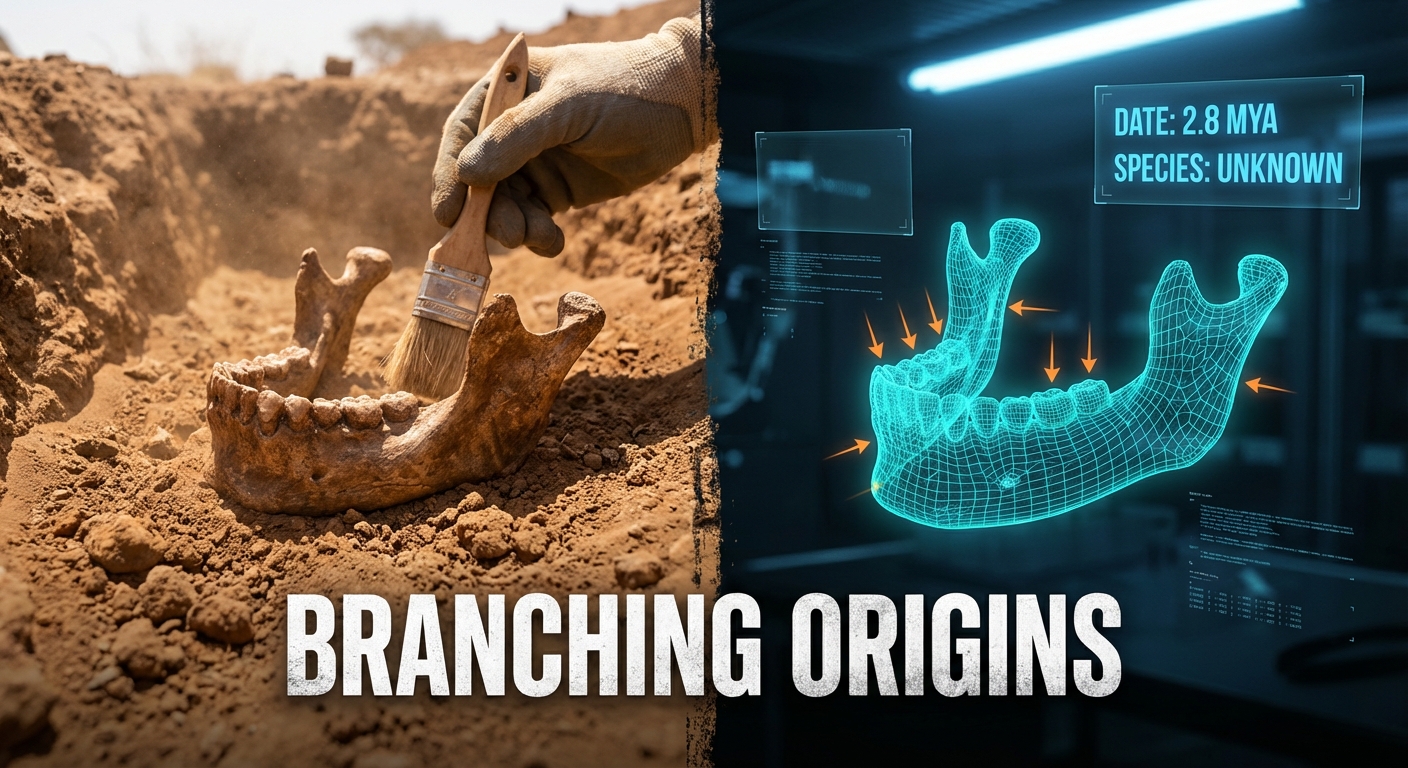
Researchers recovered a mandible (jawbone) labeled LD 350-1, dated to approximately 2.8 million years ago. This fossil exhibits a unique mosaic of traits. While the chin retains the primitive slope of an australopith, the teeth show the slimmer, more uniform proportions characteristic of modern humans. This finding is significant because it pushes the origin of our genus back by 400,000 years, suggesting that Homo evolved much earlier than previously thought, likely in response to rapid climate shifts that turned forests into savannahs.
The implications here are profound. Just as Particle Accelerator Discoveries are currently rewriting the standard model of physics, these fossils are forcing a rewrite of the biological standard model. We can no longer view our history as a straight line; the Ledi-Geraru jaw proves that the transition was gradual, experimental, and localized.
2. Paranthropus boisei: The Hand That Held the Tool
Perhaps the most shocking recent discovery concerns Paranthropus boisei, a species often dismissed as an evolutionary dead-end. Traditionally nicknamed “Nutcracker Man” due to its massive molars and powerful jaw muscles, P. boisei was thought to be a specialized vegetarian that went extinct because it couldn’t adapt. However, new fossils from the Ileret site in Kenya have completely overturned this narrative.
For the first time, scientists have analyzed the hand and foot bones of P. boisei. The analysis reveals a hand with a long, powerful thumb and broad fingertips—traits previously believed to be unique to the tool-making Homo habilis. This anatomical structure suggests that P. boisei had the dexterity to manipulate stones and perhaps fashion primitive tools. If this species could use tools, then the “technological spark” was not unique to modern human ancestors but was a survival strategy adopted by multiple hominin lineages simultaneously.
This finding parallels the complexity we see in modern systems. Much like Semantic Search technologies rely on understanding complex relationships rather than simple keywords, understanding human origins now requires looking at the complex ecological relationships between species, rather than looking for a single “missing link.”
Recommended Resource: Evolution: The Human Story
For a visual guide to these species and their tools, this updated edition by Dr. Alice Roberts offers incredible 3D reconstructions of the fossils discussed above.

3. Drimolen Cave: The Melting Pot of Early Species
Moving south to the “Cradle of Humankind” in South Africa, the Drimolen Cave system has yielded evidence that completely destroys the idea of a single species dominating a landscape. Recent excavations have uncovered the contemporaneous remains of Australopithecus sediba, Paranthropus robustus, and early Homo erectus—all dating to roughly 2 million years ago.
This coexistence is the key finding. It suggests that these species were living side-by-side, likely utilizing different resources to avoid direct competition (niche partitioning). Paranthropus likely focused on hard roots and tubers, while early Homo exploited meat and softer fruits. This biological diversity indicates that early human evolution was not a relay race where one runner passes the baton to the next. It was a rugby scrum.
According to the Smithsonian National Museum of Natural History, these finds at Drimolen provide the earliest definitive evidence of Homo erectus, shifting the potential origin point of our direct ancestor from East Africa to South Africa, or at least suggesting a pan-African distribution much earlier than anticipated.
4. The End of the "March of Progress"
We have all seen the famous illustration: a chimp crouching, slowly standing up taller until he becomes a man in a suit. That image, known as the “March of Progress,” is scientifically dead. The recent discoveries at Ledi-Geraru and Drimolen confirm a Branching Tree Model (cladogenesis) rather than Anagenesis (linear change).
In a branching model, an ancestral population splits into two or more distinct species that continue to evolve independently. This explains why we see “primitive” features (like small brains) persisting in some lineages (like Homo naledi) long after “advanced” features appeared in others. It implies that there is no “goal” to evolution; there is only adaptation to the immediate environment.
A common misconception is that if humans evolved from apes, apes shouldn’t exist. The branching theory solves this: we didn’t evolve from modern apes; we share a common ancestor with them. We are cousins, not descendants. The new fossils clarify that we also had many “human” cousins—like the robust australopiths—who simply didn’t survive the climate fluctuations of the Pleistocene.
5. Methodology: How We Date the Undatable
How do we know the Ledi-Geraru jaw is 2.8 million years old? The certainty of these discoveries relies on advanced Radiometric Dating. In East Africa, volcanic ash layers provide perfect time stamps. Scientists measure the decay of Argon-40 to Argon-39 in volcanic crystals surrounding the fossil.
However, in South African caves like Drimolen, there are no volcanic ash layers. Here, researchers use Uranium-Lead (U-Pb) dating on the flowstones (calcite deposits) that capped the fossils, combined with Paleomagnetism—aligning the magnetic particles in the rock with known reversals of the Earth’s magnetic field. This dual-method approach ensures that when a study claims a fossil is from the “early Pleistocene,” it is a geological fact, not a guess.
Understanding these timelines is crucial. Just as we use timelines to track trends in culture and history, precise geological dating allows us to correlate human development with major climate events, proving that climate change was likely the primary driver of our brain expansion.
Recommended Resource: A Pocket History of Human Evolution
For a quick, accessible breakdown of these dating methods and the family tree, this guide is indispensable for students and enthusiasts.

Frequently Asked Questions
Did humans and Australopithecus live at the same time?
Yes. Recent fossil evidence from Ethiopia and South Africa confirms that early species of Homo lived alongside Australopithecus and Paranthropus for hundreds of thousands of years, likely sharing the same landscape but exploiting different food sources.
What is the significance of the Ledi-Geraru discovery?
The Ledi-Geraru jawbone (LD 350-1) is the oldest known fossil of the genus Homo, dating to 2.8 million years ago. It bridges the gap between the more ape-like Australopithecus afarensis and later humans, showing the earliest transition of dental anatomy.
Could Paranthropus make tools?
New analysis of Paranthropus boisei hand bones suggests they had the grip and dexterity required to make and use tools. This challenges the long-held belief that only the genus Homo was technologically capable.
Is the "March of Progress" image accurate?
No. The linear progression from ape to human is a gross oversimplification. Evolution is a branching process (cladogenesis), resulting in a “bushy” family tree with many dead ends and coexisting species.
Where is Drimolen Cave located?
Drimolen Cave is located within the Cradle of Humankind World Heritage Site in South Africa. It is one of the most productive sites for early hominin fossils, yielding remains of Paranthropus, early Homo, and ancient baboons.