- How International Trade Policy Affects the Economy: The Direct Answer
- How International Trade Policy Steers the Economy
- The Economic Impact of Tariffs: Inflation and Employment
- How Trade Policy Uncertainty Stifles Global Growth
- Do Free Trade Agreements Actually Boost the Economy?
- The Critical Link: Trade Policy and Global Supply Chains
- Frequently Asked Questions
How International Trade Policy Affects the Economy: The Direct Answer
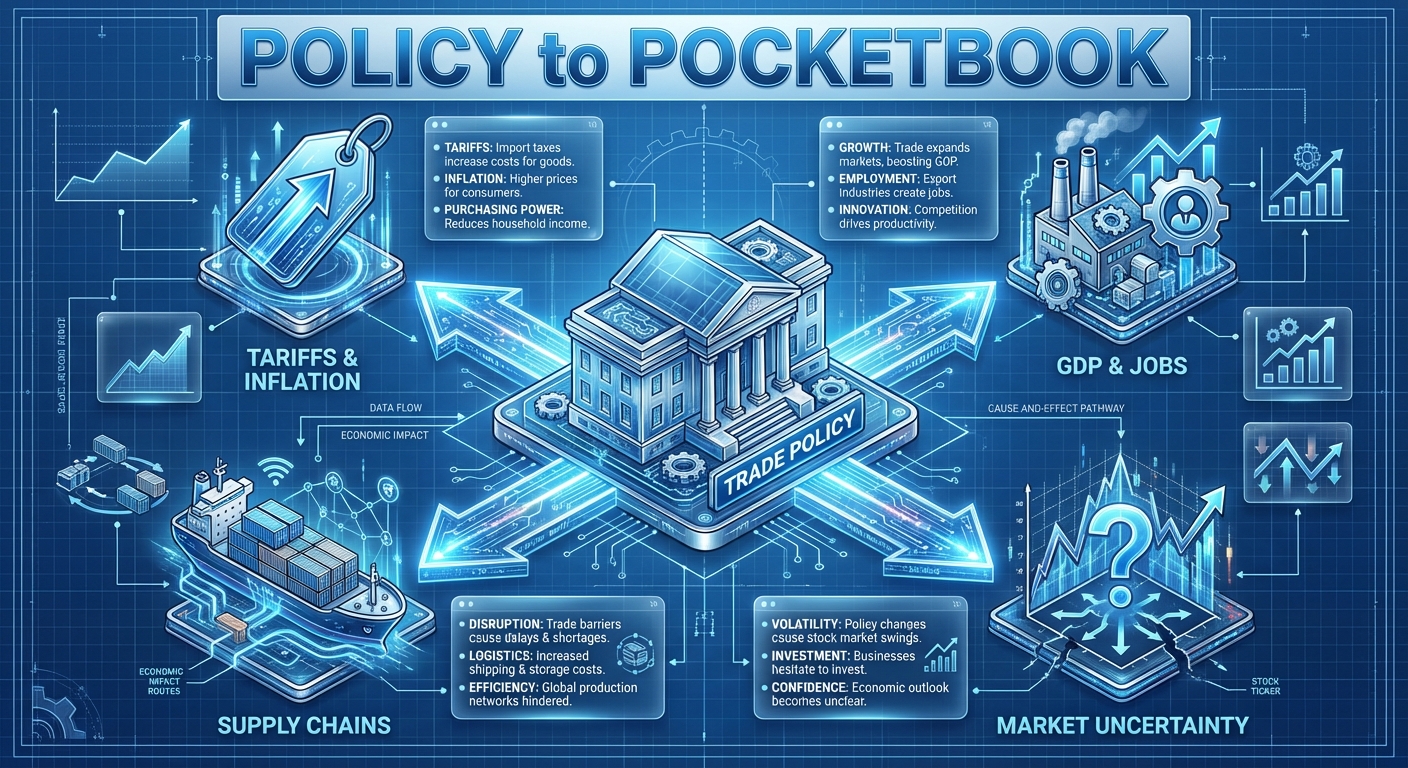
International trade policy directly affects the economy by influencing GDP, inflation, and employment levels. Policies like tariffs can raise consumer prices and disrupt supply chains, while trade agreements can foster growth and create jobs. Ultimately, trade policy sets the rules for the global flow of goods and services, impacting everything from manufacturing output to investment security.
How International Trade Policy Steers the Economy
Many people see international trade policy as an abstract concept, disconnected from their daily lives. The problem is that this perception masks the powerful influence these policies have on the prices we pay, the jobs we have, and the overall health of the economy. This disconnect becomes agitating when unexpected economic shifts—like sudden price hikes on everyday goods or layoffs in the manufacturing sector—seem to come out of nowhere. The solution is to understand that trade policy acts as the economy’s steering mechanism. It uses tools like tariffs (taxes on imported goods), quotas (limits on imports), and free trade agreements (FTAs) to direct economic activity. These tools can be used to protect domestic industries from foreign competition or to open up new markets for exports, fundamentally shaping the economic landscape.
A common misconception is that a trade deficit is always a sign of economic weakness. However, as experts from Tufts University have pointed out, trade deficits and surpluses are not simple indicators of economic health. An economy can run a deficit while still experiencing strong growth and low unemployment. The real impact of trade policy lies in its influence on core economic variables. For example, protectionist policies like high tariffs can lead to retaliatory tariffs from other countries, sparking a trade war that harms multiple economies. The U.S.-China trade tensions that escalated in recent years are a prime example, leading to documented job losses in trade-exposed sectors. Understanding trade policy isn’t about memorizing complex regulations; it’s about recognizing how these governmental decisions create ripple effects that touch every corner of the economy, from multinational corporations to local businesses.
The Economic Impact of Tariffs: Inflation and Employment
One of the most debated tools of trade policy is the tariff. The primary problem with tariffs is that their economic consequences are often complex and counterintuitive. A government might impose tariffs to protect local jobs, but the resulting chain reaction can lead to higher prices for consumers and disruptions for businesses. This is deeply agitating for both households and companies, as rising costs erode purchasing power and unstable supply chains make business planning nearly impossible. The solution is to analyze the dual impact of tariffs on inflation and employment. Initially, a tariff increases the cost of imported goods. This cost is often passed directly to consumers, leading to higher inflation. At the same time, domestic companies that use these imported goods as parts for their own products face higher input costs, which can reduce their competitiveness and even lead to layoffs.
A crucial mistake is focusing only on the intended goal of a tariff (e.g., protecting a specific industry) without considering its broader macroeconomic impact. Research from the San Francisco Fed highlights this dynamic adjustment. While tariffs might temporarily shield one industry, they can reduce overall demand in the economy, initially lowering inflation and increasing unemployment. Over time, as supply chains reorient and costs are passed on, inflation rises and unemployment normalizes, but the economy may be less efficient. This creates a volatile environment for businesses and consumers. Here’s a typical sequence of events:
- Phase 1: Tariff Imposition. The government places a tax on imported steel.
- Phase 2: Cost Increase. The price of both foreign and domestic steel rises. Domestic car manufacturers, for example, now pay more for a key material.
- Phase 3: Consumer Impact. Car prices increase for consumers, contributing to inflation.
- Phase 4: Employment Effects. While the steel industry might see job gains, the auto industry could face job losses due to reduced sales and higher costs.
How Trade Policy Uncertainty Stifles Global Growth
Beyond specific policies like tariffs, the mere uncertainty about future trade rules can severely damage the economy. The problem is that businesses thrive on predictability. When they don’t know what trade policies will look like next year—or even next month—they hesitate to make long-term investments. This hesitation is agitating because it translates directly into slower economic growth, fewer new jobs, and increased market volatility. An unpredictable trade environment forces companies to delay expansion plans, hold off on hiring, and reconsider cross-border partnerships. The solution is to recognize trade policy uncertainty as a direct economic threat. Stable, clear, and predictable trade policies create the confidence necessary for businesses to invest, innovate, and grow.
A common misconception is that trade uncertainty only affects large, multinational corporations. In reality, it creates a chilling effect across the entire global market. According to a report from UNCTAD, trade policy uncertainty raises costs, destabilizes financial conditions, and erodes international trust. This can lead to bizarre economic behavior, such as companies front-loading shipments to beat anticipated tariffs, which creates temporary booms followed by busts. Small and medium-sized enterprises (SMEs) are particularly vulnerable because they lack the resources to hedge against policy shifts or quickly reconfigure their supply chains. This uncertainty acts like a tax on the global economy, slowing down the engine of commerce and making everyone poorer. For developing countries, the effects are even more pronounced, as unpredictable access to major markets can derail their economic progress entirely.
Do Free Trade Agreements Actually Boost the Economy?
On the opposite end of the spectrum from tariffs and trade wars are Free Trade Agreements (FTAs). The problem is that FTAs are often politically contentious, with critics claiming they lead to job losses in domestic manufacturing. This creates public anxiety, as people worry that opening up to international competition will harm local workers and industries. This agitation is fueled by headlines about factory closures, which are often blamed on free trade. The solution is to look at the comprehensive economic data on the impact of FTAs. While some specific jobs may be displaced, these agreements are designed to lower barriers to trade, which generally leads to a more efficient allocation of resources and overall economic expansion.
Many people mistakenly attribute all manufacturing job losses to FTAs, ignoring other significant factors like automation and changes in consumer demand. Economic modeling provides a clearer picture. For instance, research from the Bay Area Council Economic Institute shows that existing FTAs have had a net positive effect on the U.S. economy, boosting GDP, increasing overall employment, and raising real wages. FTAs work by making exports cheaper for foreign consumers, opening up vast new markets for domestic companies. At the same time, they make imports cheaper, which lowers prices for consumers and provides businesses with more affordable materials and components. The key is that while some sectors may shrink due to increased competition, other, more competitive sectors expand, often creating higher-skilled, better-paying jobs. The net effect, according to extensive economic analysis, is positive, leading to a larger and more dynamic economy.
The Critical Link: Trade Policy and Global Supply Chains
In our modern globalized world, products are rarely made in a single country. The problem is that these intricate global supply chains are highly sensitive to changes in trade policy. A single new tariff or regulation can break a critical link, causing massive disruptions. This vulnerability is agitating for both businesses and consumers, leading to product shortages, shipping delays, and sudden price spikes. The recent experiences with supply chain breakdowns have shown just how quickly these issues can impact daily life. The solution is to understand that resilient and efficient supply chains depend on stable and open trade policies. When policies are disruptive, companies are forced into costly and time-consuming reconfigurations of their entire production process.
A widespread mistake is underestimating the complexity of these supply chains. A smartphone, for example, contains components and raw materials from dozens of countries, each sourced based on cost and quality. A tariff on just one of those components can make the final product more expensive or force a company to find a new, potentially less efficient, supplier. As analysis from the Richmond Fed points out, recent tariff measures have forced precisely this kind of disruptive adjustment, raising input costs and creating a drag on economic output. Effective trade policy, therefore, is not just about the final product that crosses a border; it’s about ensuring the smooth flow of all the intermediate goods and services that make modern production possible. Policies that ignore this reality inevitably lead to higher costs, reduced efficiency, and a less resilient global economy.
Frequently Asked Questions
How do tariffs specifically impact inflation and unemployment?
Tariffs impact inflation by directly increasing the price of imported goods. This cost is often passed on to consumers, leading to higher overall prices. The effect on unemployment is more complex. While tariffs may protect jobs in a specific domestic industry, they can lead to job losses in other sectors that rely on imported materials (due to higher costs) or in export industries that face retaliatory tariffs. According to the San Francisco Fed, the net effect can be an initial rise in unemployment as the economy adjusts to these new costs and trade patterns.
What are the long-term effects of trade policy uncertainty on global markets?
Long-term trade policy uncertainty acts as a major drag on the global economy. As highlighted by UNCTAD, it discourages investment, as businesses are hesitant to commit capital without knowing the future rules of trade. This leads to slower GDP growth, less innovation, and increased financial market volatility. It also erodes trust between nations, making international cooperation on economic issues more difficult and potentially leading to a more fragmented and less efficient global market.
How do free trade agreements influence economic growth and job creation?
Free trade agreements (FTAs) are designed to stimulate economic growth by removing barriers like tariffs and quotas. This typically leads to increased trade volumes, allowing countries to specialize in producing goods and services where they have a competitive advantage. According to economic modeling, this increased efficiency boosts a nation’s GDP. While FTAs can cause job displacement in less competitive industries, they also create new jobs in more competitive export-oriented sectors. The overall effect is generally found to be positive for employment and real wages in the long run.