- Direct Answer: The 2024/2025 Evolutionary Shift
- 1. Homo juluensis: The New “Big Bad” of East Asia
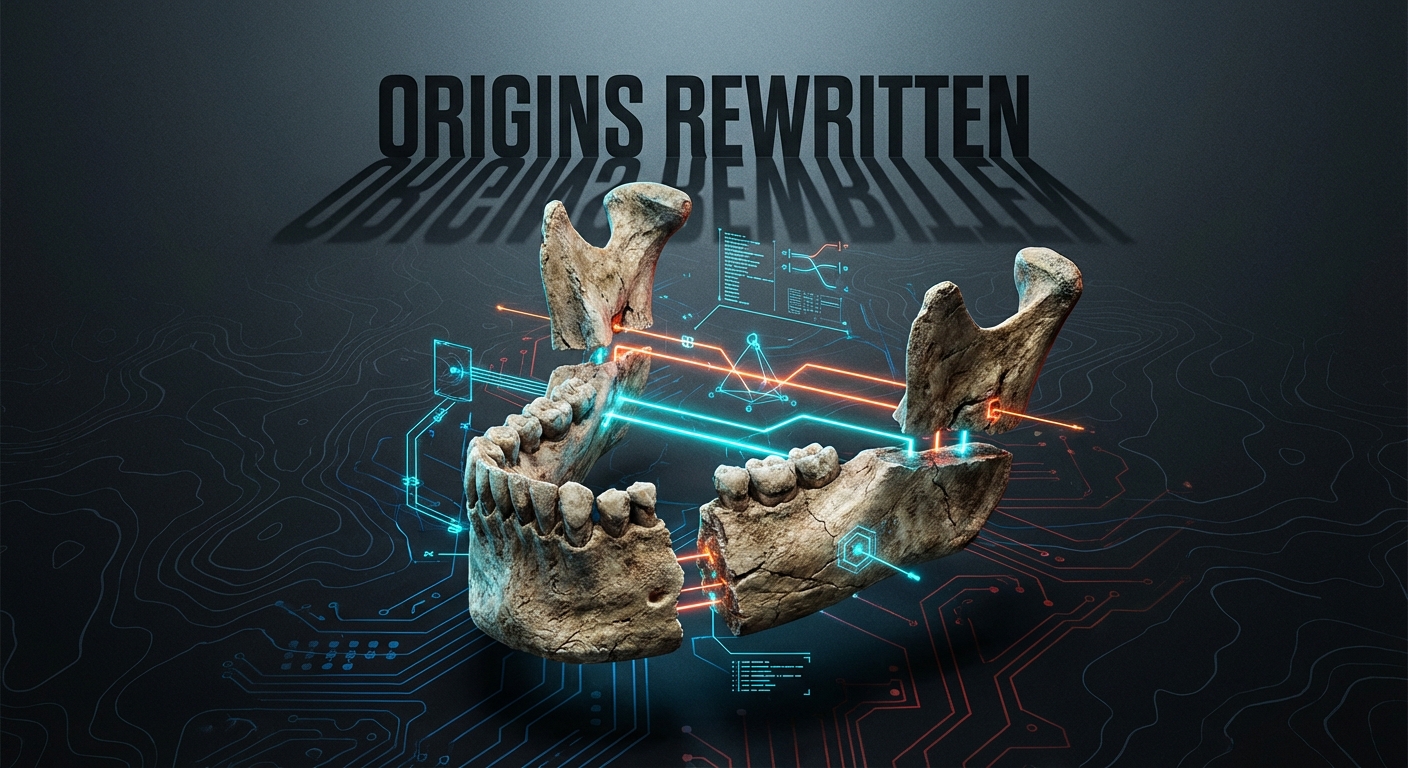
- 2. The Hualongdong Mandible: A Modern Face on an Ancient Skull
- 3. Walking Together: The Koobi Fora Footprints
- 4. Thorin: The Neanderthal Who Refused to Mix
- 5. Ledi-Geraru and the “Bushy Tree” Confirmation
- 6. Recommended Resource: Visualizing Our Ancestors
- Frequently Asked Questions
Recent paleontology discoveries in 2024 and 2025 have fundamentally decentralized the story of human evolution. The most significant finding is the proposal of a new species, Homo juluensis, in East Asia, which suggests that complex speciation occurred globally, not just in Africa. Additionally, the Hualongdong fossils (300,000 years old) exhibit a unique mix of primitive and modern traits, challenging the timeline of when “modern” facial features first appeared. These findings collectively replace the linear “March of Progress” with a complex, branching model of coexistence.
1. Homo juluensis: The New “Big Bad” of East Asia
For decades, the narrative of human evolution was heavily Euro-centric and Afro-centric. Asia was often viewed merely as a migration route. In 2024, that assumption was shattered by the proposal of a new distinct lineage: Homo juluensis.
Researchers analyzing fossils from China, Korea, and Japan realized that many specimens previously dumped into the “Homo erectus” or “Archaic Homo sapiens” wastebasket didn’t fit. These hominins, dating between 300,000 and 50,000 years ago, possessed large brains and complex teeth that matched neither Neanderthals nor modern humans.
The Denisovan Connection:
This new classification likely includes the mysterious Denisovans. Until now, Denisovans were a “ghost species” identified mostly by DNA. Homo juluensis gives a physical body to this genetic ghost. This reclassification means that East Asia was not an evolutionary dead-end but a vibrant hub of experimentation where large-brained humans lived, hunted, and likely interbred with our own ancestors.
2. The Hualongdong Mandible: A Modern Face on an Ancient Skull
While Homo juluensis rewrites the species list, the Hualongdong fossils (excavated in Anhui, China) rewrite the timeline of anatomy.
Dated to roughly 300,000 years ago, these fossils present a confusing puzzle that experts call “mosaic evolution.” The skull cap is thick and primitive, typical of ancient humans. However, the face is flat, and the mandible (jawbone) shows the beginnings of a chin—a feature previously thought to be exclusive to Homo sapiens and appearing much later.
Why the Chin Matters:
According to the Smithsonian’s 2025 outlook, the presence of a chin suggests that the genetic architecture for modern human faces was already present in Asia 300,000 years ago. This supports a “multi-regional” influence on our origins, where traits might have flowed back and forth between African and Asian populations rather than exploding out of Africa in a single event.
3. Walking Together: The Koobi Fora Footprints
In Kenya, the ground itself has spoken. At the Koobi Fora site, researchers used 3D scanning and photogrammetry to analyze a set of 1.5-million-year-old footprints. The results confirm a long-debated theory: direct coexistence.
The prints show two distinct stride patterns on the same sediment layer:
- Homo erectus: An efficient, long-striding gait adapted for endurance hunting.
- Paranthropus boisei: A shorter, wider stance adapted for stability and foraging.
This is definitive proof of niche partitioning. Just as lions and hyenas share the Serengeti today, these two hominin species shared the Turkana Basin. One chased gazelles; the other crunched tubers. For a deeper dive into how these species managed to live side-by-side without driving each other to extinction, read our analysis on Paranthropus boisei and the “Hand That Held the Tool.”
4. Thorin: The Neanderthal Who Refused to Mix
Genetic analysis in 2024 brought us the tragedy of “Thorin,” a Neanderthal whose remains were found in France. Dated to roughly 42,000 years ago, Thorin lived near the very end of the Neanderthal era. But his DNA told a shocking story of isolation.
While other Neanderthal groups were interbreeding with migrating humans or moving around Europe, Thorin’s lineage had remained genetically isolated for nearly 50,000 years. They did not exchange genes with neighboring groups.
The Mechanism of Extinction:
This discovery highlights inbreeding depression as a key factor in the Neanderthal demise. It wasn’t necessarily a war with humans that killed them; it was their inability to network. Small, isolated populations lack the genetic diversity to fight off disease or adapt to climate change. Thorin represents the final, lonely stand of a species that simply lost its connection to the wider world.
5. Ledi-Geraru and the “Bushy Tree” Confirmation
Finally, continued analysis of the Ledi-Geraru site in Ethiopia (dating back 2.8 million years) continues to serve as the anchor for our understanding of the genus Homo. The 2025 reports reinforce that early human evolution was a “bushy tree” of experimentation.
The Ledi-Geraru jawbone (LD 350-1) proves that the transition from Australopithecus to Homo happened rapidly, likely driven by climate instability. This site remains the most important reference point for separating the “apes” from the “humans.” To understand the specific dating methods (Argon-Argon) used to validate this critical timeline, check out our full breakdown: Oldest Human Ancestors Found: 2025 Ledi-Geraru Discovery.
6. Recommended Resource: Visualizing Our Ancestors
Understanding the difference between a Hualongdong skull and a Neanderthal skull is difficult with text alone. We strongly recommend Evolution: The Human Story for its medical-grade 3D reconstructions of these specific fossils.

Frequently Asked Questions
What is the most important human fossil found in 2024?
The definition of “most important” varies, but the Hualongdong mandible is a top contender because it challenges the timeline of facial evolution, suggesting modern features appeared in Asia 300,000 years ago.
Who is Homo juluensis?
Homo juluensis is a newly proposed species name that groups together various Middle Pleistocene fossils from East Asia (China, Korea, Japan), potentially including the Denisovans. It represents a distinct lineage of large-brained humans separate from Neanderthals and Sapiens.
Did humans and Neanderthals coexist in 2024 research?
Yes, research on “Thorin” confirms that while coexistence and interbreeding were common in some regions, other Neanderthal populations remained isolated until their extinction around 40,000 years ago.
What does the Koobi Fora discovery prove?
The footprints at Koobi Fora prove that Homo erectus and Paranthropus boisei walked the same land at the same time. This physical evidence supports the theory of niche partitioning, where different hominin species exploited different food sources to survive together.
Are the "Hobbits" (Homo floresiensis) related to these new finds?
Indirectly. The 2024 report on a tiny 700,000-year-old arm bone from Flores suggests that the ancestors of the “Hobbits” arrived on the island and evolved small stature much earlier than expected, adding yet another branch to the complex evolutionary tree.