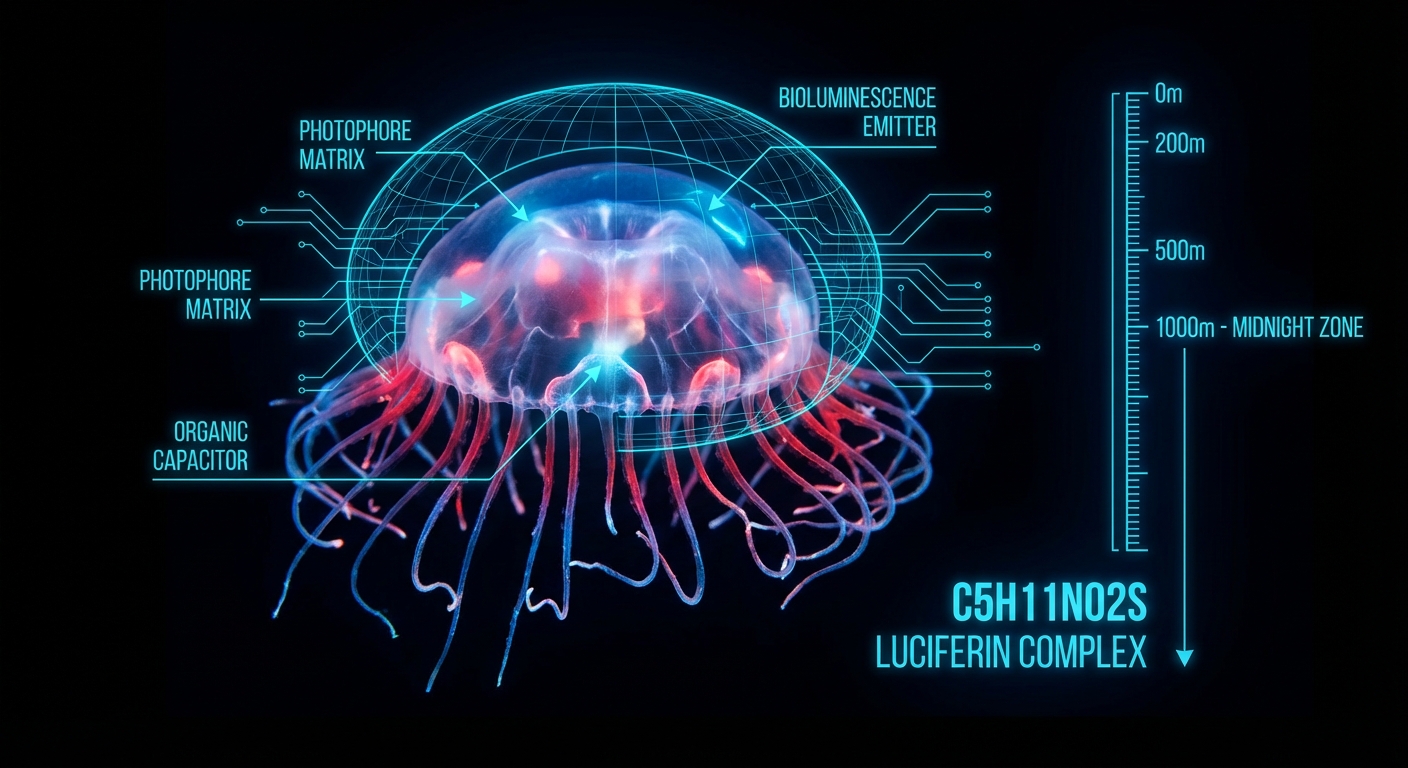
- Quick Summary: The Living Light of the Abyss
- 1. The Chemistry: Luciferin, Luciferase, and Oxygen
- 2. Cloaking Devices: The Art of Counter-Illumination
- 3. Defense Mechanisms: Burglar Alarms and Sacrificial Limbs
- 4. Evolution: How Light Accelerates Speciation
- 5. Unexplored Frontiers: What We Still Don’t Know
- Frequently Asked Questions
What is marine bioluminescence and why is it important in the deep sea?
Marine bioluminescence is a biochemical emission of light by living organisms, occurring in approximately 76% to 80% of deep-sea animals. It serves three primary survival functions: feeding (luring prey), defense (startling predators or camouflage via counter-illumination), and communication (mating signals). It is the dominant form of communication in the ocean’s "Twilight Zone" (200m–1000m).
1. The Chemistry: Luciferin, Luciferase, and Oxygen
To understand why the deep ocean glows, we must first look at the chemistry. Bioluminescence is not the same as fluorescence (which requires an external light source to reflect). It is chemiluminescence—light produced by a chemical reaction within the organism.
The Mechanism:
The process requires two key components: a light-producing molecule called luciferin and an enzyme called luciferase. When luciferin reacts with oxygen, catalyzed by luciferase, energy is released in the form of “cold light.” Unlike a lightbulb, which wastes 90% of its energy as heat, this biological light is nearly 100% efficient. This efficiency is critical in the deep sea, where food is scarce and metabolic energy must be conserved.
Common Misconception:
Many people believe all glowing sea creatures produce their own light. In reality, some animals, like the Anglerfish, do not produce the light themselves. Instead, they host colonies of bioluminescent bacteria in their lures (esca) in a symbiotic relationship. For a deeper dive into how we classify these symbiotic relationships, refer to our guide on Marine Biology Species Identification Techniques.
2. Cloaking Devices: The Art of Counter-Illumination
In the Mesopelagic zone (the Twilight Zone), faint sunlight still filters down from the surface. This creates a problem: if a predator looks up, they can see the silhouette of a fish against the lighter surface waters.
The Solution:
Deep-sea inhabitants like the Hatchetfish and Lanternfish have evolved a sophisticated form of camouflage called counter-illumination. These fish possess light-producing organs called photophores along their bellies. By regulating the intensity of these photophores to match the exact brightness of the sunlight coming from above, they effectively erase their own shadow.
Why It Matters:
This is not just a passive trait; it is an active, dynamic optical system. If a cloud passes over the sun, the fish dims its lights. According to research from MBARI, this adaptation is so effective that it has become one of the most common traits in the vertebrate world, evolved independently by dozens of species.
Recommended Reading:
For a comprehensive visual guide to these adaptations, The Extreme Life of the Sea offers an authoritative look at the physiology of these creatures.

3. Defense Mechanisms: Burglar Alarms and Sacrificial Limbs
While camouflage hides an animal, bioluminescence is also used as a weapon of startling defense.
The "Burglar Alarm" Response:
The Atolla jellyfish uses a fascinating tactic. When attacked by a predator, it pulses a brilliant, rotating display of blue light. This show isn’t intended to scare the attacker—it is intended to attract something bigger. The light screams "Dinner is here!" into the darkness, summoning a larger predator to eat the creature attacking the jellyfish.
Sacrificial Parts:
Other creatures, like the Green Bomber Worm (Swima bombiviridis), release glowing green "bombs" (fluid-filled sacs) when threatened. These glowing decoys drift away, distracting the predator while the worm escapes into the darkness. This behavior highlights the complex behavioral adaptations discussed in our analysis of Deep Ocean Exploration Discoveries.
4. Evolution: How Light Accelerates Speciation
Bioluminescence is not just a cool party trick; it is an engine of evolution. A study published in NCBI revealed that deep-sea lineages with bioluminescence diversify (split into new species) much faster than those without it.
The Mechanism of Speciation:
Because photophore patterns are species-specific, they act as highly precise mating signals. This creates reproductive isolation—a female lanternfish will only mate with a male displaying the exact correct light pattern. This isolation prevents interbreeding between slightly different populations, allowing them to drift apart genetically and become distinct species at an accelerated rate. This explains why the deep sea, despite having few physical barriers, is one of the most biodiverse environments on Earth.
5. Unexplored Frontiers: What We Still Don’t Know
Despite knowing the chemistry, we have explored less than 5% of the deep ocean. We are constantly discovering new forms of light. For example, recent expeditions have found organisms that emit red light—a color that is invisible to most deep-sea eyes, giving these predators a "sniper scope" advantage to see prey without being seen.
The Unknown:
We still do not understand the full extent of bacterial communication (quorum sensing) in these depths, or how these chemical reactions might be adapted for medical use in cancer research. The deep sea remains the planet’s final frontier.
Recommended Reading:
To explore the monsters and mysteries of this zone further, Creatures of the Deep provides incredible photography that captures the alien nature of these animals.
Frequently Asked Questions
Can bioluminescent creatures turn their light on and off?
Yes, most can. While bioluminescent bacteria glow continuously, the animals that host them (like the Anglerfish) can retract the bacteria into a pouch to "turn off" the light. Animals that produce their own light (intrinsic) control it via their nervous system, allowing for rapid flashing.
Why is most deep-sea bioluminescence blue?
Blue light (wavelength ~470nm) travels the furthest through water. Red light is absorbed very quickly by water molecules. Therefore, deep-sea eyes have evolved to be most sensitive to blue light, making it the most efficient color for communication.
Are there any bioluminescent animals in the Midnight Zone?
Yes. The Midnight Zone (Bathypelagic, 1000m–4000m) is pitch black, and bioluminescence is the primary source of light. Anglerfish, gulper eels, and vampire squid all utilize light in this zone for hunting and defense.
Do all jellyfish glow?
No, not all jellyfish glow. However, it is estimated that about 50% of jellyfish species are bioluminescent. Many others are biofluorescent, meaning they glow only when UV light hits them, which is different from producing their own light.
How does the "Green Bomber Worm" use light?
The Green Bomber Worm releases fluid-filled sacs that glow bright green. It drops these sacs like flares to distract predators, allowing the worm to swim away into the safety of the dark water.