- Quick Summary: Flow Cytometry for Stem Cells
- 1. Core Principles: Hydrodynamic Focusing & Fluorescence
- 2. Essential Surface Markers: HSCs vs. MSCs
- 3. Sample Preparation: The Art of Single-Cell Suspensions
- 4. Gating Strategies: Excluding Dead Cells & Doublets
- 5. FACS: Isolating Rare Progenitor Cells
- 6. Recommended Resources for Researchers
- Frequently Asked Questions
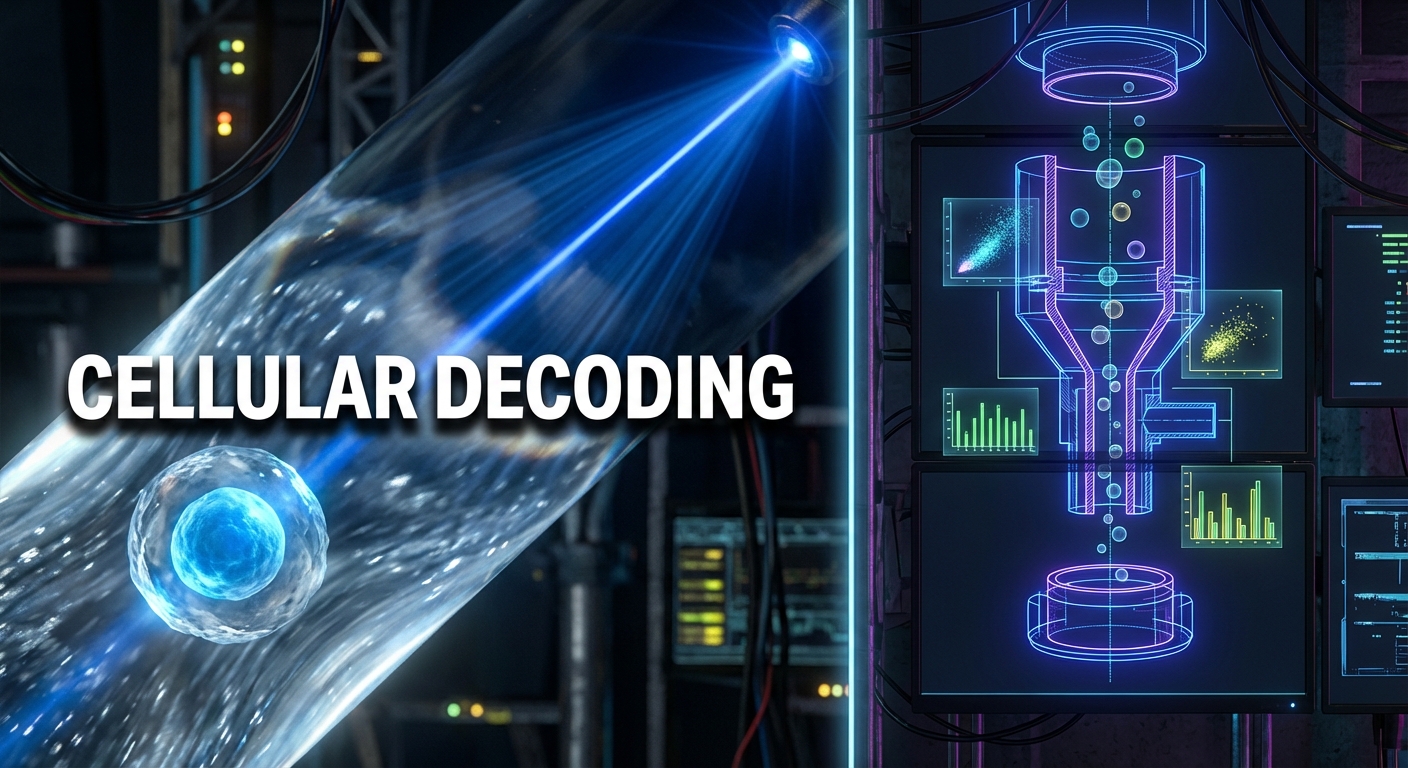
Flow cytometry techniques for stem cell analysis rely on hydrodynamic focusing to align cells in a single file, allowing lasers to interrogate them individually. This high-throughput method identifies stem cells based on specific surface markers (immunophenotyping). For example, Hematopoietic Stem Cells (HSCs) are typically identified as CD34+/CD38-, while Mesenchymal Stem Cells (MSCs) are positive for CD73, CD90, and CD105 but negative for hematopoietic lineage markers.
1. Core Principles: Hydrodynamic Focusing & Fluorescence
Flow cytometry is the gold standard in regenerative medicine because it allows for the multi-parameter analysis of millions of cells in seconds. Unlike standard microscopy, which looks at morphology, flow cytometry quantifies the expression levels of proteins on the cell surface or inside the nucleus.
How It Works:
The mechanism relies on hydrodynamic focusing. A sheath fluid pressurizes the sample, forcing cells to align in a single file line as they pass through a laser beam. As the laser hits each cell, it scatters light in two distinct ways:
- Forward Scatter (FSC): Correlates with cell size. Larger stem cells scatter more light forward.
- Side Scatter (SSC): Correlates with granularity or internal complexity. Granulocytes have high SSC, while agranular stem cells typically have low SSC.
Fluorescence Detection:
Beyond physical properties, specific antibodies tagged with fluorochromes bind to stem cell receptors. When the laser hits these fluorochromes, they emit light at specific wavelengths, which the machine detects to determine the cell’s phenotype.
2. Essential Surface Markers: HSCs vs. MSCs
Identifying stem cells is a game of inclusion and exclusion. Because stem cells are rare and often morphologically similar to other cells, you must use a panel of markers to confirm their identity.
Hematopoietic Stem Cells (HSC):
HSCs, which give rise to all blood cells, are arguably the most well-characterized. According to protocols from the National Institutes of Health (NIH), a standard identification panel involves:
- Positive Markers: CD34, CD90 (Thy-1), CD133.
- Negative Markers (Lineage Negative): CD38, CD45RA (for primitive cells), and a “Lin” cocktail (CD2, CD3, CD14, CD16, CD19, CD56) to exclude mature immune cells.
Mesenchymal Stem Cells (MSC):
MSCs are multipotent stromal cells found in bone marrow and adipose tissue. The International Society for Cellular Therapy (ISCT) defines them by a “positive-negative” profile:
- Must Express: CD105, CD73, CD90.
- Must Lack: CD45, CD34, CD14 or CD11b, CD79alpha or CD19, and HLA-DR.
Understanding these markers is similar to how scientists map the immune system in other contexts. For a deeper look at cellular instruction and immune response, see our guide on mRNA Vaccine Immunology, which explains how cells present proteins to T-cells.
3. Sample Preparation: The Art of Single-Cell Suspensions
The most common failure point in stem cell flow cytometry is not the machine; it is the sample. Flow cytometers clog easily, and cell clumps (doublets) can ruin data integrity.
Enzymatic Dissociation:
To analyze adherent stem cells (like MSCs or iPSCs), you must detach them from the culture flask.
The Trap: Using harsh enzymes like Trypsin for too long can cleave the very surface markers (epitopes) you are trying to detect.
The Solution: Use gentler alternatives like Accutase or TrypLE, which preserve surface antigens better than standard Trypsin-EDTA.
Filtering:
Always pass your sample through a 30-40 µm nylon mesh strainer immediately before running it. This removes aggregates that could clog the flow cell nozzle.
4. Gating Strategies: Excluding Dead Cells & Doublets
Data analysis in flow cytometry is performed through “gating”—drawing digital boundaries around populations of interest.
Step 1: Viability Gating
Dead cells bind antibodies non-specifically, leading to false positives (autofluorescence). Always use a viability dye like 7-AAD or DAPI. Dead cells will take up the dye and fluoresce brightly; you should gate these out.
Step 2: Doublet Discrimination
A “doublet” occurs when two cells stick together and pass through the laser as one. This can trick the machine into thinking it is analyzing one large, complex cell. By plotting FSC-Height vs. FSC-Area, single cells will fall on a diagonal line, while doublets will appear as outliers. Excluding these is critical for determining true stem cell purity.
5. FACS: Isolating Rare Progenitor Cells
Fluorescence-Activated Cell Sorting (FACS) takes analysis a step further by physically separating the cells. As the stream breaks into droplets, the machine applies an electrical charge to droplets containing your target stem cells.
The Challenge of Rare Cells:
Stem cells often represent less than 0.01% of a tissue sample. To sort them effectively, you must balance purity (how clean the output is) with yield (how many cells you recover). For rare populations, use a “purity mask” setting, which discards any droplet containing a contaminating cell, even if it means losing some target cells.
6. Recommended Resources for Researchers
For those establishing a new flow cytometry core or designing complex multi-color panels, having a technical reference on hand is invaluable. We recommend the following texts for their depth on protocols and troubleshooting artifacts.
For Protocol Design:
Flow Cytometry for Research Scientists offers a practical, bench-side approach to setting up experiments, titrating antibodies, and interpreting histograms.

For Clinical Applications:
If your work bridges into hematology or diagnostics, Clinical Flow Cytometry provides essential context on standardizing assays for patient samples.

Frequently Asked Questions
What is the best control for stem cell flow cytometry?
The Fluorescence Minus One (FMO) control is the industry standard. An FMO control contains all the fluorochromes in your panel except the one you are measuring. This allows you to accurately place the gate by accounting for fluorescence spillover from other channels.
Why do we use CD45 to identify MSCs?
Actually, we use CD45 to exclude them. CD45 is the “Leukocyte Common Antigen,” present on all white blood cells. Since Mesenchymal Stem Cells are not of hematopoietic origin, they must be CD45-negative. If your MSC culture is CD45+, it is contaminated with blood cells.
Can you perform flow cytometry on intracellular markers?
Yes, but it requires fixation and permeabilization. Markers like Oct4, Sox2, and Nanog are transcription factors located inside the nucleus. To stain them, you must poke holes in the cell membrane using detergents (permeabilization) so the antibodies can enter.
What is ALDEFLUOR assay used for?
The ALDEFLUOR assay measures the activity of the enzyme Aldehyde Dehydrogenase (ALDH). High ALDH activity is a hallmark of primitive hematopoietic stem/progenitor cells. It is a functional marker rather than just a surface protein.
How many colors can modern flow cytometers detect?
While traditional machines detected 3-4 colors, modern spectral flow cytometers can detect over 30-40 parameters simultaneously. This allows for deep immunophenotyping, where a single stem cell is characterized by dozens of markers at once.