- Direct Answer: The 2025 Ledi-Geraru Breakthrough
- 1. The Ledi-Geraru Jawbone: Pushing Back the Clock
- 2. Shattering the Linear Model: The “Bushy Tree” Explained
- 3. The Science of Dating: How We Know It’s 2.8 Million Years Old
- 4. Diet as the Driver: What Ancient Teeth Reveal
- 5. The Gona Face: Insights into Early Migration
- 6. Recommended Reading: The Mechanism of Evolution
- Frequently Asked Questions
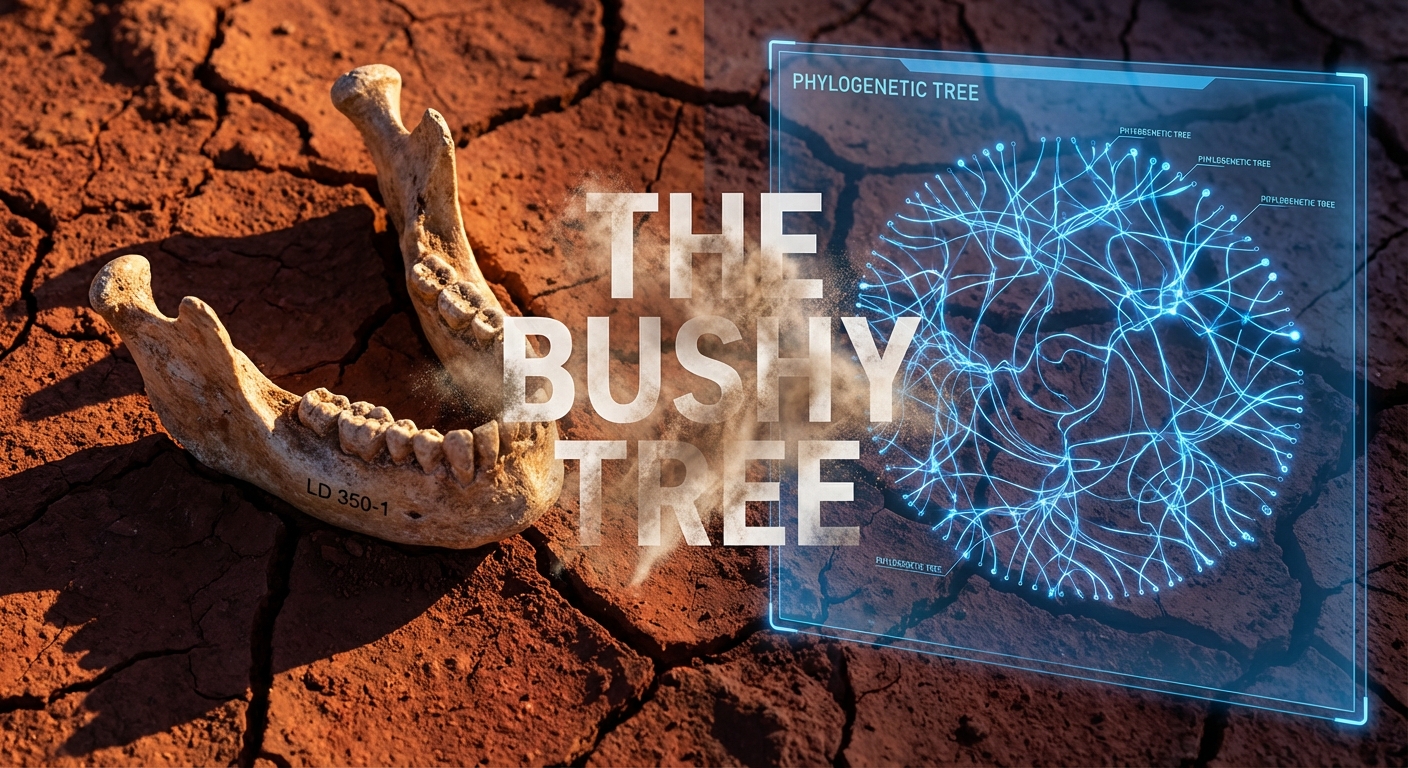
Recent paleontology discoveries in 2025 centered on the Ledi-Geraru research site in Ethiopia have fundamentally altered the evolutionary timeline. The recovery of a 2.8-million-year-old jawbone (LD 350-1) confirms that the genus Homo emerged 400,000 years earlier than previously thought. Crucially, these findings prove that early humans did not evolve in a straight line but coexisted with Australopithecus species in a complex, overlapping “bushy tree” of evolution.
1. The Ledi-Geraru Jawbone: Pushing Back the Clock
For decades, a massive gap existed in the fossil record between 2 and 3 million years ago. This period is the “black box” of human evolution—the transition zone where the ape-like Australopithecus afarensis (Lucy’s species) supposedly gave way to the tool-using Homo habilis.
The discovery at Ledi-Geraru, Ethiopia, has finally illuminated this dark age. The fossil in question, a mandible known as LD 350-1, dates back to between 2.75 and 2.8 million years ago. This is significant because it predates the previously known oldest Homo specimens by nearly half a million years.
Why is this a paradigm shift?
According to the research published in Phys.org, this jawbone possesses a mix of primitive and derived traits. While the chin is retreating (an ape-like feature), the teeth are smaller and more symmetrical—a distinct hallmark of the Homo lineage. This suggests that the biological hardware for “being human” began developing much earlier than we believed, likely in response to rapid climate shifts in East Africa.
2. Shattering the Linear Model: The “Bushy Tree” Explained
The most popular image of evolution is the “March of Progress”—a monkey slowly standing up to become a man. The 2025 discoveries prove this image is not just simplified; it is wrong.
The Coexistence Evidence:
Alongside the early Homo fossils, researchers found teeth belonging to a completely new species of Australopithecus. As reported by VCU researchers, this means that distinct hominin species were walking the same landscape, at the same time, likely competing for the same resources.
This supports the “Bushy Tree” model of evolution. Instead of a single trunk growing straight up, human evolution is a messy bush with many branches. Most of these branches (various Australopithecus and Paranthropus species) went extinct, while only one thin twig (Homo) survived. This mirrors the biodiversity we see in other mammals; just as there are many types of antelope on the savanna, there were once many types of humans.
3. The Science of Dating: How We Know It’s 2.8 Million Years Old
A common skepticism regarding paleontology is the accuracy of the dates. How can we be sure a jawbone is 2.8 million years old and not 2.8 thousand?
The method used at Ledi-Geraru is Argon-Argon (Ar/Ar) dating, a radiometric technique that measures the decay of radioactive isotopes in volcanic ash layers. The fossils were found sandwiched between two layers of volcanic tuff (solidified ash).
- Step 1: Geologists date the ash layer below the fossil (providing a maximum age).
- Step 2: They date the ash layer above the fossil (providing a minimum age).
- Step 3: They analyze the magnetic orientation of the sediment particles (Magnetostratigraphy) to correlate with known reversals of Earth’s magnetic field.
This is the same rigorous methodology used to analyze soil samples on other planets. Just as we look for biosignatures in Martian soil, we analyze the isotopic signature of Ethiopian dust to reconstruct the timeline of our origins.
4. Diet as the Driver: What Ancient Teeth Reveal
Why did Homo survive while Australopithecus perished? The answer lies in the teeth. The newly discovered teeth from Ledi-Geraru were subjected to stable carbon isotope analysis.
The Mechanism:
Plants absorb Carbon-12 and Carbon-13 differently depending on how they photosynthesize (C3 plants like trees vs. C4 plants like grasses). By analyzing the ratio of these isotopes in the tooth enamel, scientists can reconstruct the creature’s diet millions of years later.
The results show that early Homo had a more flexible, generalized diet, including more meat and tougher vegetation, whereas Australopithecus likely relied on softer fruits or specific sedges. When the African climate dried out and forests turned into grasslands, the specialized eaters starved, but the versatile eaters (us) adapted.
5. The Gona Face: Insights into Early Migration
While Ledi-Geraru tells us when we started, the fossil face found at Gona (dated to 1.5 million years ago) tells us when we left.
This partial cranium belongs to Homo erectus (sometimes called Homo ergaster in Africa). It is the first species to have body proportions like ours—long legs for walking and shorter arms. The discovery at Gona provides a critical snapshot of the species just before it began the first great migration out of Africa and into Eurasia.
Interestingly, this mirrors the technological leaps we observe today. Just as the James Webb Telescope allows us to look back at the formation of early galaxies, these fossils allow us to look back at the formation of the early human mind, specifically the development of spatial awareness required for migration.
6. Recommended Reading: The Mechanism of Evolution
To truly understand why the transition from Australopithecus to Homo happened, you need to look at the fuel source: food. The physical changes in the Ledi-Geraru fossils (smaller teeth, larger brains) are directly linked to the mastery of fire and cooking.
Recommended Book: Catching Fire by Richard Wrangham
This book offers the most compelling explanation for the “bushy tree.” Wrangham argues that what separated the Homo lineage was the ability to cook. Cooking pre-digests food, allowing our ancestors to develop smaller guts and larger brains. It is the perfect companion read to understand the biological mechanisms behind the fossils found in Ethiopia.

Frequently Asked Questions
What is the difference between Australopithecus and Homo?
The main differences are brain size, tooth size, and locomotion. Australopithecus had smaller brains (approx. 400-500cc), larger teeth for grinding plants, and retained some climbing adaptations. Homo (like the Ledi-Geraru specimen) shows reduced tooth size, larger brain capacity, and legs fully adapted for long-distance walking.
Did humans evolve from chimps?
No. Humans and chimpanzees share a common ancestor that lived roughly 6 to 7 million years ago. We are cousins, not descendants. The “bushy tree” model shows that we split from that common ancestor and then branched out into many different human-like species, of which we are the only survivors.
How does volcanic ash help date fossils?
Volcanic ash contains potassium-40, which decays into argon-40 at a known rate. By measuring the ratio of gas in the ash crystals, scientists can calculate exactly when the volcano erupted, providing a precise timestamp for any fossils buried within that ash layer.
What is the “Missing Link”?
The term “Missing Link” is scientifically outdated. Because evolution is a branching bush rather than a chain, there is no single link. However, fossils like LD 350-1 serve as “transitional fossils” that bridge the gap between specific groups, such as Australopithecus and Homo.
Are there more human species left to discover?
almost certainly. The discovery of the new Australopithecus species at Ledi-Geraru and the Denisovans in Siberia proves that the fossil record is far from complete. As we explore new regions of Africa and Asia, we will likely find more “twigs” on the human family tree.