The Current State of Superconductor Research
For decades, the idea of a room-temperature superconductor was widely considered the “Holy Grail” of condensed matter physics. The implications are staggering: lossless power grids that could save billions in wasted energy, magnetically levitating trains that require minimal power, and quantum computers that can operate without building-sized refrigerators.
Recent months have seen a flurry of activity that has fundamentally changed the conversation. We are no longer just hunting for new materials; we are engineering new states of matter. By manipulating atomic geometry and pressure protocols, laboratories from Columbia University to Stanford are bypassing the traditional temperature limits of superconductivity.
The Twisted Bilayer Breakthrough: Geometry as a Switch
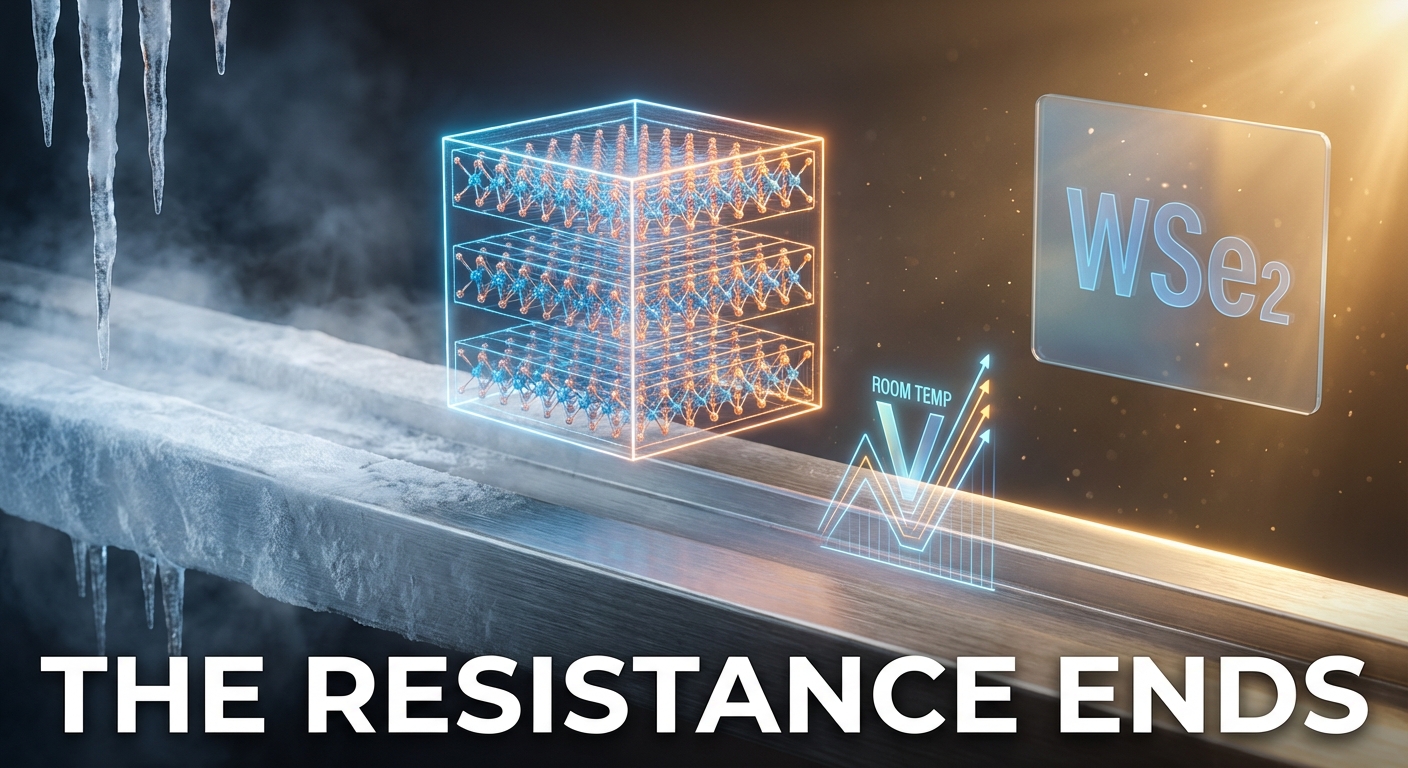
One of the most fascinating developments comes from Columbia University, where physicists have successfully induced superconductivity using a method that sounds more like origami than traditional chemistry. The focus here is on twisted bilayer WSe2 (tungsten diselenide).
The concept relies on “Moiré patterns.” When two atom-thin sheets of material are stacked and twisted at a precise angle—in this case, around 5 degrees—the misalignment creates a new periodic superstructure. This “twist” slows down the electrons moving through the material. In physics terms, this creates “flat bands” where kinetic energy is quenched, forcing electrons to interact strongly with one another.
Why does this matter? Superconductivity relies on electrons pairing up into Cooper pairs. In normal metals, electrons repel each other. But in these twisted bilayers, the strong interactions mediate an attraction, allowing them to flow without resistance. This finding is critical because it demonstrates that superconductivity can be engineered structurally, not just chemically found. It brings us a step closer to designing materials that support these Cooper pairs at higher temperatures.
Ambient Pressure: The “Cheat Code” Protocol
A major hurdle in superconductor research has been the requirement for extreme pressure. Many materials that superconduct at higher temperatures only do so when crushed between diamond anvils at pressures resembling the Earth’s core. This is useless for practical applications like power lines.
Enter the Pressure-Quench Protocol (PQP), a technique highlighted by researchers at the University of Houston. Think of this method as a “save state” in a video game. Researchers subject a material to high pressure to force its atoms into a superconducting lattice structure. Then, using a specialized quenching (cooling) process, they “lock” this structure in place before releasing the pressure.
The result is a material that retains its high-pressure superconducting phase even when returned to ambient (room) pressure. This metastability is a massive leap forward. If we can reliably stabilize these phases, we can manufacture high-performance superconductors in factories and deploy them in standard environments without needing heavy pressure vessels.
Nickelates, Cuprates, and Nodal Metals
Beyond twisted layers and pressure tricks, the chemical composition of superconductors is evolving. Two families of materials are currently leading the charge: Cuprates (copper oxides) and Nickelates.
Recent work at SLAC/Stanford has successfully stabilized nickelates at room pressure. Nickelates are electronically similar to cuprates but have historically been difficult to synthesize. The breakthrough involved using thin-film growth techniques and lateral compression to force the nickelates into a superconducting state. While the critical temperature ($T_c$) is still cold, the removal of the high-pressure requirement allows scientists to study these materials much more rapidly.
Simultaneously, research into multilayer cuprates has revealed a “nodal metal” state—an anomalous electronic state that appears to be a precursor to high-temperature superconductivity. Understanding this “strange metal” behavior is the key to reverse-engineering the mechanism. If we can control the nodal metal state, we can theoretically push the transition temperature higher, eventually reaching room temperature.
Experience the Physics at Home
While room-temperature superconductors are still being perfected in billion-dollar labs, the fundamental principle of magnetic levitation (the Meissner effect) is something you can witness on your kitchen table. Understanding how magnetic fields interact with levitating bodies is the first step to grasping the magnitude of this technology.
For students, hobbyists, or anyone wanting to visualize the “frictionless” future, we recommend this magnetic levitation kit. It demonstrates the same anti-gravity principles that future superconducting trains will use.

Frequently Asked Questions
When will we have room-temperature superconductors?
While precise timelines are difficult, the pace of discovery has accelerated in 2024 and 2025. With breakthroughs in ambient pressure stabilization and twisted bilayer materials, we are likely to see a stable room-temperature prototype in a lab setting within the next 3-5 years, though commercial scaling will take significantly longer.
What is the difference between high-temperature and room-temperature superconductors?
Historically, “high-temperature” meant anything above liquid nitrogen temperatures (-196°C / -321°F). “Room-temperature” refers to materials that superconduct at roughly 20°C (68°F), requiring no specialized cooling equipment at all.
Why are Cooper pairs important?
Cooper pairs are the fundamental mechanism of superconductivity. In a standard metal, electrons scatter off impurities, causing resistance and heat. In a superconductor, electrons pair up (Cooper pairs) and move through the lattice as a coherent quantum state, experiencing zero friction.
What is a “Strange Metal”?
A “Strange Metal” is a phase of matter found in many high-temperature superconductors just above their transition temperature. In this state, resistance increases linearly with temperature in a way that standard physics cannot explain. Solving the mystery of strange metals is considered a prerequisite for designing room-temperature superconductors.
How will this technology change my life?
The impact will be ubiquitous. Expect MRI machines that fit in doctor’s offices (no liquid helium needed), power grids that never lose energy (lowering electricity bills), and magnetic levitation transport systems that are cheaper and faster than air travel.