- Direct Answer: What Happens to Consciousness During Sleep?
- 1. The Architecture of the Sleeping Mind: NREM vs. REM
- 2. The Neuroscience of Dreams: Why Logic Fails
- 3. Lucid Dreaming: The Hybrid State of Consciousness
- 4. Sleep as the Brain’s ‘Save Button’ for Memory
- 5. Sensory Gating: How the Brain Blocks the World
- Frequently Asked Questions
1. The Architecture of the Sleeping Mind: NREM vs. REM
A common misconception is that the brain ‘shuts down’ to rest. In reality, the sleeping brain consumes nearly as much energy as the waking brain, but it redirects that energy toward internal maintenance rather than external processing. To understand consciousness in sleep, we must distinguish between the two primary modes of operation: NREM (Non-Rapid Eye Movement) and REM (Rapid Eye Movement).
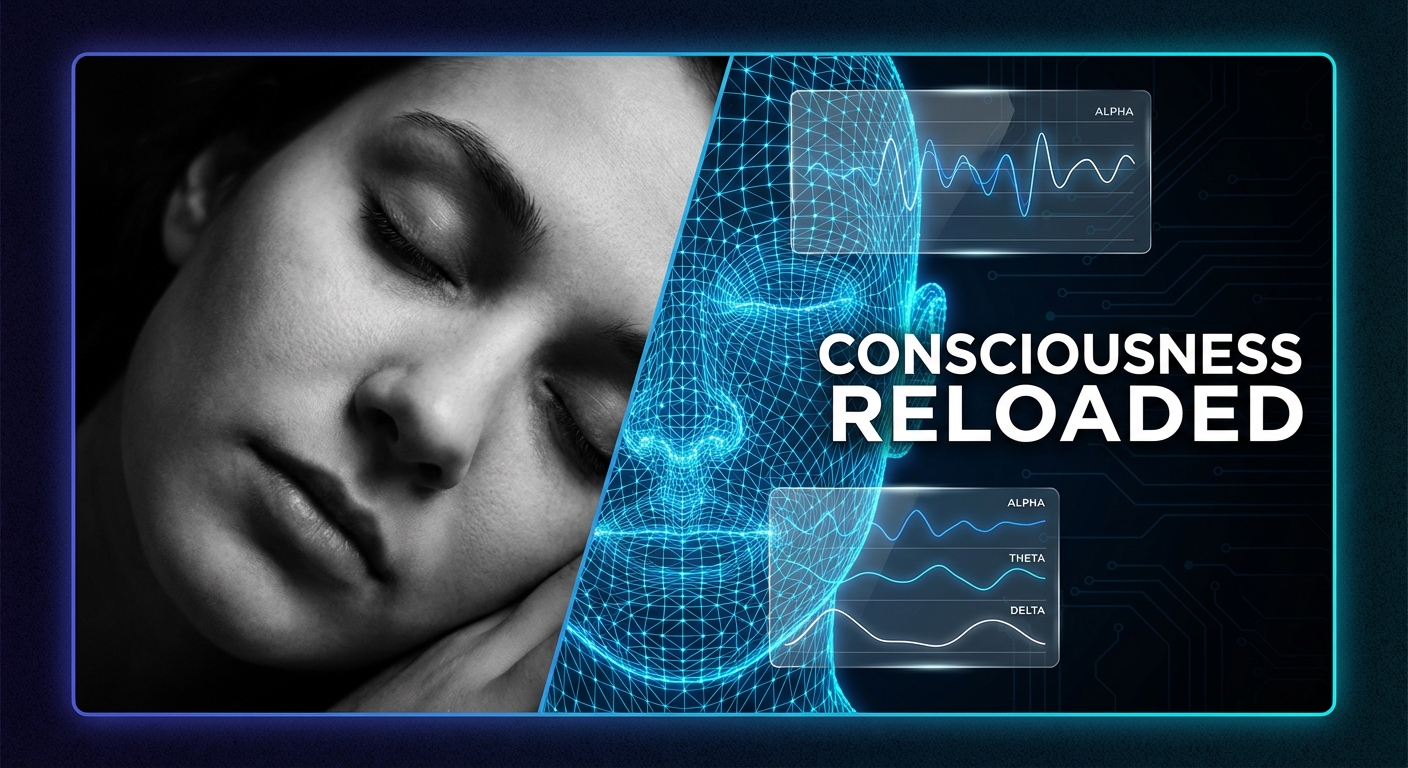
NREM sleep is the ‘deep dive.’ As you transition from wakefulness, the brain’s firing patterns slow down from rapid Beta waves to slow, high-amplitude Delta waves. According to research published in Neuroscience News, this stage is characterized by a breakdown in functional connectivity. The different regions of the brain stop talking to each other. This is why NREM sleep is often associated with a complete loss of consciousness or ‘mind blanking.’ The isolated neural populations cannot sustain a unified conscious experience.
However, this silence is necessary. It provides the quiet environment required for synaptic homeostasis—the process of scaling down the noise of the day so you can learn new things tomorrow. Without this ‘reset,’ your brain’s plasticity would become saturated, preventing new learning.
2. The Neuroscience of Dreams: Why Logic Fails
If NREM is the silence, REM is the symphony. During this stage, brain activity explodes. The limbic system (responsible for emotion) and the visual cortex become highly active, creating the visceral, emotional, and visual intensity of dreams. Yet, there is a specific ‘glitch’ in the system that makes dreams feel bizarre and disjointed.
The dorsolateral prefrontal cortex (DLPFC)—the CEO of the brain responsible for logic, decision-making, and reality testing—remains largely inactive. This distinct pattern of activation explains the phenomenology of dreaming: we accept impossible scenarios (like flying or talking animals) as absolute reality because the part of the brain that would usually say, ‘Wait, this makes no sense,’ is offline.
This dissociation is critical for emotional processing. It allows us to simulate dangerous or anxious scenarios in a safe, paralyzed body, effectively ‘debugging’ our emotional responses. For a deeper look at how the brain strengthens these neural pathways, read our guide on neuroscience research on memory formation.
3. Lucid Dreaming: The Hybrid State of Consciousness
Lucid dreaming represents a rare neurological anomaly: a hybrid state where the dreamer becomes aware they are dreaming while still asleep. This occurs when the DLPFC (the logic center) unexpectedly reactivates during REM sleep. Suddenly, metacognition (thinking about thinking) is restored, but the sensory hallucination of the dream remains.
Studies using high-density EEG have shown that lucid dreamers exhibit measurable increases in Gamma wave activity (40 Hz) in the frontal regions, a frequency associated with high-level conscious processing. This suggests that consciousness is not an all-or-nothing phenomenon but a dimmer switch that can be adjusted even during sleep.
For those attempting to induce this state, the primary challenge is maintaining the delicate balance between awareness and sleep. If you get too excited, you wake up; if you relax too much, you lose lucidity. Many practitioners use sensory deprivation tools to minimize external noise and focus on internal signals.

4. Sleep as the Brain’s ‘Save Button’ for Memory
While we sleep, our consciousness may fade, but our memory systems go into overdrive. The brain engages in a process called system consolidation. It takes the fragile memories formed during the day (stored temporarily in the hippocampus) and transfers them to the neocortex for long-term storage.
This transfer relies on sleep spindles—brief bursts of brain activity that occur during NREM sleep. Research from Northwestern University indicates that dreams may be the conscious byproduct of this memory replay. As the brain sifts through fragments of the day, it creatively reassembles them, often mixing recent events with distant memories to extract patterns and insights.
Interestingly, this process is highly sensitive to external disruptors. As we explored in our analysis of social media and mental health, the blue light from screens can delay the onset of melatonin, shortening the duration of this critical memory-processing window.
5. Sensory Gating: How the Brain Blocks the World
Why doesn’t the sound of a passing car wake you up? The answer lies in the thalamus, the brain’s sensory relay station. During wakefulness, the thalamus streams sensory data (sight, sound, touch) directly to the cortex. But during sleep, the thalamus is inhibited by the brainstem, effectively closing the gate.
This process, known as sensory gating, allows the brain to generate its own internal reality (dreams) without interference from the outside world. However, this gate is not locked tight; it is selective. The brain remains vigilant for ‘high-priority’ signals, such as your own name or the sound of a baby crying, which can bypass the gate and trigger an immediate awakening.
To improve your dream recall and metacognitive awareness, keeping a record of your dreams is essential. The act of writing down a dream immediately upon waking reinforces the neural bridge between the dreaming mind and the waking mind.

Frequently Asked Questions
Is a sleeping person conscious?
It depends on the stage of sleep. In deep NREM sleep, consciousness is minimal or absent due to the breakdown of cortical connectivity. In REM sleep, a vivid, hallucinatory form of consciousness emerges, though it lacks the self-reflective awareness typical of the waking state.
Why do we forget our dreams so quickly?
Dream amnesia occurs because the neurochemicals required to encode long-term memories (specifically norepinephrine and serotonin) are at their lowest levels during REM sleep. Unless you wake up and actively recall the dream, the memory trace evaporates.
Can you learn new skills while sleeping?
You cannot acquire complex new skills (like learning a language) from scratch while sleeping. However, sleep significantly improves the consolidation of skills learned during the day, effectively ‘saving’ the practice you did while awake. For more on this, read about neuroplasticity and learning.
What part of the brain is active during lucid dreaming?
Lucid dreaming is characterized by the reactivation of the dorsolateral prefrontal cortex and the precuneus during REM sleep. These areas are associated with self-referential processing and executive control, allowing the dreamer to recognize the dream state.
Do animals have consciousness during sleep?
While we cannot ask them, neuroimaging shows that mammals exhibit REM sleep patterns and hippocampal replay similar to humans. This suggests they likely experience visual and emotional dream states, though the level of complexity varies by species.