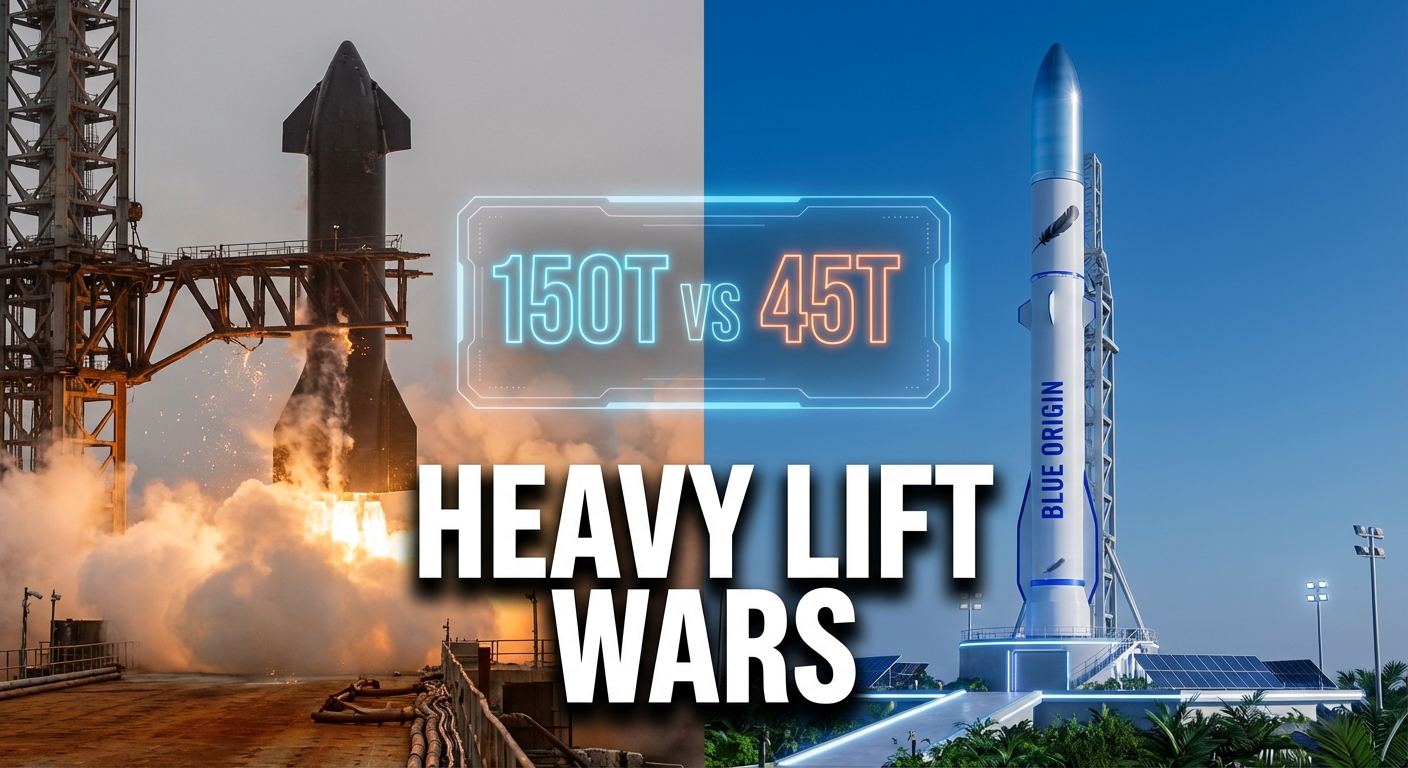
What is the main difference between SpaceX Starship and Blue Origin New Glenn?
The primary difference lies in their reusability architecture and payload capacity. SpaceX Starship is designed for full system reusability (both stages land) and targets a payload of 100-150 metric tons to Low Earth Orbit (LEO). In contrast, Blue Origin New Glenn currently focuses on a reusable first stage only with an infrastructure-first approach, offering a payload of 45 metric tons to LEO. While Starship relies on rapid, explosive iteration, New Glenn emphasizes methodical, high-reliability operations from day one.
1. The Philosophical Divide: Iteration vs. Infrastructure
To understand the hardware, you must understand the mindset. SpaceX and Blue Origin are not just building different rockets; they are proving different engineering hypotheses. SpaceX operates on the “hardware-rich” philosophy of rapid iteration—build it, blow it up, learn, and repeat. This is why we see frequent test flights and public failures at Starbase. Their goal is to reach Mars at any cost, a mission heavily reliant on finding water sources for fuel, as discussed in our analysis of Mars water discoveries.
Blue Origin, conversely, follows the motto Gradatim Ferociter (Step by Step, Ferociously). Their approach is defined by massive upfront investment in ground infrastructure and ground testing before a single flight occurs. According to NewSpace Economy, this “infrastructure-focused approach” aims to create a commercial spaceline that feels as reliable as an airline from day one, rather than a prototype program. While SpaceX accepts high risk for high speed, Blue Origin prioritizes methodical validation to secure lucrative national security and commercial contracts.
2. Propulsion Wars: Raptor (Methalox) vs. BE-4
The engine is the heart of the rocket, and 2025 is the year of Methalox (Liquid Methane and Liquid Oxygen). Both companies have abandoned the traditional Kerosene (RP-1) used in the Saturn V and Falcon 9 in favor of methane. Why? Methane burns cleaner (essential for reusability) and can theoretically be synthesized on Mars.
SpaceX Raptor V3:
The Raptor is a Full-Flow Staged Combustion engine. This is the “ferrari” of rocket engines—complex, running at insane pressures (350 bar), and designed for maximum efficiency. Starship uses 33 of these monsters on the booster alone.
Blue Origin BE-4:
The BE-4 uses an Oxygen-Rich Staged Combustion cycle. It is less complex than the Raptor but physically larger and designed for robust reusability. Crucially, the BE-4 is not just for New Glenn; it also powers ULA’s Vulcan rocket, making Blue Origin a critical supplier in the broader space economy. Investors tracking unicorn startup valuations have noted that this supplier status gives Blue Origin a diversified revenue stream that SpaceX lacks.
3. Payload to Orbit: The 100-Ton Gap
When it comes to raw power, the numbers tell a stark story. The Space Insider 2025 comparison highlights a massive disparity in lift capability.
- SpaceX Starship: Targets 100 to 150 metric tons to Low Earth Orbit (LEO) in fully reusable mode. This capacity is necessary to launch massive megastructures or colonization fleets.
- Blue Origin New Glenn: Targets 45 metric tons to LEO. While smaller, this is still a “Heavy Lift” vehicle capable of launching the heaviest satellites currently in existence.
The Misconception: Bigger isn’t always better for every customer. A satellite operator needing to launch a 10-ton comsat doesn’t necessarily need a 150-ton monster like Starship. New Glenn is positioning itself as the “right-sized” heavy lifter for the existing commercial market, whereas Starship is trying to create a new market for massive payloads.
4. Reusability: ‘The Catch’ vs. The Landing Gear
The most visually striking difference is how these rockets return to Earth. SpaceX has opted for the “Mechazilla” approach—catching the Super Heavy booster in mid-air using giant chopsticks on the launch tower. This deletes the weight of landing legs from the rocket, increasing payload capacity. It is high-risk, high-reward engineering.
Blue Origin employs a more traditional (but proven) approach. New Glenn’s first stage features massive, self-leveling landing gear and will land on a moving ship at sea (the Jacklyn). While this requires carrying the extra weight of legs, it allows for landing flexibility away from the launch site. However, a critical distinction remains: Starship is fully reusable (both stages land), while New Glenn is currently only partially reusable (the upper stage is expendable). This gives SpaceX a theoretical long-term cost advantage, assuming they can refurbish the heat tiles on the upper stage quickly.

5. The Future: Project Jarvis and Mars
Neither company is standing still. As noted in recent NASA Spaceflight Forum discussions, Blue Origin is actively developing “Project Jarvis,” a reusable upper stage that would mimic Starship’s stainless steel tank structure. If successful, this would close the reusability gap.
For now, the winner depends on the timeline. If you need 100 tons sent to Mars in one go, Starship is the only game in town (eventually). If you need a reliable, heavy-lift bus to GEO for a national security payload in 2025, New Glenn’s conventional architecture might arguably offer a smoother ride to certification. The “winner” will likely be the space economy itself, which finally has two private heavy-lift options driving down costs.
Frequently Asked Questions
Why does New Glenn use Hydrolox for the second stage?
While the first stage uses Methalox (BE-4), the second stage uses Hydrolox (BE-3U). Hydrogen offers a higher Specific Impulse (efficiency in a vacuum) than Methane, making it ideal for the second stage which does the “long haul” work to higher orbits.
Can Starship land on the Moon?
Yes, a specific variant called the “Human Landing System” (HLS) is being developed for NASA’s Artemis program. It lacks the heat shield and flaps needed for Earth return but features landing legs for the lunar surface.
What is the benefit of Methalox propulsion?
Methalox (Methane + Oxygen) prevents “coking” (soot buildup) in the engines, which is critical for rapid reuse. It is also slightly more dense than Hydrogen, allowing for smaller fuel tanks.
How much does a launch cost?
Specific pricing is opaque, but SpaceX aims for Starship to eventually cost under $10M per launch due to full reusability. New Glenn is expected to be competitive with current heavy-lift market rates but likely higher than a fully mature Starship system.
Is New Glenn fully reusable?
No. Currently, only the first stage booster of New Glenn is reusable. The second stage is expendable, though Blue Origin is working on a reusable upgrade known as “Project Jarvis.”