- Direct Answer: Top Sectors for 2025
- 1. The AI Hegemony: From Chatbots to Agentic Workflows
- 2. Health Tech & Biotech: The $390B Defensive Moat
- 3. Enterprise SaaS & Cybersecurity: Protecting the Stack
- 4. Climate, AgriTech, and Robotics: Funding the Physical World
- 5. Geographic Concentration: The San Francisco Gravity Well
- Frequently Asked Questions
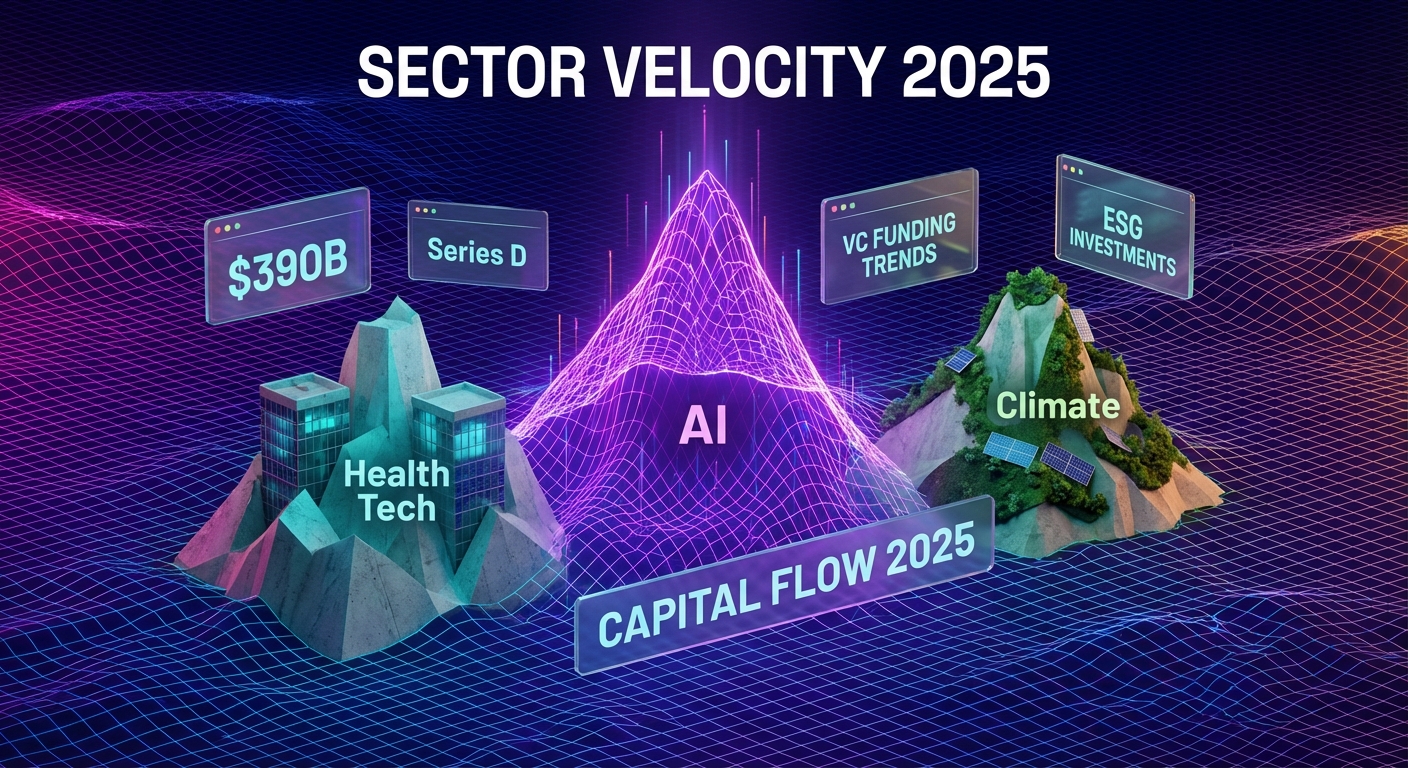
Unicorn startup funding in 2025 is dominated by the Generative AI and Health Tech sectors. AI startups, particularly those focusing on “Agentic” workflows (like Field AI and Mercor), captured over 52% of total funding in major hubs, driving valuations into the multi-billions. Health Tech remains the second strongest pillar with a cumulative sector value of $390B, led by oncology and precision medicine platforms like Thyme Care. Emerging interest is also surging in Climate Tech and autonomous robotics as investors pivot toward “physical world” solutions.
1. The AI Hegemony: From Chatbots to Agentic Workflows
In 2025, the narrative has shifted from “Generative AI” to “Agentic AI.” Investors are no longer funding simple text wrappers; they are pouring capital into autonomous systems that can execute complex tasks without human intervention. This distinction is crucial for understanding the massive rounds seen this year.
The Mechanism of Value:
The reason companies like Mercor ($2B valuation) and Anysphere ($2.3B Series D) are commanding such high multiples is their ability to replace labor, not just augment it. Unlike the SaaS tools of 2021 which sold efficiency, these 2025 unicorns are selling outcomes. For instance, coding assistants like Cursor (hovering near unicorn status with $950M valuation) are not just code-completers; they are becoming autonomous developers.
This trend helps explain the explosion in funding rounds. To build these models, startups require massive compute resources, necessitating “Mega-Rounds” (Series C and D upwards of $200M). If you are a founder in this space, understanding the technical differentiation in AI models is vital to justifying these capital requirements to technical investors.
2. Health Tech & Biotech: The $390B Defensive Moat
While AI grabs the headlines, Health Tech remains the quiet giant of the 2025 venture landscape, boasting a total sector valuation of $390B. The funding logic here is “recession resistance.” Regardless of economic volatility, the demand for oncology care and drug discovery platforms remains inelastic.
Notable Winners:
Thyme Care recently secured a $1.5B valuation by focusing on oncology management. Unlike pure software plays, Thyme Care integrates technology with actual care delivery coordination. This “Tech-Enabled Services” model is becoming a favorite for private equity and late-stage VCs who want safer, revenue-generating assets rather than speculative moonshots.
Furthermore, the intersection of AI and Bio (TechBio) is seeing Series B rounds exceeding $100M. Companies using AI to simulate protein folding or accelerate clinical trials are effectively shortening the time-to-market for life-saving drugs, creating a compelling ROI case for deep-pocketed firms like Andreessen Horowitz (Bio + Health fund).
3. Enterprise SaaS & Cybersecurity: Protecting the Stack
As AI agents proliferate, the attack surface for enterprises has expanded exponentially. This has triggered a counter-wave of funding into Cybersecurity and Blockchain Security. The standout example in 2025 is CertiK, a blockchain security firm that has cemented its unicorn status by securing Web3 infrastructure.
The Shift to “Zero Trust”:
The funding data shows a preference for platforms that offer “self-healing” code and automated compliance. Investors are betting that as corporations adopt AI, they will need an “immune system” to prevent data leakage and model poisoning. For a broader look at how these valuations stack up against historical trends, reviewing the broader valuation trends for 2025 provides necessary context on liquidity preferences and down-round protections.
Recommended Resource: Venture Deals
Understanding the terms of these late-stage security rounds—which often come with complex governance structures—is critical. We recommend “Venture Deals” as the definitive guide to navigating term sheets.

4. Climate, AgriTech, and Robotics: Funding the Physical World
A surprising trend in 2025 is the return of capital to the “Physical World.” After years of purely digital investing, VCs are funding hardware-heavy sectors like Robotics and AgriTech.
Infarm (vertical farming) and Gaussian Robotics (autonomous navigation) are prime examples of this shift.
Why Now?
The mechanism driving this is Labor Shortage and Supply Chain Sovereignty. Robotics companies like Field AI ($2B) are being funded not just because the tech is cool, but because logistics companies are desperate to automate warehouses. Similarly, Climate Tech is no longer seen as charity; it is seen as energy security. The median funding round for these hardware companies is higher ($275M) because they require factories, not just servers.
5. Geographic Concentration: The San Francisco Gravity Well
Despite the “remote work” narrative of the past, 2025 has seen a massive recentralization of capital into the San Francisco Bay Area. Data indicates that 52% of all AI funding in 2025 went to San Francisco-based startups, totaling over $58 billion. While global hubs like London and Bangalore are producing unicorns, the “Mega-Rounds” (Series D+) remain a Silicon Valley phenomenon.
For founders, this implies that while you can build anywhere, raising a $200M+ Series C might still require a physical presence in the Bay Area ecosystem. To learn how to frame your location and traction to these specific investors, see our playbook on structuring your pitch deck.
Frequently Asked Questions
Which sector has the highest median funding in 2025?
While AI has the highest volume of deals, CleanTech and Hardware sectors often command higher median funding rounds (approx $275M) due to the capital-intensive nature of building physical infrastructure.
How many new unicorns were minted in 2025?
Approximately 80 new tech unicorns were minted in 2025. This marks a recovery from the lows of 2023-2024, signaling renewed investor confidence in late-stage assets.
What is the valuation of Luma AI?
Luma AI reached a valuation of $4 billion in 2025, driven by its generative 3D modeling technology which is becoming a standard asset creation tool for gaming and spatial computing.
Is Fintech still a top sector for unicorns?
Yes, but the focus has shifted. Unlike the consumer neo-bank boom of 2021, the 2025 Fintech unicorns are focused on B2B infrastructure, payments orchestration, and CFO-stack automation.
What does “Series D” mean in 2025?
A Series D round in 2025 typically implies a company is preparing for an IPO within 12-18 months. These rounds are often led by pre-IPO crossover funds and focus heavily on profitability metrics rather than just pure growth.