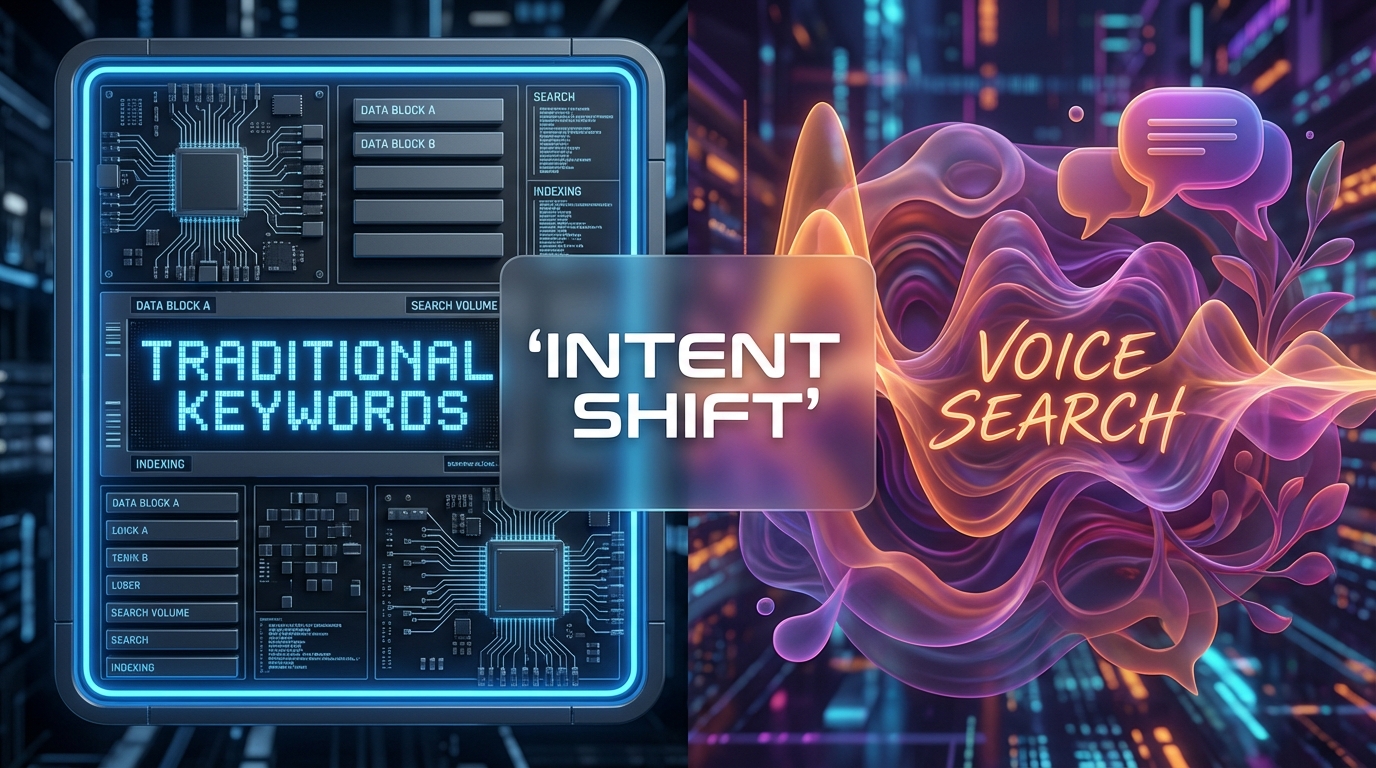
- The Core Difference: Typing vs. Talking
- The Mechanics of the Query: Keywords vs. Conversation
- User Intent and Context: The “Near Me” Factor
- Device Ecosystem: Why Mobile and Smart Speakers Change the Game
- Technical SEO: Structured Data and Schema for Voice
- Content Strategy: Writing for the Ear, Not the Eye
- Measuring Success: Analytics for Voice vs. Text
- Frequently Asked Questions
Voice search optimization differs from traditional keyword SEO by focusing on natural language, long-tail conversational keywords, and direct answers rather than fragmented short-tail phrases. While traditional SEO targets broad research intent, voice search prioritizes immediate, local, and action-oriented user needs, often aiming for “position zero” or featured snippets to provide a single spoken answer.
The Mechanics of the Query: Keywords vs. Conversation
The most fundamental shift between traditional SEO and voice search optimization lies in the structure of the search query itself. Traditional SEO has trained users to speak “robot.” When we sit at a desktop, we compress our thoughts into efficient, fragmented strings like “best Italian restaurant NYC” or “weather London.” We strip away the grammar and syntax to save keystrokes. This reliance on short-tail keywords (1-3 words) has defined search engine optimization for two decades.
Voice search reverses this behavior. When users speak to assistants like Alexa, Siri, or Google Assistant, they revert to natural human communication. A query transforms into “Where is the best Italian restaurant near me that’s open right now?” These are long-tail, conversational keywords that mirror natural speech patterns. The mechanism behind this is Natural Language Processing (NLP), which allows search engines to understand the semantic relationship between words rather than just matching string patterns.
A common misconception is that you simply need to add more keywords to your page. This is incorrect. The goal is to optimize for questions. Content must be structured to answer specific who, what, where, when, and how questions directly. As noted by Siteimprove, understanding these conversational nuances is critical because voice assistants are programmed to read the most direct, grammatically correct answer found in the Featured Snippet.
User Intent and Context: The “Near Me” Factor
User intent in voice search is often far more urgent and specific than in text search. When a user types “how to fix a leaky faucet,” they might be looking for a video tutorial, a blog guide, or a plumber, and they are likely in a research phase. However, when a user asks a voice assistant, the intent is typically immediate and action-oriented. This is often described as a “micro-moment”—a reflex where a user turns to a device to act on a need to learn, do, discover, watch, or buy something right now.
Local context is the powerhouse of voice search. A significant portion of voice queries contain the phrase “near me.” Traditional SEO captures broad research intentions, but voice search captures the user who is already in the car or walking down the street. If your business relies on local foot traffic, ignoring voice search is dangerous. You must optimize your Google Business Profile and ensure your Name, Address, and Phone number (NAP) are consistent across the web.
The Pragmatic Digital blog highlights that voice search is heavily location-dependent. If you are running a local business, you need to treat your content differently. Instead of broad industry guides, focus on hyper-local content that answers specific questions about your immediate area. For example, if you are working on your SEO survival guide, ensure you include a section dedicated to local schema, as this signals to search engines that your content is relevant to specific geographic voice queries.
Device Ecosystem: Why Mobile and Smart Speakers Change the Game
Traditional SEO encompasses a wide range of devices, including desktops, laptops, and tablets. Voice search, however, is predominantly a mobile and smart speaker phenomenon. This distinction dictates how you should structure your digital presence. When a user searches on a desktop, they can scan a SERP (Search Engine Results Page) with 10 blue links, ads, and maps. They have the luxury of choice. On a smart speaker, there is no screen. There is only one result: the answer read aloud by the device.
This “winner takes all” dynamic means that ranking #2 or #3—which is often acceptable in traditional SEO—is effectively invisible in voice search. Your content must target “position zero,” the Featured Snippet. Furthermore, because these searches happen on mobile devices or smart speakers, your site’s technical performance is non-negotiable. Page speed must be instant. If your site takes 3 seconds to load, the voice assistant will likely skip it in favor of a faster source.
To truly understand how users interact with these devices, it is helpful to test your content on the hardware they use. Understanding the limitations and capabilities of a smart speaker can refine your optimization strategy.

Technical SEO: Structured Data and Schema for Voice
While content is king, technical infrastructure is the kingdom. In traditional SEO, metadata (title tags and meta descriptions) plays a massive role in click-through rates. In voice search, these elements are less visible to the user but critical for the search engine’s understanding. The most important technical element for voice optimization is Structured Data or Schema Markup.
Schema is code that you put on your website to help search engines return more informative results for users. For voice search, specific types of schema are vital. FAQ Schema and Speakable Schema tell Google exactly which parts of your content are suitable for text-to-speech conversion. By marking up your content effectively, you are essentially hand-feeding the voice assistant the answer it needs to provide to the user.
A major failure point for many sites is having great content that is trapped in unstructured paragraphs. If you are using AI content creation tools to generate your drafts, make sure you are also using tools that can generate valid schema markup. This ensures that the natural language content you produce is technically accessible to voice algorithms. Without this structured data, even the most conversational content may be overlooked by the indexing bots that power voice results.
Content Strategy: Writing for the Ear, Not the Eye
Writing for voice search requires a shift in style. Traditional web copy is often scannable, using bullet points and bold text to catch the eye. While this is still important for the mobile user who might see a screen, the voice component requires content that sounds natural when read aloud. This means using complete sentences, proper grammar, and a conversational tone. It’s about writing for the ear.
Your content strategy should pivot to include “People Also Ask” sections. Use tools like AnswerThePublic or Google’s own “People Also Ask” boxes to identify the exact questions users are typing—and speaking. Create a dedicated FAQ section at the bottom of your blog posts. This is “snippet bait.” By explicitly asking the question in an H2 or H3 tag and immediately following it with a concise, 40-60 word answer, you drastically increase your chances of being the chosen result for a voice query.
Don’t just fluff the content. Be definitional and precise. If you are writing about complex topics, break them down. For instance, if you are discussing digital marketing trends, ensure you have a clear definition of each trend. If you have a post about the future of content marketing, verify that you have answered the basic questions—”What is content marketing?” “How does AI affect content?”—in clear, spoken-word friendly paragraphs.
Measuring Success: Analytics for Voice vs. Text
One of the biggest challenges in voice search optimization is measurement. Unlike traditional keyword SEO, where Google Search Console provides detailed data on impressions and clicks, voice search data is currently much more opaque. Google does not yet explicitly filter “voice queries” in its standard reporting tools. This leaves many marketers guessing about the ROI of their efforts.
However, you can infer success through proxy metrics. Monitor the performance of your Featured Snippets. Since voice assistants read from these snippets, a rise in snippet capture often correlates with a rise in voice visibility. Additionally, look at the traffic for long-tail keywords in your analytics. An increase in traffic from conversational, question-based queries is a strong indicator that your voice optimization strategy is working.
Another method is to track “Micro-Conversions” on your local pages. Are you seeing an uptick in “Click to Call” or “Get Directions” actions? These are heavily associated with mobile voice search behavior. While we wait for better analytics tools, focusing on these indicators will give you the best view of your performance.
Frequently Asked Questions
How can I effectively use long-tail keywords in voice search optimization?
To use long-tail keywords effectively, focus on natural language questions. Think about how a person would ask a friend for advice. Instead of optimizing for “shoe store,” optimize for “What is the best running shoe store near me?” incorporate these complete phrases into your headers and body content.
What are the main challenges in optimizing for voice search?
The main challenge is the lack of specific data from search engines, making it hard to track ROI directly. Additionally, the “winner takes all” nature of voice results means you must rank in position zero to be heard, which is highly competitive compared to the top 10 positions in traditional SEO.
How does voice search optimization impact local SEO strategies?
It makes local SEO critical. Since many voice searches have local intent (“near me”), businesses must ensure their Google Business Profile is flawless, with accurate hours, location, and reviews, to appear in local voice results.
What role does natural language processing play in voice search optimization?
Natural Language Processing (NLP) allows search engines to understand the intent and context behind words, rather than just matching keywords. This means your content must be semantically rich and answer the user’s underlying intent, not just repeat a specific keyword.
How can I measure the success of my voice search optimization efforts?
Currently, you must rely on proxy metrics such as the number of Featured Snippets you own, traffic from long-tail question queries, and local actions like “click-to-call” or “get directions” in your Google Business Profile insights.